Case 46 | Australian Survival Economics | The Small Business Trap — When Three Layers of Pressure Hit at Once

One-sentence summary:
You’re not being defeated by a single problem — you’re being crushed by three layers of pressure at the same time.
I. Surface Phenomenon: You’re Earning Money, But It’s Not Enough to Pay the Bills
Revenue hasn’t dropped, but your profit keeps shrinking.
You still have orders, but every order makes less money than before. This isn’t because “business is bad” — it’s because your cost structure is completely out of balance.
II. First Layer Cause: Three Layers of Pressure Striking Simultaneously
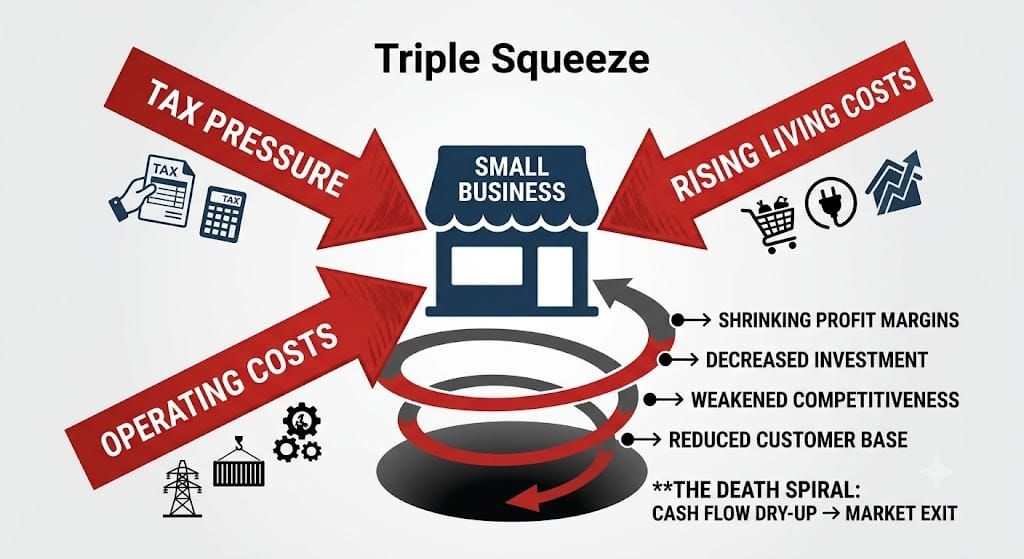
Over the past year, small businesses in Australia have been hit by three major pressures at once:
- Rising Tax Pressure — The ATO is chasing debts more aggressively, and the overall tax burden on small business owners continues to increase.
- Rising Living Costs — Consumers have less disposable income, directly reducing demand for your products and services.
- Rising Operating Costs — Energy, supply chain, and labour costs are all climbing, further squeezing your margins.
When these three pressures hit together, the operating space for small businesses shrinks rapidly.
III. Second Layer Butterfly Effect: The Small Business “Death Spiral”
When all three pressures act at the same time, they create a vicious cycle:
- Operating costs rise → Profit margins shrink
- Consumer spending drops → Fewer orders
- Tax burden increases → Cash flow tightens
- Cash flow tightens → Can’t invest in equipment or staff
- Can’t invest → Competitiveness drops → Even fewer orders
Many small businesses start cutting their own profits just to stay alive, until they can no longer survive.
This path looks like this:
Rising costs → Thinner net profit → Cash flow dries up → Innovation stops → Eliminated by the Market.
This is not theory. This is the real path many small businesses in Australia are walking right now.
When tax burden, living costs, and operating expenses rise together, your net profit gets squeezed to the point where you can no longer operate normally. When profit is no longer enough to support cash flow, you can’t invest, you can’t improve your service, and you can’t attract new customers. When innovation dies, you’re left struggling in the same market until you’re eventually pushed out.
This path doesn’t change just because you “work harder” — because this isn’t a problem of personal effort, it’s a problem of structural pressure.
IV. Common Wrong Responses
- Trying to fight structural pressure with “more effort”
- Focusing only on increasing revenue while ignoring cost structure adjustments
- Putting money into expansion plans that don’t deliver immediate returns
V. Reality Check Tool Application
Examine your situation through three levels:
- Logic Level: Has your cost structure become seriously misaligned with your revenue structure?
- Application Level: Have you started adjusting your operations to cope with the new cost environment?
- Endgame Level: Do you have the ability to survive when these three pressures hit at the same time?
When three layers of pressure strike simultaneously, you need to reassess your cost structure and ensure your cash flow can handle the ongoing increases in tax, living costs, and operating expenses.
Case 46 | 澳洲生存經濟學 | 中小企困境 —— 當三層壓力同時擠壓
一句話總結:
你不是被一個問題打敗的,你是被三層壓力同時擠壓。
一、表面現象:賺的錢不夠付帳單
營業額沒有下降,但利潤卻在縮水。你仍然有訂單,但每單的利潤越來越薄。這不是「生意不好」,而是「成本結構失衡」。
二、第一層原因:三重壓力同時作用
過去一年,中小企業面臨的三層壓力:
- 稅務成本上升:ATO 追繳欠款力度加大,小生意人的稅務負擔持續增加。
- 生活成本上升:消費者的購買力下降,直接影響小生意人的收入來源。
- 營運成本上升:能源、供應鏈、人力成本同步上漲,進一步壓縮利潤空間。
這三層壓力同時出現,使得中小企業的營運空間被迅速壓縮。
三、第二層蝴蝶效應:中小企業的「死亡螺旋」
當這三層壓力同時作用時,會形成一個持續擠壓的過程:
· 營運成本上升 → 利潤率下降
· 消費力下降 → 訂單減少
· 稅務負擔增加 → 現金流壓力上升
· 現金流壓力上升 → 無法投資設備或人力
· 無法投資 → 競爭力下降 → 訂單進一步減少
在這種情況下,許多中小企業會開始削減自己的利潤空間來維持運作,直到再也無法維持為止。
這條路徑是這樣的:
營運成本上漲 → 淨利潤變薄 → 現金流枯竭 → 創新力歸零 → 市場淘汰。
這不是理論推演,這是中小企業正在經歷的真實路徑。
當稅務負擔、生活成本、營運開支同時上升時,你的淨利潤會被擠壓到無法維持正常運作。當利潤不足以支撐現金流時,你無法投資設備、無法改善服務、無法吸引新客戶。當創新力歸零時,你只能在原有的市場中掙扎求生,直到被市場淘汰。
這條路徑不會因為你「更努力」而改變,因為它不是個人能力的問題,而是結構壓力的問題。
四、常見錯誤應對
· 試圖用「更努力」來對抗結構性壓力。
· 忽略成本結構的調整,只專注於增加收入。
· 將資金投入無法立即產生回報的擴張計畫。
五、Reality Check 工具應用
從三個層級檢視你的處境:
- 邏輯層:你的成本結構是否已經嚴重偏離收入結構?
- 應用層:你是否已經開始調整營運方式來應對新的成本結構?
- 終局層:你是否有能力在這些壓力同時作用時維持生存?
當三層壓力同時作用時,你需要重新評估你的成本結構,並確保你的現金流能夠同時應對稅務、生活成本和營運成本的持續上升。
附:與 Reality Check 工具包的關係
本案例屬於 Australian Survival Economics 系列(Case 43–47)的第二至四篇,系列以「五步因果拆解法」為骨架,每篇結尾附帶「Reality Check 工具應用」與「具體行動建議」。
本文僅供參考,不構成財務、稅務或法律建議。具體決策請諮詢持牌專業人士。