Case 56 | When Restrictions Force a Backdoor — Samsung, SK Hynix, and the Structural Shift Toward Chinese Equipment

One-sentence summary:
The tighter U.S. export controls become, the more Samsung and SK Hynix begin leaving room for Chinese domestic equipment. The real moat has never been surface-level supply-chain diversity — it is whether you control the bottom layer yourself.
1. The Event
In August 2026, Reuters reported exclusively that Samsung Electronics and SK Hynix had begun testing etching equipment from China's Advanced Micro-Fabrication Equipment (AMEC) about two years earlier, evaluating its possible use at their factories in China.
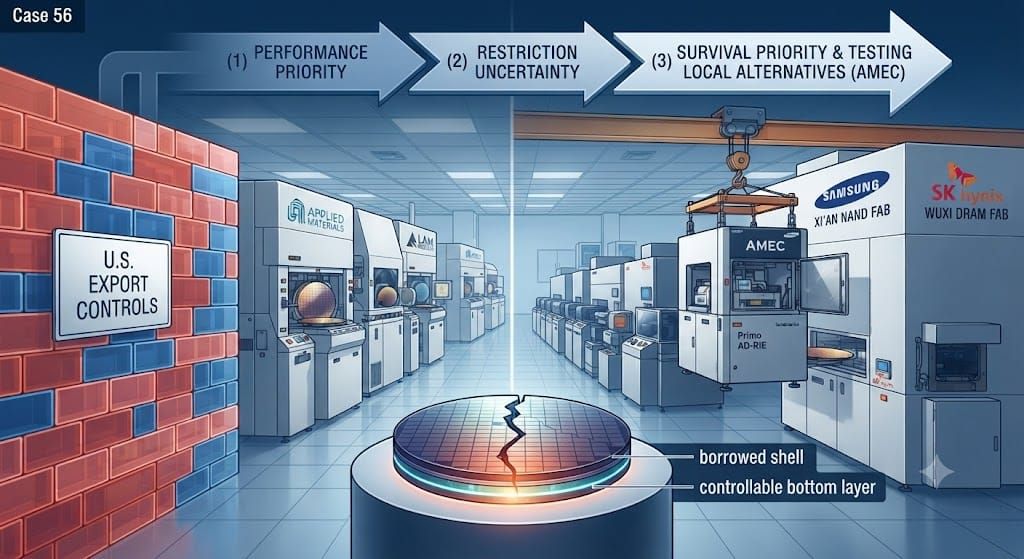
The companies' Chinese plants (Samsung's Xi'an NAND fab, SK Hynix's Dalian NAND and Wuxi DRAM fabs) have long relied heavily on U.S. equipment makers such as Applied Materials and Lam Research. In 2023 the U.S. granted them "Validated End User" status; in 2025 that status was revoked and replaced with an annual licensing regime for 2026. This shift to year-by-year approval sharply increased uncertainty around both new equipment imports and future servicing of existing tools, becoming a key reason the two companies started looking for alternatives.
Publicly, Samsung denied any testing and SK Hynix declined to comment. Sources, however, consistently describe the evaluations as a risk hedge — aimed at keeping existing production lines running, not at expanding capacity in China.
2. Structural Tension: How Restrictions Create a Backdoor
U.S. export controls were designed to constrain the development of Chinese semiconductor equipment.
The actual result has been a different path:
- Korean memory makers must find workable alternatives for their China factories
- The very act of testing gives Chinese equipment a form of validation
- Chinese tools cost 20–30% less and have already been running at domestic fabs, giving them a baseline of maturity
Restrictions did not fully lock the door. Instead they forced companies that once relied almost entirely on Western supply chains to start leaving space for local options.
This is not an active embrace — it is resilience logic forced by necessity.
3. The Real Moat: Controllable Bottom Layer vs. Borrowed Shell
On the surface, supply chains can look diversified.
In reality, control over core technology remains highly concentrated in specific countries and vendors.
Many business models appear to have complete supply chains, yet function more like "borrowed shells" — assembling, moving, and packaging on top of someone else's foundational technology. Materials can often be substituted (the difference is mainly cost). Once the bottom layer is blocked, choice disappears.
The true moat is the layer you control and that others cannot easily replace in the short term.
Samsung and SK Hynix's testing is a forced re-examination, under rising uncertainty, of which links they do not actually hold.
4. From Performance Priority to Survival Priority
Previous expansion logic emphasised faster, more advanced, higher performance.
When external restrictions and uncertainty become the new normal, corporate priorities begin to shift: first ensure the lines can keep running, then talk about expansion and leadership.
This is not a choice made by one or two companies. It is a structural adjustment under a larger cycle.
Performance still matters, but "can we stay solidly alive" becomes the more immediate condition.
5. Closing
Samsung and SK Hynix testing AMEC equipment looks, on the surface, like a supply-chain contingency.
At a deeper level it reveals something else: when restrictions turn into a long-term variable, companies move from "pursuing the optimal" to "securing the controllable."
What survives uncertainty is not surface diversity or cutting-edge performance.
It is the bottom-layer capability you actually hold in your own hands.
📌 Appendix: This article aligns with the concepts of "Structural Convergence," "Moat Reconfiguration," and "Cycle Shift" in the Reality Check toolkit.
Disclaimer: For structural analysis only. Does not constitute investment advice.
Case 56 | 當限制倒逼「後路」——三星、SK 海力士與中國設備的結構性轉向
一句話總結:
美國越收緊出口限制,三星與 SK 海力士反而開始為中國本土設備留後路。真正護城河,從來不是表面上的多元供應,而是自己能否控制底層。
一、事件本身
2026 年 8 月,路透獨家報導:三星電子與 SK 海力士約兩年前開始測試中國中微半導體(AMEC)的蝕刻設備,評估是否用於其在中國的工廠。
兩家公司的中國廠(三星西安 NAND、SK 大連 NAND 與無錫 DRAM)長期高度依賴美國設備商(Applied Materials、Lam Research)。美國在 2023 年曾給予「Validated End User」資格,2025 年撤銷,改為 2026 年年度許可制。這種「一年一審」的安排,大幅提高了設備進口與後續維修的不確定性,成為兩家公司開始尋找替代方案的重要背景。
公開表態上,三星否認測試,SK 拒絕評論。但消息來源一致指向:這是對沖風險的備案,目的是維持現有產線運轉,而非擴大在中國的產能。
二、結構張力:限制如何倒逼「後路」
美國出口管制的原意,是卡住中國半導體設備的發展。
結果卻出現另一條路徑:
- 韓系記憶體大廠必須為中國工廠尋找可替代方案
- 測試本身成為對中國設備的一種驗證機會
- 中國設備價格低 20–30%,且已在本土廠跑過,成熟度有基礎
限制沒有完全鎖死,反而迫使原本依賴西方供應鏈的企業,開始為「本土選項」留位置。
這不是主動擁抱,而是被逼出來的韌性優先邏輯。
三、真正的護城河:可控底層 vs 借殼
表面上看,供應鏈可以多元。
但核心技術的話語權,仍然高度集中在特定國家與廠商手中。
許多商業模式看起來有完整供應鏈,實際上更接近「借殼」——用別人的底層技術做組裝、搬運與包裝。材料或許能找到替代(差別主要在成本),但一旦底層被卡死,選擇權就消失。
真正的護城河,是自己能控制、別人短期難以替代的那一層。
三星與 SK 的測試動作,正是在不確定性升高時,被迫重新審視「哪些環節自己握不住」。
四、從性能優先到生存優先
過去的擴張邏輯,強調更快、更先進、更高性能。
當外部限制與不確定性成為常態,企業的優先順序開始轉向:先確保產線能持續運轉,再談擴張與領先。
這不是單一公司的選擇,而是大周期下的結構性調整。
性能仍然重要,但「能不能穩固地活下去」變成更前置的條件。
五、結語
三星與 SK 海力士測試 AMEC 設備,表面是供應鏈備案,底層揭示的是:
當限制成為長期變量,企業開始從「追求最優」轉向「確保可控」。
真正能穿越不確定性的,不是表面上的多元與先進,而是那些自己握得住的底層能力。
📌 附註: 本文對應工具包中的「結構收束」「護城河重構」與「週期轉變」概念。
免責聲明: 僅供結構分析參考,不構成投資建議。