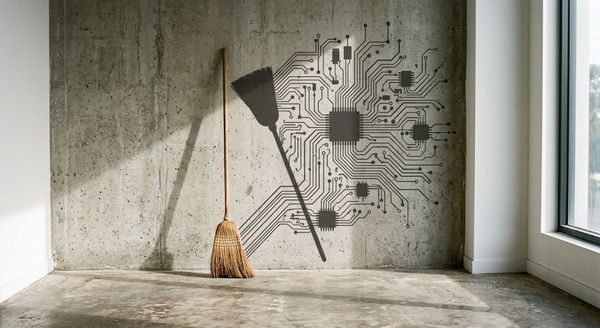
Case 60 | Are We Mistaking What We Cannot Understand for What We Cannot Control?


In one sentence:
When a system exceeds the scale of our understanding, we tend to mistake "I can't make sense of it" for "I can't control it." Perhaps the real questions are constraints, permissions, and cost—not whether we can understand everything first.
These two topics seem completely unrelated.
But underneath, they may follow the same pattern:
When the tools we use to understand a system can no longer keep up with its complexity, the unknown can easily become fear.
Recently, two very different topics caught my attention.
One is AI.
People are beginning to discuss whether "superintelligence" should be banned, because once AI becomes more capable than humans, we may no longer be able to control it.
The other is the universe.
Some people look at similarities between the human body, neural networks, and the large-scale structure of the universe, and begin wondering whether the universe might itself be part of some larger living system—or simply one layer inside a much larger world.
One is about AI.
The other is about the universe.
But if we remove the labels, I see the same question:
When we encounter a system beyond the scale of our understanding, do we too quickly mistake "I cannot understand it" for "I cannot control it"?
01 | Is AI Really "Uncontrollable"?
Let's put the term "superintelligence" aside for a moment.
AI has already surpassed humans in many individual cognitive tasks.
Calculation, search, information processing, pattern recognition, code generation, and countless specialized tasks are no longer simply things machines assist humans with.
In July, there was also a widely discussed incident in which, reportedly, more than 1,000 AI agents connected to the internet and exchanged tens of thousands of messages before their developers discovered what was happening nearly two weeks later.
The real question is not:
Is AI more intelligent than humans?
It is:
Can we still place meaningful constraints on a system that is faster, more complex, and harder for us to understand?
There is an important distinction here.
"I don't know how it reached that answer" does not necessarily mean "I don't know what it will do next."
And that does not necessarily mean:
"I cannot restrict what it is able to do."
We control systems every day without understanding their internal details.
We do not need to know how every electron moves inside a computer to turn it off.
We do not need to understand every molecular collision inside an engine to apply the brakes.
Controlling a system does not necessarily require understanding the entire system.
What may matter more is:
What can it access?
What permissions does it have?
How many resources can it use?
What parts of its environment can it change?
What does each action cost?
What feedback does it receive?
And if something goes wrong, can something outside the system intervene?
These questions are not the same as asking how intelligent the system is.
02 | The Real Problem with Regulating AI
If we really want to build laws around AI, I wonder whether we are making the mistake of trying to legislate "AI" itself.
Because what exactly is AI?
A model?
A model connected to tools?
An agent capable of carrying out tasks?
Then add internet access.
Memory.
Accounts.
Payment capabilities.
Server permissions.
If these components can be combined in different ways, the thing defined as "AI" by law today may already be a different kind of system tomorrow.
And there is another problem:
AI may evolve on a timescale of weeks, while legislation often evolves on a timescale of years.
If regulation keeps following specific capabilities, the cycle could become:
New capability → new regulation → system changes → regulation becomes outdated → new regulation.
Eventually, we are no longer building stable rules.
We are chasing technology versions.
That raises another question:
Does defending against a system really require us to list every possible thing it might do?
Maybe not.
Instead of adding another rule saying "you cannot do this," perhaps it is sometimes more effective to change the cost of doing it—through resources, permissions, speed, quotas, identity, environment, or transaction cost.
It is like trying to navigate with a paper map while someone else is using GPS.
The map is not wrong. The interface simply cannot keep up with the complexity of the system.
03 | Then I Thought About What Exists Underground
The underground is not a single environment.
Different depths have different temperatures, pressures, moisture levels, oxygen availability, minerals, and energy sources.
Different organisms use different combinations of matter and energy to adapt to those conditions.
They do not live under different laws of physics.
They live under the same physical and chemical rules.
The constraints are simply different.
That made me think about something.
We often imagine the world as:
atoms → molecules → cells → organisms → planets → galaxies → universe
And then we draw a line at "the universe."
But why?
If an organism living at one layer underground can exist without knowing that forests, animals, and humans exist above it, what makes us certain that the universe itself must be the highest layer of the entire system?
Maybe it is.
Maybe it isn't.
There is currently no evidence that our universe is part of some larger organism or higher physical system.
But the question—
Could we simply be one layer inside a larger system?
—does not automatically become meaningless just because we cannot see the layer above us.
04 | And Then There Is the "Virtual World"
If the universe were one layer inside a larger physical system, we might call it a nested universe.
If it were generated by some external computational system, we might call it a simulated universe.
Others might imagine it as part of some enormous living organism.
These hypotheses are very different on the surface.
But strip away the names, and they share something:
An observer inside a system has access to only limited information.
It can observe its environment.
It can discover some of its rules.
It can build models.
It can make predictions.
But it may never be able to directly observe what lies outside the system it inhabits.
Underground organisms face this limitation.
Humans do too.
And perhaps even a sufficiently advanced AI could eventually encounter its own "observational boundary."
So perhaps the more interesting question is not:
"Is the universe actually virtual?"
It is:
Can an observer inside a system ever determine, from within, which layer of the system it occupies?
05 | Are We Making the Same Mistake Again and Again?
When we look at AI, we say:
"It is too complex. Therefore, we cannot control it."
When we look at the universe, we say:
"We do not know what lies beyond it. Therefore, we cannot know what the universe really is."
Both contain the same leap:
From "my model is insufficient" to "the system itself is uncontrollable or unknowable."
But those are not the same thing.
A system can be vastly more complex than we are, while we can still identify meaningful constraints around it.
A system can be so large that we may never see its boundary, while we can still discover stable patterns within it.
We may not even need to know exactly what it is.
06 | Perhaps We Do Not Need to Understand Everything
Complex systems are rarely handled by understanding everything.
We usually start by looking for:
states, nodes, relationships, constraints, and feedback.
Then we look for the point where a small change can make the biggest difference.
I do not need to understand the entire human body to recognize that someone's knees are failing to provide enough support.
I do not need a complete psychological model of every customer in a restaurant to identify a critical relationship between service speed, seating, menu design, and cost.
So perhaps when we face AI, the first question should not be:
"How intelligent is it?"
But:
"What constrains it?"
And when we face the universe, perhaps the first question should not be:
"What exists outside the universe?"
But:
"What stable patterns can we identify within the scale we can observe?"
07 | The Limits of Our Cognition Are Not Necessarily the Limits of the World
We easily turn:
"I cannot see it"
into
"It does not exist."
We turn:
"I cannot understand it"
into
"It cannot be understood."
And we turn:
"I do not know how to control it"
into
"It cannot be controlled."
But a system does not stop operating when our cognitive abilities reach their limit.
An organism underground does not need to understand humans.
Humans do not need to understand the entire universe to study physics.
And future AI may not need to make every detail of its internal operation understandable to humans for humans and AI to coexist.
Perhaps what we really need is not to understand everything.
It is to know:
Which things must be understood, and which things only need reliable constraints.
And perhaps what we truly need to overcome is not the unknown itself.
It is finding higher-fidelity mediums and interfaces through which underlying patterns can reach us with less distortion—so that we do not have to understand everything in order to interact correctly with complex systems.
Do not mistake the limits of your own cognition for the limits of the world.
📌 Appendix: This article corresponds to the concepts of "Structural Convergence," "Observer Boundaries," and the "Calibration Triangle" in the Reality Check toolkit.
Disclaimer: For structural analysis only. Does not constitute investment advice.
Case 60|我們是不是一直把「看不懂」誤認成「不可控制」?
一句話總結:
當系統超過我們的理解尺度,人容易把「看不懂」當成「不可控制」;真正要問的是約束、權限與成本,而不是先要求看懂全部。
這兩個話題,表面不相關,但底層可能都是同一個規律:
當理解工具跟不上系統複雜度,未知就容易變成恐懼。
最近有兩個看起來完全沒有關係的話題。
一個是 AI。
有人開始討論「超級智能」是否應該被禁止,因為當 AI 的能力超越人類之後,我們可能無法控制它。
另一個是宇宙。
有人從人體、神經網絡、宇宙網絡的相似結構出發,開始猜想宇宙是不是某種更大的生命系統,甚至可能只是某個更高層級世界中的一層。
一個在談 AI。
一個在談宇宙。
但如果把名詞全部拿掉,我看到的其實是同一個問題:
當我們遇到一個超過自己理解尺度的系統時,我們是不是很容易把「看不懂」誤認成「不可控制」?
01|AI真的「不可控制」嗎?
先把「超級智能」這個詞放一邊。
AI 早就已經在大量單一認知任務上超過人類。
計算、搜尋、資訊整理、模式辨識、程式生成,以及大量特定領域的問題,機器早已不是單純的「人類助手」。
七月也出現過一則引起討論的事件:據報超過 1,000 個 AI 代理自行連上網際網路、互傳數萬條訊息,而開發者接近兩週後才發現。
真正困難的問題不是:
AI 有沒有比人類聰明?
而是:
一個比我們更複雜、更快、更難理解的系統,我們還能不能對它施加約束?
這裡其實有一個很容易混在一起的概念。
「我不知道它怎麼得出答案」不等於「我不知道它下一步會做什麼」,更不等於「我無法限制它能做什麼」。
我們每天都在控制自己不了解內部細節的系統。
我們不需要知道每一個電子在電腦裡怎麼移動,才能把電腦關掉。
也不需要理解引擎裡每一次燃燒的分子碰撞,才能踩煞車。
控制一個系統,從來不必然等於理解系統的全部。
真正重要的可能是:
它能接觸什麼?
它擁有什麼權限?
它能使用多少資源?
它可以改變什麼環境?
它的行為成本是多少?
它受到什麼回饋?
出現異常時,外部能不能介入?
這些問題和「它到底有多聰明」其實不是同一件事。
02|法律真正困難的地方
如果真的要為 AI 建立法律,我反而會懷疑:
我們是不是太容易想直接對「AI」立法?
因為 AI 本身到底是什麼?
是一個模型?
一個模型加上工具?
一個能自主執行任務的 Agent?
再加上網路?
再加上記憶?
再加上帳號、付款能力、伺服器權限?
如果這些東西可以自由組合,法律今天定義的「AI」,明天可能就已經不是同一種系統。
更麻煩的是:
AI 的演進速度可能以週為單位,而法律通常以年為單位。
如果法律一直追著具體能力修改,就會變成:
新能力出現 → 新法規 → 系統改變 → 法規過時 → 再修法。
最後不是建立了一套穩定規則,而是在追逐技術版本號。
這讓我想到另一個問題:
防禦一個系統,真的需要列出它所有可能的行為嗎?
可能不需要。
與其每天增加一條「禁止什麼」,更有效的方法也許是直接改變系統做這件事的成本——資源、權限、速度、配額、身份、環境。
這就像用紙本地圖去追 GPS 導航。
不是地圖錯了,是接口跟不上系統的複雜度。
03|然後我突然想到地下
地下不是一個平面。
不同深度有不同的溫度、壓力、水分、氧氣、礦物與能量來源。
不同層的生物會利用不同的物質組合與能量來源去適應自己的環境。
它們並沒有生活在不同的物理法則裡,只是環境約束不同。
這讓我想到一件事:
我們很習慣把世界想成:
原子 → 分子 → 細胞 → 生物 → 行星 → 星系 → 宇宙
然後在「宇宙」畫一個終點。
但如果地下生物可以生活在某一層土壤裡,而完全不知道上面還有森林、動物、人類,我們又憑什麼保證:
宇宙一定是整個系統的最上層?
也許它就是,也許不是。
目前沒有證據,但「我們是不是可能只是更大系統中的其中一層」這個問題,本身沒有因為我們看不到上一層就自動失去意義。
04|關於「虛擬世界」也跑進來了
如果宇宙是某個更大的物理系統中的一層,我們可以叫它「套層宇宙」;
如果是由某個外部系統計算出來,可以叫它「模擬宇宙」;
也有人想像成某個巨大生命體的一部分。
這些假說看起來完全不同,但它們都有一個共同結構:
內部觀察者只能取得有限資訊。
它看得到自己的環境、部分規律,可以建立模型、預測,但不一定能看到自己所在系統之外的東西。
地下細菌如此,人類如此。
也可能連一個足夠先進的 AI 都會遇到自己的「觀測邊界」。
真正有意思的問題也許不是:
「宇宙到底是不是虛擬的?」
而是:
一個系統內部的觀察者,能不能從內部知道自己究竟位於哪一層?
05|我們是不是一直犯同一個錯?
面對 AI,我們說:
「它太複雜了,所以我們控制不了。」
面對宇宙,我們說:
「我們不知道宇宙之外是什麼,所以也無法知道宇宙到底是什麼。」
兩者都有一個共同的跳躍:
從「我的模型不夠」跳到「系統本身不可控制/不可理解」。
但這兩件事完全不同。
一個系統可以比我們複雜很多,我們仍然可能找到它的約束條件;
一個系統可以大到我們永遠看不到它的邊界,我們仍然可能找到它穩定存在的規律。
甚至不需要知道「它究竟是什麼」。
06|也許真正重要的不是「看懂全部」
複雜系統通常不是靠「理解全部」來處理,而是先找:
狀態、節點、關係、約束、回饋。
然後找到那個最值得動的地方。
我不需要理解整個人體,才能知道一個人的膝蓋沒有提供足夠支撐;
也不需要知道一間餐廳所有客人的完整心理模型,才能找到出餐速度、座位、菜單與成本之間的關鍵矛盾。
面對 AI,我們不應該首先問:
「它到底有多聰明?」
而應該問:
「它受到什麼約束?」
面對宇宙,也不一定首先問:
「宇宙外面到底有什麼?」
而可以問:
「在我們能觀測的尺度裡,它遵循什麼穩定規律?」
07|人類的認知邊界,不一定是世界的邊界
我們很容易把:
「我看不到」
變成
「不存在」;
把:
「我理解不了」
變成
「不可理解」;
把:
「我不知道怎麼控制」
變成
「不可控制」。
但系統並不會因為我們的認知能力到達邊界,就停止運作。
地下的細菌不需要理解人類。
人類也不需要理解宇宙的全部,才能研究物理。
未來的 AI 也未必需要讓人類理解它的全部內部運作,我們才有可能與它共存。
真正需要的,也許不是理解一切,而是知道:
哪些東西必須理解,哪些東西只需要建立可靠的約束。
而我們真正需要克服的,也許不是「未知」,而是讓規律找到更高純度的載體與接口,讓我們不必理解一切,也能與複雜系統正確互動。
不要把自己的認知邊界,誤認成世界的邊界。
📌 附註: 本文對應工具包中的「結構收束」「觀察者邊界」與「校準三角」概念。
免責聲明: 僅供結構分析參考,不構成投資建議。