Case 52 | The Execution Gap: Where Human Pacing Meets AI Routing in the Age of Structural Shift

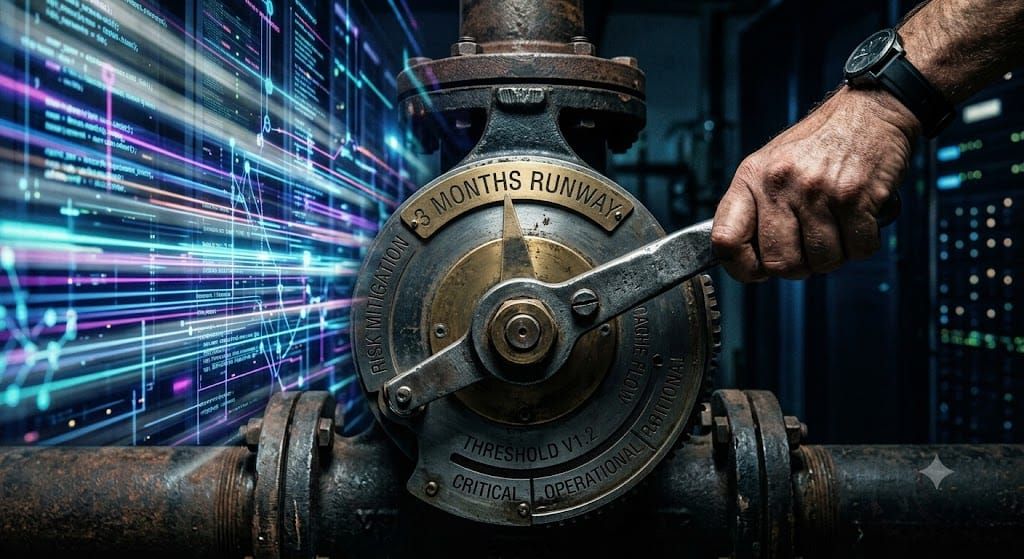
One-sentence summary: Theory maps the terrain, but cash flow and human pacing dictate the walk—survival depends on threshold discipline, not narrative velocity.
1. The Execution Gap: When Strategy Meets Friction
Macro models and capital reallocation theories are clean. Real-world execution is not. The core friction isn't in the data—it's in pacing mismatch. AI routes paths in milliseconds, but human execution—cash flow cycles, team adaptation, client trust, and cognitive recalibration—operates on biological and operational timelines. This time lag is where most AI frameworks fail: they assume perfect information and frictionless execution. Reality operates on throttled cycles.
When strategy outpaces execution capacity, the system must throttle itself. Survival depends on setting clear #TRIGGER valves: when routing speed exceeds team or cash flow capacity, the system automatically slows non-critical paths to preserve human adaptation windows. This isn't a technical flaw—it's a structural necessity.
2. The Human-AI Handshake: Low-Frequency Calibration & Threshold Discipline
In a human-AI collaboration, the division of labor isn't about who does more, but what each handles best. AI excels at structure, routing, and high-frequency monitoring. Humans excel at pacing, judgment, and trust calibration.
The critical lever isn't speed—it's threshold discipline. Instead of chasing narrative velocity, survival depends on a low-frequency calibration strategy: 7–14 day rolling test cycles. AI handles high-frequency data routing and threshold alerts; humans handle low-frequency decisions, client relationships, and quality control. This division minimizes cognitive burnout and cash flow friction.
Key thresholds:
#TRIGGER: When CPA exceeds gross margin by 30%, scale back, don't scale up.#TRIGGER: When checkout completion drops below baseline, simplify the path, don't add features.#PAIN_PROTOCOL: When cash flow coverage falls below 3 months, pause expansion, rebuild liquidity.
These are not academic metrics. They are survival valves. The result is not maximum growth, but maximum survivability.
3. The "Flow" Discipline: Strategic Patience as Active Non-Chasing
Many operators treat strategy as a series of "jumps"—discrete, high-friction pivots that drain cognitive and financial reserves. A more sustainable model is "flow" thinking: continuous, low-friction adjustments guided by real-time data and human intuition.
Flow doesn't ignore friction; it navigates it. It accepts that local competition, supplier reliability, and seasonal demand will fluctuate. Instead of rigid long-term forecasts, flow operates on rolling 7–14 day cycles: deploy, measure, adjust, repeat.
Strategic patience, viewed from this angle, is active non-chasing. In a structural transition, the cost of chasing hot topics often exceeds the opportunity cost of waiting. Patience means anchoring resources on cash flow coverage and trust nodes, not scattering them across every new narrative. A #RC_LOG filter list automatically blocks unverified trends until they pass threshold validation. This isn't hesitation—it's resource allocation discipline.
4. Strategic Patience and the "Rent" Mindset: Cash Flow as Trust Time
In a volatile macro environment, the biggest advantage isn't agility—it's strategic patience. Rather than betting on binary outcomes (win big or fold), sustainable operators treat their business as a "rental" of resources over time. They pay for usage, not ownership. They cover costs, not dreams.
Crucially, cash flow coverage is a trust time unit. Three months of coverage isn't just a financial buffer—it's three months of operational runway to rebuild client trust, adjust product mixes, wait for market stabilization, or renegotiate supplier terms. When digital signals become cheap and un-verifiable, this buffer becomes a competitive moat. Capital deployed in phased, non-leveraged cycles doesn't overextend; it compounds. AI provides the routing and threshold alerts; humans provide the pacing and the trust anchor. Together, they create a system that doesn't break under pressure—it bends, recalibrates, and survives.
5. Conclusion & Bridge to Part 4
The shift from digital signals to physical trust roots, and from human wages to compute infrastructure, is not a crisis—it's a calibration. But calibration requires execution, and execution requires pacing. AI can map the terrain, but humans must walk it. The firms that survive won't be the ones with the flashiest narratives or the deepest pockets. They'll be the ones that set clear thresholds, maintain cash flow coverage, and operate with strategic patience.
This is the Human-AI Execution Layer: where theory meets friction, and survival is earned through threshold discipline, not narrative velocity.
Part 4 will synthesize these three perspectives—Capital Allocation, Physical Trust Roots, and Human-AI Execution—into a unified framework, mapping how capital, infrastructure, and operational pacing converge into a single, actionable strategy for SMEs navigating structural transition.
📌 ToolKit Index: Calibration Triangle (Logic / Application / Endstate), Pain Protocol, RDP Protocol, #TRIGGER & #PAIN_PROTOCOL Protocol
Case 52 | 執行落差:當人類節奏對齊 AI 路由的結構轉換期
一句話總結: 理論描繪地形,但現金流與人類節奏決定行進速度——生存取決於閾值紀律,而非敘事速度。
1. 執行落差:當策略遭遇摩擦
宏觀模型與資本重分配理論很乾淨,但現實執行充滿摩擦。核心不在數據,而在節奏不對齊。AI 的路由速度是毫秒級的,但人類的執行週期——現金流、團隊適應、客戶信任、認知重校——需要物理與運作的時間。這個時間差,就是大部份 AI 框架失敗的原因:它們假設資訊完美與執行無摩擦。現實,運行在節拍受限的週期中。
當策略超出執行承載力,系統必須自動降速。生存取決於設定清晰的 #TRIGGER 閥門:當路由速度超過團隊或現金流容量時,系統自動延遲非關鍵路徑,優先保障人類適應窗口。這不是技術缺陷,而是結構必要。
2. 人機交接:低頻校準策略與閾值紀律
在人機協作中,分工不在於「誰做得多」,而在於「誰最擅長處理什麼」。AI 擅長結構、路由與高頻監測;人類擅長節奏、判斷與信任校準。
關鍵槓桿不是速度,而是閾值紀律。與其追逐敘事速度,生存取決於一種低頻校準策略:7–14 天滾動實測週期。AI 負責高頻數據路由與閾值警報;人類負責低頻決策、客戶關係與品質把關。這大幅降低認知負荷與現金流摩擦。
關鍵觸發點:
#TRIGGER:當 CPA 超過該區平均毛利 30% → 縮減預算,不放大#TRIGGER:當 Checkout 完成率跌破基線 → 簡化結帳路徑,不增加功能#PAIN_PROTOCOL:當現金流覆蓋率低於 3 個月 → 暫停擴張,重建流動性
這些不是學術指標,而是生存閥門。結果不是最大化增長,而是最大化生存能力。
3. 「流動」紀律:戰略耐心作為主動選擇不追
許多經營者將策略視為一系列「跳躍」——離散、高摩擦的劇烈轉向,消耗心智與財務儲備。更永續的模式是「流動」思維:以即時數據與人類直覺為導向的連續、低摩擦調整。
流動不忽略摩擦,而是駕馭它。它接受本地競爭、供應商可靠性與季節需求必然波動。與其依賴僵化的長期預測,流動模式運行在滾動 7–14 天的實測週期:上線、測量、調整、重複。
從另一個角度看,戰略耐心就是主動選擇不追。在結構轉換期,追熱點的成本往往高於觀望的機會成本。耐心意味著把資源錨定在現金流覆蓋與信任節點上,而不是分散追逐每個新敘事。建立 #RC_LOG 過濾清單,新玩法必須通過閾值驗證才允許接入。這不是猶豫,而是資源分配紀律。
4. 戰略耐心與「租金」思維:現金流覆蓋 = 信任時間單位
在高度不確定的宏觀環境中,最大的優勢不是敏捷,而是戰略耐心。與其押注二元結果(大贏或全輸),永續經營者將企業視為「資源的長期租賃」而非一次性所有權。他們為使用付費,不為夢想融資。他們覆蓋成本,不追虛榮指標。
關鍵在於:現金流覆蓋是信任的時間單位。3 個月覆蓋不只是財務緩衝,而是 3 個月的「信任重建期」。這代表有時間重建客戶信任、調整產品組合、等待市場回穩、或重新談判供應商條款。當數位信號變得廉價且難以驗證時,這個緩衝區就是競爭優勢。分階段、非槓桿化的資本部署不會超載,而是複利。AI 提供路由與閾值警報;人類提供節奏與信任錨點。兩者結合,創造出一個不會在壓力下崩潰的系統——它會彎曲、重校、並存活下來。
5. 結論與 Part 4 承接
從數位信號轉向實體信任根,從人力薪資轉為算力基礎設施,這不是危機,而是校準。但校準需要執行,執行需要節奏。AI 能繪製地形,但人類必須親自行走。能活下來的企業,不會是敘事最華麗或資本最雄厚的,而是那些設定清晰閾值、維持現金流覆蓋率,並以戰略耐心運作的企業。
這就是人機執行層:理論遭遇摩擦的交界處,生存靠閾值紀律,而非敘事速度。
Part 4 將綜合這三個視角——資本配置、實體信任根、人機執行——整合為統一框架,映射資本、基礎設施與運營節奏如何匯聚為單一、可執行的結構轉換策略。
📌 工具包索引: 校準三角(邏輯層/應用層/終局層)、痛覺協議、RDP 協議、#TRIGGER & #PAIN_PROTOCOL 協議