Case 37 | The Three Major Paths of AI Development — Compute Maximalism, Energy Foundation, and Pragmatism

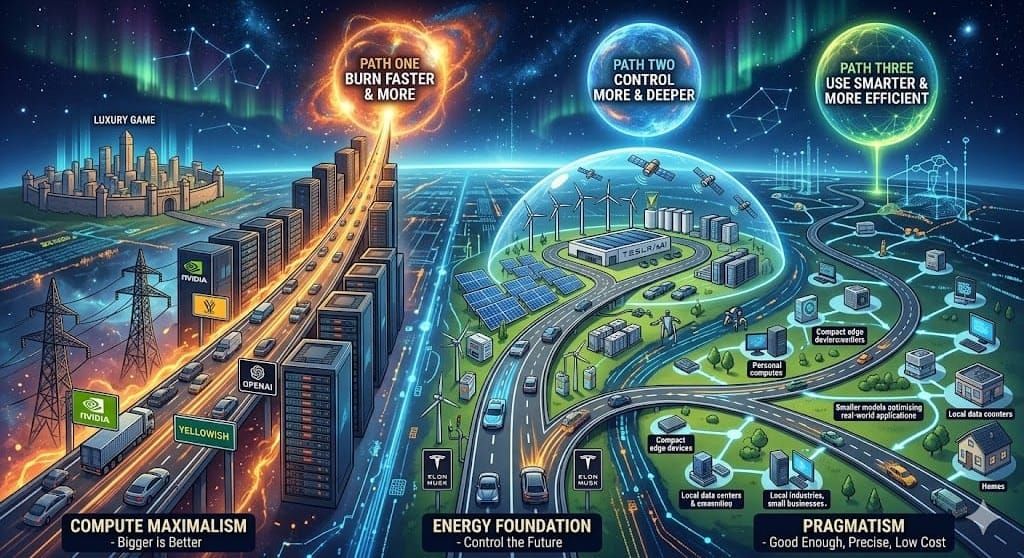
The AI industry is quietly splitting into three distinct paths. These paths represent three fundamentally different values and point toward three very different futures.
🔥 Path One: Compute Maximalism — “Bigger is Better”
Representatives: Jensen Huang, NVIDIA, OpenAI, and others
Core Belief: The larger the parameters and the more compute power, the better the model. Performance at all costs equals victory.
Advantages: Clear short-term technological leadership and the ability to rapidly attract massive capital and top talent.
Costs: Extremely high energy consumption and hardware expenses, making it difficult to reduce token prices to affordable levels.
Risks: Easily trapped in an endless arms race, ultimately becoming a “luxury game” that only a few super-giants can afford.
🔋 Path Two: Energy Foundation — “Control the Foundation to Control the Future”
Representatives: Elon Musk, Tesla / xAI
Core Belief: Don’t just build models — master energy, computing infrastructure, and embodied intelligence to create a complete closed-loop ecosystem.
Advantages: Once the ecosystem matures, it creates an extremely deep and durable moat with strong long-term resource control.
Costs: Enormous upfront capital investment and very long payback periods, highly sensitive to policy and macroeconomic conditions.
Risks: If progress in robotics or energy technology falls short, the entire vision could be significantly delayed.
🛠️ Path Three: Pragmatism — “Good Enough, Precise, Low Cost”
Core Belief: Instead of chasing the biggest and strongest models, focus on being “good enough” in critical domains. Through structured methodologies, toolkits, and domain specialization, enable smaller models to deliver near-top-tier practical performance while dramatically reducing compute and energy consumption.
Advantages: Low deployment threshold, low energy usage, easy to run locally, high data privacy. Particularly suitable for SMEs and individual users.
Costs: May still lag behind in extremely complex or highly open-ended creative tasks.
Potential: As energy costs continue to rise and the public grows tired of high-consumption models, this pragmatic path is likely to demonstrate strong long-term competitiveness.
🧭 Three Paths, Three Futures
Compute Maximalism: Competing over who burns more and faster.
Energy Foundation: Competing over who controls more and deeper.
Pragmatism: Competing over who uses resources more intelligently and efficiently.
These three paths are not mutually exclusive. They will likely coexist, serving different market segments: large enterprises chasing ultimate performance, vertically integrated giants building ecosystems, and the vast majority of SMEs and individual users ultimately choosing practical, cost-effective solutions.
The real winner in the future of AI may not be the one with the largest model, but the one who can create the greatest value in the real world at the lowest cost.
Case 37 | AI 的三條發展路線 —— 算力狂熱、能源根基、與實用主義
當前 AI 產業正在悄然分裂成三條截然不同的路徑。它們不僅代表三種完全不同的價值觀,更指向三種截然不同的未來。
🔥 路線一:算力狂熱 —— 「更大就是更好」
代表人物/企業:黃仁勳、NVIDIA、OpenAI 等
核心理念:參數越大、算力越強、模型越強大,就是勝利。
優勢:短期技術領先顯著,能快速吸引巨額資本與頂尖人才。
代價:極其驚人的能源消耗與硬體成本,Token 價格難以真正普及。
風險:陷入無止境的軍備競賽,最終可能淪為只有少數超級巨頭才玩得起的「奢侈遊戲」。
🔋 路線二:能源根基 —— 「掌握底層才掌握未來」
代表人物/企業:Elon Musk、Tesla / xAI
核心理念:不只是打造模型,而是全面掌握能源、算力基礎設施與具身智能,形成完整的閉環生態。
優勢:一旦生態成熟,將擁有極深的護城河與長期資源控制力。
代價:前期投入極其巨大,回收週期漫長,受政策與宏觀環境影響極大。
風險:若機器人或能源技術進展不如預期,整條路線可能被大幅拖延。
🛠️ 路線三:實用主義 —— 「夠用、精準、低成本」
核心理念:不追求最大最強,而是追求在關鍵領域「夠用就好」。透過結構化方法、工具包與領域特化,讓中小模型發揮接近頂級模型的實用效果,同時大幅降低算力與能源消耗。
優勢:部署門檻低、能耗低、可本地運行、隱私安全高,最適合中小企業與廣大個人用戶。
代價:在極高複雜度或高度開放的創意任務上,仍可能存在差距。
潛力:當能源成本持續上升、大眾對高燒錢模式開始感到疲勞,這條路線的長期競爭力將會越來越強。
🧭 三條路線,三種未來
算力狂熱:在比誰燒得更快、更多。
能源根基:在比誰掌握得更深、更全。
實用主義:在比誰用得更聰明、更省。
這三條路線並非互相排斥,而是會在不同市場層級共存。大企業追求極致性能,垂直整合者布局生態,而數量最龐大的中小企業與個人用戶,最終很可能選擇「夠用且划算」的務實方案。
未來 AI 的真正勝負,可能不再是誰的模型最大,而是誰能在真實世界中,用更低的成本創造更大的價值。