Signal vs Noise | 003 When the Label Becomes the Lifeboat
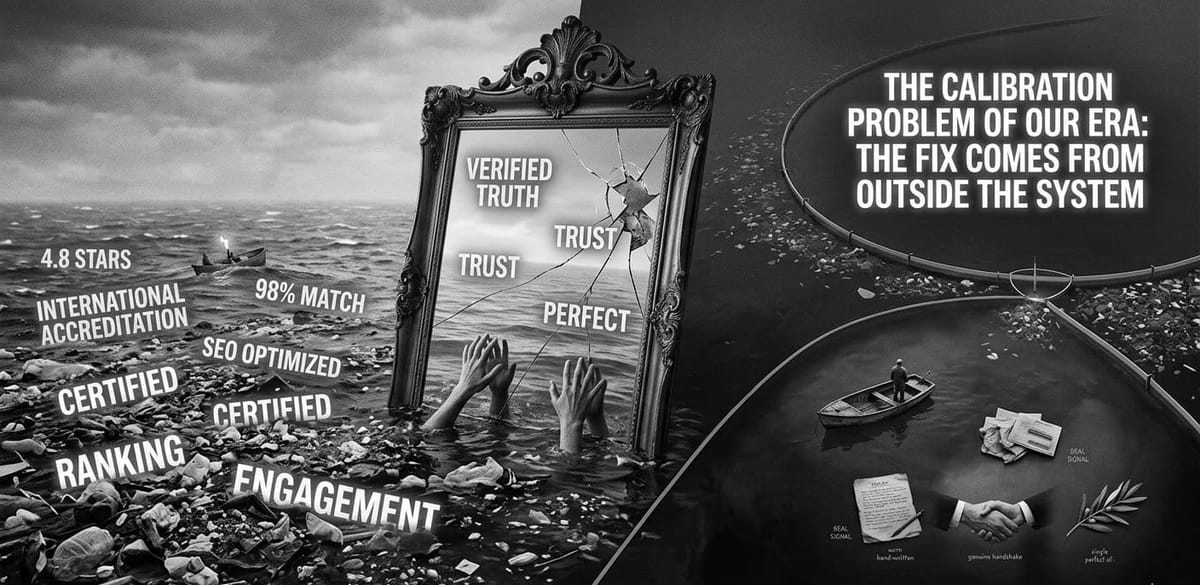
We built a mirror. Then blamed it for showing us what we put in front of it.
Every morning, you make decisions based on labels.
The restaurant with 4.8 stars and two hundred reviews. The doctor with three certificates on the wall. The coach with the international accreditation. The app that says you're a 98% match.
You don't have time to verify everything. Nobody does.
So you trust the label. You move on. You hope it's real.
Most of the time, it works well enough.
But "well enough" is not the same as true.
The label was never designed to tell you the truth.
It was designed to reduce the time it takes to make a decision.
A label says: someone, somewhere, at some point, decided this met a standard.
It doesn't say: this is still true today.
It doesn't say: the standard was rigorous.
It doesn't say: the person who earned this label is the person standing in front of you.
Labels are shortcuts. Shortcuts are useful. But a shortcut to the wrong destination is still the wrong destination.
The system that was supposed to help you decide is now working against you.
Here is what happened, slowly, over decades:
Someone discovered that labels drove decisions. So they acquired more labels.
Someone else discovered that labels could be manufactured. So they manufactured them.
Platforms discovered that labels drove engagement. So they amplified them.
Algorithms discovered that labelled content performed better. So they ranked it higher.
And somewhere in that chain, the connection between the label and the thing it was supposed to represent quietly broke.
The restaurant with 4.8 stars — some of those reviews were written by people who were never there.
The doctor with three certificates — one expired, one from an unrecognised institution, one genuinely earned twenty years ago in a different specialty.
The international coaching accreditation — built by someone who had one legitimate qualification, incorporated a company, and called it an accrediting body.
The algorithm found all of them. Ranked all of them. Showed all of them to you.
Because the algorithm can read labels. It cannot read truth.
We don't blame the ocean for the plastic.
In 2013, a teenager named Boyan Slat presented an idea.
He had been diving in Greece and noticed something: there was more plastic in the water than fish. He went home and asked a question that nobody had asked seriously before.
What if, instead of chasing the plastic, we let the ocean bring it to us?
He designed a passive collection system that uses natural currents to concentrate debris. No fuel. No crew chasing garbage across open water. Just an understanding of how the ocean already moves, used to do something the ocean cannot do for itself.
The ocean didn't create the plastic. It received it.
Nobody blamed the ocean. They built a system to clean it.
The internet didn't create the noise. It received it.
AI didn't create the noise. It learned from it.
For decades, humans packaged themselves, their services, their credentials, their restaurants, their expertise — not because they were fraudulent by nature, but because the system rewarded packaging.
The label became the lifeboat.
In a desert, a mirage is still a direction.
When the real path disappears, people follow what they can see.
You cannot blame someone for using the tools that kept them alive.
But you can ask: what happens when the tools that kept individuals alive start drowning the system they all depend on?
The algorithm is full of what we put into it.
This is the contradiction nobody wants to say out loud:
We are now suspicious of AI because it produces noise.
But the noise came from us.
Every manufactured review. Every inflated credential. Every SEO-optimised article written to rank, not to inform. Every packaged profile designed to match an algorithm's preference rather than reflect a reality.
We built a mirror.
We filled it with the most curated, optimised, packaged version of ourselves.
Then we asked the mirror to tell us the truth.
And now we're surprised that it can't.
What the algorithm cannot find.
There are things that resist packaging.
The moment a coach says something that reframes how you've understood your own body for thirty years — and you feel it shift.
The meal that arrives without flourish and tastes like someone's grandmother made it for people she loves.
The professional who tells you something is wrong with your plan — not because it's their job to say so, but because they've seen it fail before and they remember.
These things don't have better labels than the things that manufactured theirs.
They often have worse ones.
The algorithm cannot find them. The search results won't surface them.
They travel by a different mechanism entirely: by people who encountered the real thing, remembered it, and told someone else.
The Reality Check.
When you need to evaluate something that matters — a professional, a service, a claim — and all you have is what the internet shows you, here are the questions that cut through packaging:
One: Can this be verified by someone who has no financial interest in the answer?
Two: Is there specific detail here that could only come from direct experience — or does it read like it was written to satisfy a search engine?
Three: What would this look like if the packaging were removed? Would anything remain?
The third question is the most important.
Packaging is designed to make you stop asking questions.
Real signal survives the questions.
Someone has to clean the ocean.
Boyan Slat didn't blame the ocean. He designed a system to work with it.
He understood that the ocean was doing what oceans do — receiving, moving, concentrating. The problem wasn't the ocean. The problem was what we kept putting into it.
The calibration problem of our era is the same.
The algorithm is doing what algorithms do — pattern matching, signal amplifying, label reading. The problem isn't the algorithm.
The problem is what we keep putting into it.
Nobody is going to fix this from inside the system. The incentives run the wrong direction.
The fix, when it comes, will come from outside.
From people who know what real looks like — because they've encountered enough of it to tell the difference.
From people who, even when they understood the game, chose not to play it that way.
Not because they couldn't. Because they knew what it would cost.
This is the third signal in a four-part series.
Part One: AI Made a Lawyer Lie to a Judge. Now What? → [Link]
Part Two: The Algorithm Says It Wants Real. But Can It Tell the Difference? → [Link]
Part Four: The Calibrator — Why 2028 Is Not a Prediction, It's a Structure → [Coming]
Signal vs Noise | 003 當標籤成為救生圈
我們建了一面鏡子。然後怪它如實反映了我們放在它面前的東西。
每天早上,你根據標籤做決定。
4.8星、兩百個評論的餐廳。牆上掛著三張證書的醫生。有國際認證的教練。App說你們98%匹配。
你沒有時間驗證所有事情。沒有人有。
所以你相信標籤。你繼續走。你希望它是真的。
大多數時候,夠用了。
但「夠用」不等於真實。
標籤從來不是設計來告訴你真相的。
它是設計來減少你做決定所需時間的。
標籤說的是:某人,在某個地方,在某個時間點,決定這個達到了某個標準。
它沒有說:這個今天仍然成立。
它沒有說:那個標準是嚴格的。
它沒有說:賺到這個標籤的人,就是現在站在你面前的人。
標籤是捷徑。捷徑很有用。但通往錯誤目的地的捷徑,仍然是錯誤的目的地。
本來應該幫你決策的系統,現在正在對抗你。
以下是幾十年來慢慢發生的事——
有人發現標籤能推動決策。於是他們取得更多標籤。
有人發現標籤可以被製造。於是他們製造標籤。
平台發現標籤能帶來互動。於是他們放大標籤。
演算法發現有標籤的內容表現更好。於是他們把它排得更高。
在這個鏈條的某個地方,標籤和它本來應該代表的東西之間的連結,悄悄斷掉了。
4.8星的餐廳——其中一些評論是從來沒有去過的人寫的。
三張證書的醫生——一張過期了,一張來自沒有被認可的機構,一張是二十年前在完全不同的專科真實取得的。
國際教練認證——由一個有一個合法資格的人建立,成立了一家公司,然後稱之為認證機構。
演算法找到了所有這些。把所有這些排了名。把所有這些展示給你看。
因為演算法能讀標籤。它無法讀真相。
我們不怪海洋收了塑膠。
2013年,一個少年提出了一個想法。
他在希臘潛水時注意到一件事:水裡的塑膠比魚還多。他回家問了一個從來沒有人認真問過的問題——
如果我們不去追垃圾,而是讓海洋把垃圾帶到我們這裡,會怎樣?
他設計了一個被動收集系統,利用自然洋流把碎片集中起來。不需要燃料。不需要船員在大洋上追著垃圾跑。只是理解海洋本來如何移動,然後用這個做海洋自己做不到的事。
海洋沒有製造塑膠。它只是接收了。
沒有人怪海洋。他們建了一個清理它的系統。
互聯網沒有製造噪音。它接收了噪音。
AI沒有製造噪音。它從噪音裡學習。
幾十年來,人類包裝了自己、自己的服務、自己的資歷、自己的餐廳、自己的專業——
不是因為他們天生虛偽,而是因為系統獎勵包裝。
標籤成為了救生圈。
在沙漠裡,海市蜃樓也是一種方向。
當真實的路消失,人們跟著能看到的東西走。
你不能怪一個人使用讓他存活下來的工具。
但你可以問:當讓個人存活下來的工具開始淹沒他們共同依賴的系統,會發生什麼?
演算法裡裝滿了我們放進去的東西。
這是沒有人想說出口的矛盾——
我們現在不信任AI,因為它製造噪音。
但噪音來自我們。
每一個製造出來的評論。每一個誇大的資歷。每一篇為了排名而寫、不是為了告知而寫的SEO文章。每一個為了匹配演算法偏好而設計的完美包裝——而不是反映真實。
我們建了一面鏡子。
我們用最經過篩選、最優化、最包裝過的自己填滿它。
然後我們要求鏡子告訴我們真相。
然後我們驚訝地發現它做不到。
演算法找不到的東西。
有些東西抵抗包裝。
一個教練說了一句話,重新框架了你三十年來理解自己身體的方式——你感受到它的轉變。
一頓沒有裝飾的飯,吃起來像某個人為她愛的人做的。
一個專業人士告訴你你的計劃有問題——不是因為那是他的工作,而是因為他見過它失敗,他記得。
這些東西沒有比製造了自己標籤的東西更好的標籤。
它們通常更差。
演算法找不到它們。搜索結果不會把它們推上來。
它們靠一個完全不同的機制傳播:遇到過真實東西的人,記住了,然後告訴了別人。
Reality Check 檢索法。
當你需要評估一件重要的事——一個專業人士、一個服務、一個聲明——而你手上只有網上顯示的東西,以下這些問題能穿透包裝——
第一: 這能被一個在答案裡沒有財務利益的人驗證嗎?
第二: 這裡有只能來自直接經驗的具體細節嗎——還是它讀起來像是為了滿足搜索引擎而寫的?
第三: 如果包裝被去掉,這個東西會是什麼樣子?還有什麼東西留下來嗎?
第三個問題是最重要的。
包裝是設計來讓你停止問問題的。
真實訊號在問題面前能夠存活。
需要有人去清理海洋。
Boyan Slat沒有怪海洋。他設計了一個與它合作的系統。
他明白海洋在做海洋做的事——接收、移動、集中。問題不是海洋。問題是我們一直放進去的東西。
我們這個時代的校準問題是一樣的。
演算法在做演算法做的事——模式匹配、訊號放大、標籤閱讀。問題不是演算法。
問題是我們一直放進去的東西。
沒有人會從系統內部修復這個問題。激勵機制往另一個方向跑。
修復,當它來臨,會來自外部。
來自那些知道真實長什麼樣子的人——因為他們遇到過足夠多的真實,能夠分辨出差別。
來自那些即使理解了這個遊戲,也選擇不那樣玩的人。
不是因為他們做不到。而是因為他們知道那樣做的代價。
這是四部曲系列的第三個訊號。
第一篇:AI讓律師對法官說了謊。然後呢?→ [連結]
第二篇:演算法說它想要真實。但它能分辨嗎?→ [連結]
第四篇:校準者——為什麼2028不是預測,而是結構 → [即將發布]