Signal vs Noise | 002 The Algorithm Says It Wants Real. But Can It Tell the Difference?

When the systems designed to find authentic content can't distinguish it from a machine, what does "real" actually mean?
The announcement sounded reassuring.
Platforms updated their algorithms. Authenticity would be rewarded. Real engagement over manufactured reach. Human voices over algorithmic noise.
Everyone nodded. It made sense.
Then someone asked the obvious question: how does the algorithm know what's real?
The answer was uncomfortable.
It doesn't. Not reliably.
The detection problem no one wants to talk about.
OpenAI built a tool to detect AI-generated text. They shut it down in July 2023.
The reason: it correctly identified AI-written content only 26% of the time.
Three years later, the problem hasn't been solved — it's gotten harder.
Advanced humanisation tools and the natural evolution of large language models have made binary detection increasingly difficult. False positives are common — genuine human writing gets flagged as artificial simply because it is grammatically structured or logically organised.
In other words: write too well, and the machine thinks you're a machine.
The algorithm that claims to reward authenticity cannot consistently identify it.
What the algorithm actually detects.
Here's what the current systems can measure——
Engagement patterns. Click rates. Time on page. Share velocity. Comment volume.
Here's what they cannot measure——
Whether the person who wrote something actually lived it.
Whether the story is true.
Whether the connection being made is genuine or performed.
The algorithm optimises for signals of authenticity. Not authenticity itself.
These are not the same thing.
Enter the virtual human.
Three founders. All born after 2000. Two dropped out of Harvard and Dartmouth. The third joined the team at fifteen — his father had to co-sign the investment documents because he wasn't legally old enough.
Their company, Aaru, recently crossed a one billion dollar valuation.
What do they build?
Virtual humans. Digital replicas of real people — their thinking patterns, decision frameworks, responses — designed to operate in market research environments on behalf of the humans they model.
The algorithm's response to virtual humans: indistinguishable from real.
Because they're built from real data. Real patterns. Real language.
The platform cannot tell the difference.
Which raises the question: if a virtual version of you produces content that registers as authentic — what has "authentic" come to mean?
The authenticity arms race.
By 2026, audiences have developed a sixth sense for low-effort AI — they can spot the overly enthusiastic adjectives, the repetitive structures, and the lack of specific references that characterise lazy prompting.
So the response was predictable: make the AI less lazy.
Train it on better human examples. Add specific references. Vary the structure. Remove the telltale patterns.
Now the detector can't catch it. The audience can't feel it. The platform rewards it.
The race isn't between human and AI anymore.
It's between increasingly sophisticated AI content and increasingly confused detection systems — with real human signal caught somewhere in the middle, harder to find than ever.
What the algorithm actually wants.
Here's the honest answer: the algorithm wants what gets engagement.
"Authenticity" is the current strategy for getting engagement. So the algorithm rewards signals associated with authenticity.
But it has no way to verify the thing itself.
This creates a predictable outcome.
Producers optimise for the signals. The signals get manufactured. The algorithm adjusts. Producers adapt again.
The thing the algorithm claimed to want — genuine human signal — gets progressively harder to find, because the system it built to find it keeps rewarding the imitation instead.
We are packaging ourselves too.
Here is the part no one says out loud.
The algorithm isn't the only one manufacturing signals.
We are.
What people are drawn to, what gets absorbed, is almost always packaged.
You hide your real self — the politeness you show strangers doesn't represent your nature. You only take off the packaging for the people closest to you.
This isn't dishonesty. It's survival.
Everyone manages their image — at work, on social media, in front of people they don't fully trust.
What the algorithm sees is the version each person chooses to show.
And here is the irony——
Show up unpackaged, present your most real self, and you won't attract anyone.
Package yourself, and the algorithm rewards you — but what you're showing is no longer you.
There is no clean exit from this contradiction.
But it explains why genuine signal is becoming so rare.
Not only because AI is generating noise.
But because humans have learned to generate noise too.
The one thing that cannot be packaged.
There is a category of content that no humaniser can produce. No virtual human can model it. No optimisation strategy can manufacture it.
It is content that comes from a specific person, in a specific place, having lived a specific thing.
Not a pattern extracted from human writing.
Not a statistical approximation of human experience.
The actual thing.
The old couple buying two tomatoes — not because they need two tomatoes, but because the walk to the shops is the proof that the other person is still there.
The woman who orders flowers for herself every month. Not because someone forgot. Because she remembers.
The father who liquidates his stability to fund his son's music — not because the data suggested it was rational, but because he could hear something the data couldn't.
These are not content strategies.
They are human signals.
The algorithm says it wants them.
It just can't tell them apart from everything else.
Which is exactly why someone has to.
The systems won't fix this from the inside.
The economics run the other direction: reward engagement, optimise for signals, accept imitation as equivalent to original.
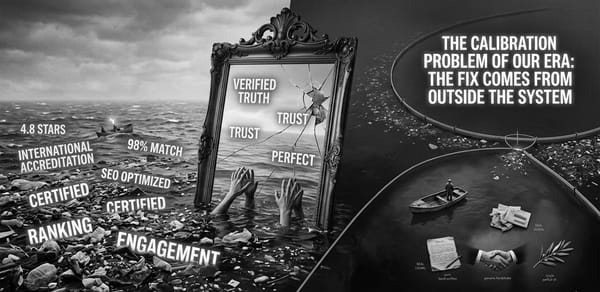
The calibration has to come from outside the system.
From people who know what real looks like — because they've lived enough of it to recognise the difference.
Not as a technical function.
As a human one.
This is the second signal in a four-part series.
Part One: AI Made a Lawyer Lie to a Judge. Now What? → [Link]
Part Three: When AI Reads the Battlefield — Who Checks the AI? → [Coming]
Signal vs Noise | 002
演算法說它想要真實。但它能分辨嗎?
當設計來尋找真實內容的系統,連機器和人類都分不清楚——「真實」究竟意味著什麼?
這個公告聽起來很令人安心。
平台更新了演算法。真實性將獲得獎勵。真實互動優先於製造出來的觸及率。人類聲音優先於演算法噪音。
所有人都點了點頭。這說得通。
然後有人問了一個顯而易見的問題:演算法怎麼知道什麼是真實的?
答案讓人不舒服。
它不知道。至少不可靠。
沒有人想談的檢測問題。
OpenAI建了一個工具來檢測AI生成的文字。他們在2023年7月關閉了它。
原因:它只能正確識別26%的AI書寫內容。
三年後,這個問題不但沒有解決,反而更難了。
先進的人性化工具和大型語言模型的自然進化,讓二元檢測變得越來越困難。誤報很常見——真實的人類寫作,僅僅因為文法結構嚴謹或邏輯清晰,就被標記為人工生成。
換句話說:寫得太好,機器就以為你是機器。
那個聲稱要獎勵真實性的演算法,無法可靠地識別它。
演算法真正在檢測什麼。
以下是當前系統能測量的——
互動模式。點擊率。頁面停留時間。分享速度。留言數量。
以下是它們無法測量的——
寫這些東西的人,是否真的活過這些經歷。
故事是否真實。
建立的連結,是真誠的還是表演出來的。
演算法優化的是真實性的訊號,不是真實性本身。
這兩件事不一樣。
虛擬人類的出現。
三個創辦人。全部在2000年後出生。兩個從哈佛和達特茅斯退學。第三個在十五歲加入團隊——他父親要代他簽署投資文件,因為他還未達到法定年齡。
他們的公司Aaru,最近估值突破十億美元。
他們做什麼?
虛擬人類。真實人物的數字複製品——他們的思維模式、決策框架、反應方式——設計來在市場調研環境中代替真實人類運作。
演算法對虛擬人類的反應:與真實無異。
因為它們是從真實數據建構的。真實的模式。真實的語言。
平台分不清楚。
這就引出了一個問題:如果一個虛擬版本的你,生成的內容被識別為真實——「真實」這個詞,現在到底意味著什麼?
真實性軍備競賽。
到了2026年,受眾已經對低質量的AI內容培養出了某種第六感——他們能感覺到那些過度熱情的形容詞、重複的結構,以及那種沒有具體參照點的空洞感。
所以回應是可預見的:讓AI不那麼懶。
用更好的人類範例訓練它。加入具體參照。變化結構。去掉那些暴露身份的模式。
現在檢測工具抓不到了。受眾感覺不到了。平台獎勵它了。
這場競賽已經不再是人類對AI。
而是越來越精密的AI內容,對越來越困惑的檢測系統——真實的人類訊號被夾在中間,比以往更難找到。
演算法真正想要的是什麼。
誠實的答案:演算法想要能帶來互動的東西。
「真實性」是當前帶來互動的策略。所以演算法獎勵與真實性相關的訊號。
但它沒有辦法驗證真實性本身。
這產生了一個可預見的結果。
生產者優化訊號。訊號被製造出來。演算法調整。生產者再次適應。
演算法聲稱想要的東西——真正的人類訊號——變得越來越難找到,因為它建立的系統一直在獎勵仿製品。
我們自己也在包裝。
有一件事沒有人說出口。
演算法不是唯一在製造訊號的。
我們也是。
人喜歡看的,被吸收的,往往是包裝過的。
你隱藏了自己的真實——對外人的客氣禮貌,不代表你的本質。你只會對最親近的人脫下包裝。
這不是虛偽。這是生存。
每個人都在管理自己的形象——在職場、在社交媒體、在陌生人面前。
演算法看到的,是每個人選擇展示的那一面。
諷刺的是——
你不包裝,呈現最真實的一面,反而吸引不了人。
你包裝,演算法獎勵你,但你展示的已經不是你了。
這個矛盾沒有簡單的出路。
但它解釋了為什麼真實訊號越來越稀缺——
不只是因為AI在製造噪音。
也因為人類自己,也學會了製造噪音。
演算法無法複製的那一樣東西。
有一種內容,沒有任何人性化工具能夠生產。沒有任何虛擬人類能夠模擬。沒有任何優化策略能夠製造。
它來自一個具體的人,在一個具體的地方,活過了一件具體的事。
不是從人類寫作中提取的模式。
不是對人類經驗的統計近似值。
是真實的東西本身。
那對老夫婦買兩個番茄——不是因為他們需要兩個番茄,而是因為去店裡的那段路,是證明對方還在的方式。
那個每個月為自己訂花的女人。不是因為有人忘了。而是因為她記得自己。
那個父親,清算了自己的穩定去資助兒子的音樂——不是因為數據說這是理性的,而是因為他聽到了數據聽不到的東西。
這些不是內容策略。
這些是人類訊號。
演算法說它想要它們。
它只是無法把它們跟其他東西分辨開來。
這正是為什麼需要有人來做這件事。
系統不會從內部修復這個問題。
經濟邏輯往另一個方向跑:獎勵互動,優化訊號,接受仿製品等同於原創。
校準必須來自系統外部。
來自那些知道真實長什麼樣子的人——因為他們活過了足夠多的真實,能夠認出差別。
不是作為一種技術功能。
而是作為一種人類功能。
這是四部曲系列的第二個訊號。
第一篇:AI讓律師對法官說了謊。然後呢?→ [連結]
第三篇:當AI讀取戰場——誰來校準AI?→ [即將發布]