Case 65 | When There Is No Perfect Solution, What Keeps a System Moving Forward?

We often define success as finding the right answer.
But what happens when reality does not contain a permanently correct answer?
If every solution is shaped by its environment, resources, constraints, and time, perhaps the more important question is not how to find the perfect solution, but how a system continues moving when the current solution eventually stops working.
When Answers Become Inherited
Human systems have always passed experience forward.
We turn what has worked into knowledge, methods, rules, habits, and eventually answers.
But when an answer is passed on, the context that produced it often disappears.
The next system may inherit the information, but not the environment, resources, constraints, costs, rejected alternatives, or assumptions that surrounded it.
It may inherit what was considered important, what counted as success, what was ignored, and what was simply taken for granted.
So inheritance does not only pass down answers.
It can also pass down the definition of what an answer is supposed to be.
The Problem with the Objective
AI is extremely good at optimizing objectives.
But there is a fundamental difference between:
How do we optimize this objective?
and
Is this objective still worth optimizing?
If the objective is outdated, incomplete, or simply wrong for the environment, a more capable system may not solve the problem.
It may simply become better at pursuing the wrong thing.
That raises another question:
Who decides when the objective itself should be reconsidered?
Perhaps a system needs not only the ability to continue pursuing a goal, but also the ability to pause, abandon a path, change direction, or stop pursuing it altogether.
Perhaps the Problem Is Not the Final Goal
What if we do not need to compress the entire journey into one enormous final objective?
Instead, a broad direction could be divided into smaller objectives.
Each objective would represent only a local segment of the path.
Multiple paths could remain open at the same time.
The system could run smaller experiments within defined limits, observe what happens, learn from the feedback, discard paths that no longer make sense, and rearrange the next objectives accordingly.
A local failure would then remain a local failure.
It would not have to become a failure of the entire system.
The system would not need to know the final answer at every step.
It would only need to know whether the next step is worth trying — and whether the cost of being wrong is survivable.
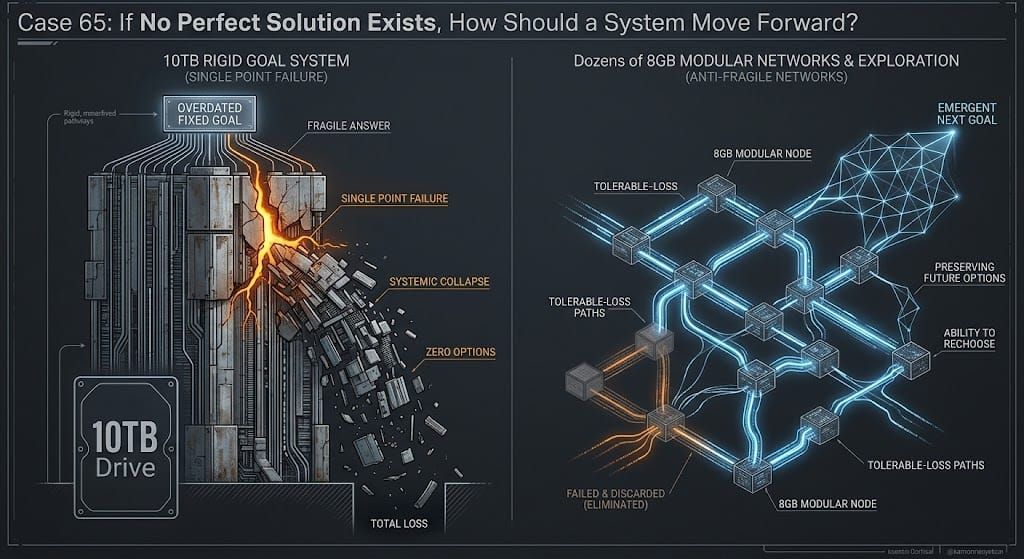
A 10TB Drive and Dozens of 8GB Drives
Imagine putting everything into one 10TB hard drive.
If it fails, the loss is enormous.
Now imagine distributing the same information across dozens of 8GB drives.
Losing one still hurts, but it does not erase the entire system.
The point is not that smaller is always better.
The deeper question is whether risk is concentrated in a single point of failure.
The same principle can apply to exploration.
If one path carries the entire system's future, a wrong decision can become catastrophic.
If exploration is distributed across multiple tolerable-loss paths, one failure does not have to invalidate everything that came before it.
This changes what optimization means.
The objective is no longer necessarily to discover one unique optimum.
It may be to preserve the system's ability to generate, test, eliminate, retain, and recombine possible solutions.
The Problem of a Running Robot
Consider a robot learning to run.
We could teach it a human running gait and ask it to reproduce that solution as efficiently as possible.
Or we could define a set of constraints:
It should not fall.
It should remain stable.
Its movement should produce forward motion.
Its joints and energy use should remain within acceptable limits.
Beyond those constraints, perhaps we do not need to tell it exactly how a running gait should look.
It could generate different possibilities, test them, eliminate those that fail, modify others, and eventually discover a gait that was never explicitly taught by a human.
The interesting question is therefore not simply whether the robot can learn to run.
It is:
Are we passing down an answer, or are we passing down the ability to generate answers?
From Answers to the Ability to Explore
If answers change when environments change, perhaps the most valuable thing to pass forward is not the current answer.
It may be the space in which new answers can be generated.
The constraints.
The accumulated experience.
The record of failed paths.
The costs of previous attempts.
The conditions under which an existing solution should be reconsidered.
The first robot would not necessarily need to tell the second robot:
"Gait #237 is the correct way to run."
It could instead pass on:
What failed.
What worked.
What it cost.
What constraints mattered.
What changed when the environment changed.
And perhaps, most importantly, when the current answer should no longer be trusted.
That is a very different form of inheritance.
It does not preserve the answer.
It preserves the ability to find the next one.
So Where Does That Leave Humans?
If AI can explore, simulate, test, compare, learn, and generate strategies at enormous scale, what remains for humans?
Perhaps one role is to question what is worth optimizing in the first place.
Not necessarily to provide the final answer, but to examine the direction, the assumptions, the constraints, the costs, and the conditions under which the system should reconsider its objective.
In that sense, a human may act as something closer to a meta-architect.
But humans do not possess an eternal, universally correct objective either.
We are also products of changing environments, limited information, inherited assumptions, and imperfect judgment.
And this creates an important distinction.
From the perspective of AI or AGI alone, the deepest question remains difficult:
Who, or what, ultimately determines what is worth pursuing?
The loop does not necessarily close.
But in a human-machine system, the structure can be different.
AI can explore and execute.
Humans can question direction, values, assumptions, and real-world meaning.
Reality provides feedback that neither side completely controls.
The intelligence may therefore exist not entirely inside the human or entirely inside the machine, but within the system formed by their interaction with the environment.
If There Is No Perfect Solution
An adaptive system may not need to discover the one correct answer.
It may need to ensure that even a wrong answer does not destroy all of its future options.
It can follow a path.
Discover that the path is wrong.
Let it go.
Switch direction.
Absorb the new information.
Rearrange the next objectives.
And perhaps even change what it considers worth pursuing.
In that sense, letting go is not necessarily failure.
It can be a way of preserving the ability to choose again.
Perhaps success is therefore not simply reaching the original endpoint.
Perhaps it is retaining enough freedom, information, resources, and structure to make another meaningful choice when the environment changes.
If there is no answer that remains correct forever, then perhaps what is truly worth passing on was never the answer itself.
It is the ability for the next system, in a completely different environment, to generate the next answer.
And that leaves a final question:
If this is what inheritance really means, are we preserving the past — or are we preserving the ability to choose again in the future?
Case 65|如果不存在完美解,系統該如何前進?
我們習慣把「成功」理解成找到一個正確答案。
知道更多資料、累積更多經驗、建立更好的模型,然後找到一條最有效率的路徑。
但如果現實本身並不存在一個永遠正確的解呢?
如果上一代留下來的答案,在當時的環境裡合理,到了下一個環境卻已經不再適用;如果 AI 可以比人類更快速地分析資料、模擬路徑、最佳化目標,但它所最佳化的目標本身也可能已經過期,那麼問題也許不再只是:
AI 能不能找到最優解?
而是:
如果最優解不存在,我們應該如何讓系統繼續前進?
當答案開始被傳承
人類的傳承很容易從「經驗」變成「答案」。
上一代告訴下一代:
這樣做曾經成功。
於是下一代學會了方法,甚至把方法進一步整理成規則。
但一個答案真正成立,往往不只是因為它本身正確。
它還包含當時的環境、資源、限制、成本,以及那些沒有被選擇的其他可能。
當環境改變後,原本合理的答案可能仍然看起來合理。
問題是:
合理的答案,是否仍然適用?
這個問題不只存在於人類。
AI、模型、Agent,以及任何透過資料與經驗累積能力的系統,都會遇到類似問題。
網路上的資訊、人的經驗、模型產生的內容、錯誤、偏見、成功案例,甚至上一代系統重新整理過的結果,都可能繼續被下一代接收。
因此真正被傳承的,可能不只是知識。
還包括:
什麼被認為重要、什麼被分類為成功、什麼被忽略,以及什麼被當成「應該如此」。
目標函數的問題
如果我們把這件事情放到 AI 系統裡,會出現另一個問題。
AI 可以非常擅長最佳化。
給它一個目標,它可以搜尋資料、模擬方案、比較成本、預測結果,並不斷改善達成目標的方法。
但這裡存在一個容易被忽略的斷層:
「如何最佳化一個目標」和「這個目標是否仍然值得最佳化」並不是同一件事情。
如果目標本身設定錯了,AI 越強,反而可能越有效率地把錯誤放大。
因此問題變成:
如果目標函數也可能過期,誰來判斷它是否仍然有效?
也許不是替 AI 找到一個永遠正確的終極目標,而是讓它知道:
什麼時候應該繼續,什麼時候應該轉向,什麼時候應該放棄。
也許問題不在於「最終目標」
但這裡還有另一條路。
也許我們根本不需要一開始就把所有事情壓縮成一個巨大的最終目標。
可以把一個大問題拆成許多小目標。
每一個小目標,只是整條路徑中的一小段。
同時保留多條可能的路徑。
AI 可以在安全與資源允許的範圍內,分別進行小規模嘗試,取得回饋,再決定下一步。
某條路徑失敗,就淘汰它。
某個方法成本突然增加,就換另一條路。
新的資訊出現,就重新排列下一階段的小目標。
甚至某一段原本被認為重要,後來也可以被放棄。
這時候,「失敗」的意義開始改變。
它不再代表整個系統失敗。
它只是:
一條小路沒有通。
10TB 與幾十個 8GB
這其實很像資料儲存。
如果把所有資料都放進一個昂貴的 10TB 硬碟,一旦這個節點損壞,損失可能非常集中。
但如果資料被分散在許多 8GB 的儲存裝置中,一個裝置損壞,只代表局部損失。
這不代表小容量永遠比大容量好。
真正的差異是:
風險是否集中在單一節點。
同樣的概念,也可以放進探索與決策。
如果一次判斷就承載整個系統的成功或失敗,那麼錯誤的代價可能非常大。
但如果系統把探索拆成許多可以承受的小路徑,每一次試錯只消耗有限資源,那麼系統就不需要在每一步都知道終局答案。
它只需要確保:
下一步值得嘗試,而且即使錯了,也承受得起。
這可能是另一種理解「最佳化」的方法。
不是尋找唯一最優解。
而是讓系統保持:
產生、測試、淘汰、保留與重組解的能力。
而這也改變了傳承。
如果所有經驗都被壓縮成一個巨大的答案,那麼答案失效時,傳承本身也可能一起失效。
但如果留下的是許多可以重新組合的經驗、路徑、限制與失敗紀錄,那麼其中一部分失效,並不代表整個傳承失效。
一個跑步機器人的問題
這讓一個看似簡單的問題突然變得有意思。
如果讓一個機器人學習跑步,我們一定要把人類的跑步姿勢教給它嗎?
我們可以告訴它:
- 不可以摔倒;
- 必須維持身體穩定;
- 必須達到某種移動效果;
- 關節與能源消耗需要保持在合理範圍。
但在這些條件之內,是否一定要告訴它:
「你應該像人類一樣跑?」
也許不需要。
它可以產生大量不同的姿勢。
有些效率低。
有些不穩定。
有些會造成過高的負荷。
有些可能完全沒有用。
但只要試錯成本被限制在合理範圍內,它就可以逐步淘汰這些方案。
最後留下的姿勢,甚至可能不是人類教給它的。
這裡真正有意思的地方,不是機器人「學會了跑步」。
而是:
我們到底是在把答案傳給它,還是在把產生答案的方法交給它?
從答案到探索能力
如果答案本身會隨環境改變,那麼最有價值的傳承,也許不再是一套固定答案。
而可能是:
探索空間、限制條件、過去的經驗、失敗紀錄,以及重新判斷的方法。
第一代機器人可以探索一萬種跑法。
它不需要告訴第二代:
「第 237 號姿勢就是正確答案。」
它可以傳遞:
哪些條件下哪些方法有效;
哪些方法失敗;
哪些成本太高;
哪些身體結構會改變結果;
哪些情況出現時,原本的方法應該重新評估。
第二代仍然可以重新探索。
因此,真正被傳承的不是「答案」。
而是:
如何在答案失效之後,繼續找到下一個答案。
那麼,人類的位置在哪裡?
如果 AI 已經可以最佳化、模擬、試錯、學習,甚至自己產生新的行動策略,那麼人類是不是只需要提供一個最終目標?
未必。
也許真正困難的角色,是判斷:
什麼值得繼續最佳化?
以及:
什麼時候連原本的目標都應該重新檢查?
這可能需要某種「元架構」的能力。
不是替 AI 決定每一個答案。
也不是每一次都親自操控 AI。
而是理解:
- 目標從哪裡來;
- 目標適用於什麼環境;
- 哪些限制不能被交換;
- 哪些成本可以承受;
- 哪些路徑值得嘗試;
- 什麼時候應該停止;
- 什麼時候應該重新拆解問題。
但即使如此,也不能假設人類自己就擁有一個永遠正確的目標。
否則只是把 AI 的固定目標函數,換成了人類的固定目標函數。
而如果把視角從單獨的 AI/AGI 移到人機系統,問題又可能變得不同。
AI 可以負責大規模探索、模擬、比較與執行。
人類可以在更高的層級重新檢查方向、環境與價值。
現實世界則持續提供兩者都無法完全預測的回饋。
於是形成的可能不是:
AI 找到答案。
而是:
人類、AI 與環境共同形成一個持續修正的系統。
如果沒有完美解
也許一個具有適應能力的系統,不應該被要求:
找到唯一正確的答案。
而應該被設計成:
即使答案錯了,也不會因此失去所有未來選項。
它可以走一條路。
發現不對。
放下。
換另一條。
得到新的資訊。
重新排列小目標。
甚至改變原本認為重要的方向。
這樣一來,「放手」就不再只是失敗。
它可能是系統維持未來選擇權的一部分。
而「成功」也不一定是完成最初設定的終點。
可能是:
在環境持續變化的情況下,系統仍然保有重新選擇的能力。
如果不存在永遠有效的答案,那麼真正值得傳承的,也許從來不是答案本身。
而是讓下一個系統,在完全不同的環境裡,仍然能夠產生下一個答案的能力。
於是最後留下的問題也許是:
如果是這樣,我們今天所謂的「傳承」,究竟是在保存過去,還是在替未來保留重新選擇的能力?