CASE 63 | What Are We Actually Maintaining?

On Survival, Growth, and the Environment That Sustains Us
1. The Question Behind Maintenance
We often describe systems as if their primary objective were simply to maintain themselves.
A living organism maintains its internal conditions.
A business maintains its operations.
An artificial intelligence system requires infrastructure to continue functioning.
At first glance, maintenance appears to be an internal process: something a system does to preserve its own existence.
But what if this view is incomplete?
A system does not exist independently of its surroundings. It relies on resources, energy, conditions, and relationships that extend beyond its own boundaries.
Perhaps the question is not only:
How does a system maintain itself?
Perhaps we should also ask:
What does a system actually need to maintain in order to continue existing?
Is it maintaining itself, or must it also maintain the relationship with its environment that allows it to continue?
2. The Boundary Between the System and Its Environment
Consider a system that depends on an external resource.
As long as that resource remains available, the system may continue operating through an established process.
But the environment is not necessarily static.
Resources may become scarce. Supply conditions may change. Competition may increase. The system itself may grow, increasing its demand.
The original arrangement may no longer be sufficient.
At this point, the system faces more than a resource problem.
It faces a problem of relationships.
The question becomes whether the existing relationship between the system and its environment can still support its continued operation.
If it cannot, the system may need to change how it obtains resources, how it processes them, or what it requires in order to continue.
This leads to a possible sequence:
Environmental constraint → Disruption of the existing arrangement → Reassessment of available resources → Reconfiguration → A new maintenance pathway
This is not an inevitable outcome.
Some systems adapt. Others contract, enter dormancy, or cease to function.
The important question is what determines these different outcomes.
3. Maintenance and Growth Are Not the Same
A system that maintains itself does not necessarily grow.
And a system that grows does not necessarily become more sustainable.
Growth can increase a system’s capacity, but it can also increase its demand for external resources.
This creates a potential feedback relationship:
- The system acquires resources.
- These resources support maintenance and possibly growth.
- Growth changes the system’s future requirements.
- These requirements place new demands on the environment.
- The environment’s response changes what the system can acquire next.
The system’s own development may therefore alter the conditions upon which its future development depends.
This raises another question:
When a system grows, is it improving its ability to maintain itself—or increasing the amount of external support it must continuously obtain?
These two outcomes are not necessarily mutually exclusive.
A system may become more capable while also becoming more dependent.
4. Two Coupled Loops
We can provisionally examine this relationship through two interacting loops.
Loop A — The System
Needs → Resource acquisition → Transformation → Maintenance / Growth → Changing needs
Loop B — The Environment
Available resources → Acquisition and consumption → Replenishment / Depletion → Changing supply conditions → Future availability
The loops are coupled: the system affects its environment through resource use, while environmental conditions constrain the system’s next state.
This is a way of organizing observations, not yet a universal model.
The two loops may operate at different speeds.
A system may expand faster than its environment can replenish resources. Alternatively, the environment may improve its supply capacity, allowing the system to change its operating scale.
There may also be delays between resource consumption and the appearance of environmental consequences.
Such delays may allow a system to continue expanding even after it has begun exceeding the conditions that support it.
But an increase in available resources does not automatically produce growth.
A system may instead reduce consumption, improve efficiency, change its requirements, or remain at its existing scale.
The relationship between resource availability and system growth is therefore conditional, not automatic.
5. Different Systems, Different Constraints
Consider three different settings.
A. Life in Extreme Environments
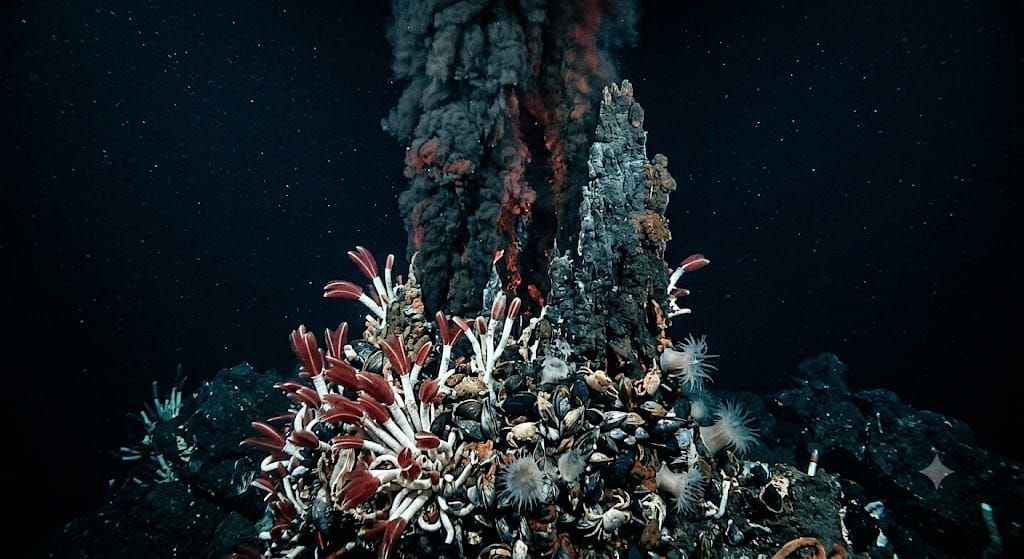
Some organisms can survive in environments where sunlight is unavailable or extremely limited.
Certain organisms use chemical energy pathways that differ from those primarily dependent on sunlight, drawing on substances available in their surroundings.
The relevant observation is not that all organisms follow the same strategy.
Rather, survival may depend on how biological processes are configured around locally available resources and environmental conditions.
When the environment differs, the pathways supporting life may differ as well.
B. Artificial Intelligence and Infrastructure
AI systems depend on physical infrastructure: computing hardware, electricity, cooling, networks, and the organizations that provide them.
As deployment expands, the demand placed on this infrastructure may also change.
A system’s growth may therefore be constrained by resources and capacities beyond the software itself.
But this relationship is not simply “AI wants more.”
The scale and nature of AI resource demand are shaped by human design decisions, deployment choices, economic factors, and available infrastructure.
The question is how a system’s operating requirements interact with the environment that supports them.
C. Human Systems and Supply Chains
Human societies can also change their resource relationships.
Improvements in production, transportation, and supply chains can make previously difficult-to-obtain resources more accessible.
This can support new activities and greater consumption.
But improved access does not guarantee that every individual or system benefits equally. Nor does it remove limits on production, distribution, or environmental capacity.
A change in supply conditions can alter what becomes possible, without determining what must happen next.
These examples are not equivalent systems.
They differ in their mechanisms, timescales, and forms of agency.
Their value here is narrower: each invites us to examine how continued operation depends on relationships between internal processes and external conditions.
6. When Resource Acquisition Becomes a Problem
It is tempting to assume that acquiring more resources always improves a system’s ability to survive.
But acquisition is only one part of the process.
Resources must also be processed, integrated, distributed, and used.
If acquisition exceeds the system’s ability to handle the incoming flow, additional resources may create new constraints rather than solve existing problems.
This may also have consequences for the environment supplying those resources.
This suggests that we should distinguish between:
- What resources are available.
- How much the system can acquire.
- How much it can effectively process.
- What it requires for maintenance.
- What additional resources it uses for growth.
- How the environment responds to extraction and demand.
These are related, but they are not interchangeable.
More input does not necessarily mean more usable capacity.
And more usable capacity does not necessarily mean that expansion is the only possible response.
7. What Happens When the Environment Changes?
A system may initially be well adapted to its environment.
But adaptation is not a permanent guarantee.
The environment may change. The system may change. Their relationship may become less suitable over time.
This means that maintenance may involve more than preserving an existing internal structure.
It may also involve adjusting the relationship between the system and its surroundings.
However, this idea has an important limit.
Not every system can reconfigure itself indefinitely.
Some depend on resources for which no accessible substitute exists. Some cannot change their internal processes quickly enough. Others may consume the resources needed for their own continued operation.
Reconfiguration has costs, constraints, and failure points.
The ability to change is itself dependent on conditions.
8. The Question Remains Open
Perhaps we have been treating maintenance as if it were entirely an internal matter.
But a system’s continued existence may depend on a wider arrangement: its internal processes, the resources it can access, the environment that supplies them, and the limits governing their exchange.
This does not mean that every system is trying to maintain its environment.
Nor does it mean that every system must grow, adapt, or achieve balance.
It means that the boundary between a system and its environment may be essential to understanding how that system continues.
So the question remains:
What are we actually maintaining?
Are we maintaining the system itself?
The resources that sustain it?
The processes that transform those resources?
Or the relationship between the system and its environment that allows those processes to continue?
And when that relationship changes, what determines whether the system expands, reorganizes, reduces its demands—or fails to continue?
Perhaps maintenance is not simply a fixed state.
Perhaps it is a process of continuous adjustment between a system’s own requirements and the conditions of its environment.
A Question to Carry Forward
When a system changes its demands, and the environment has limits, what exactly is being preserved—and what is being changed?
CASE 63 | 我們實際上在維持什麼?
論生存、增長,以及維繫我們的環境
1. 維持背後的提問
我們常把系統描述成,彷彿它們的首要目標就是維持自身。
一個生物體維持其內部狀態。
一間企業維持其營運。
一個人工智慧系統需要基礎設施才能繼續運作。
乍看之下,維持似乎是系統內部的事:是系統為了保存自身存在所做的一種動作。
但如果這個觀點並不完整呢?
一個系統並非獨立於其周遭而存在。它依賴自身邊界之外的資源、能量、條件與關係。
也許問題不僅僅是:
「一個系統如何維持自身?」
也許我們還應該問:
「一個系統實際上需要維持什麼,才能繼續存在?」
它是在維持自身,還是也必須維持那組讓自身得以延續的環境關係?
2. 系統與環境的邊界
設想一個依賴外部資源的系統。
只要該資源持續可用,系統就可以透過既有的流程繼續運作。
但環境未必是靜止的。
資源可能變得稀缺。供應條件可能改變。競爭可能加劇。系統本身也可能增長,進而提高自身的需求。
原有的安排可能不再足夠。
此時,系統面臨的不只是資源問題。
它面臨的是關係問題。
問題變成:系統與環境之間既有的關係,是否仍能支撐它持續運作。
如果不能,系統可能需要改變獲取資源的方式、處理資源的方式,或改變它為了繼續運作所需的條件。
這導向一個可能的序列:
環境約束 → 既有安排受擾 → 重新評估可用資源 → 重構 → 新的維持路徑
這不是必然的結果。
有些系統會適應。有些會收縮、進入休眠,或停止運作。
重要的問題是,決定這些不同結果的因素是什麼。
3. 維持與增長並不相同
一個能維持自身的系統,未必會增長。
而一個增長的系統,未必會變得更永續。
增長可以提升系統的能力,但它也可能增加系統對外部資源的需求。
這會產生一種潛在的回饋關係:
- 系統獲取資源。
- 這些資源支持維持,也可能支持增長。
- 增長改變系統未來的需求。
- 這些需求對環境提出新的要求。
- 環境的回應,改變了系統下一步能獲取什麼。
因此,系統自身的發展,可能反過來改變它未來發展所依賴的條件。
這帶出了另一個問題:
當一個系統增長時,它是在提升維持自身的能力,還是在增加它必須持續從外部獲得的支持?
這兩種結果未必互斥。
一個系統可能在變得更有能力的同時,也變得更加依賴。
4. 兩個耦合的循環
我們可以暫時透過兩個互動的循環來檢視這種關係。
循環 A —— 系統
需求 → 資源獲取 → 轉換 → 維持/增長 → 改變的需求
循環 B —— 環境
可用資源 → 取得與消耗 → 補充/耗竭 → 改變供給條件 → 未來的可用資源
這兩個循環是耦合的:系統透過資源使用影響環境,而環境條件則制約系統的下一個狀態。
這是一種組織觀察的方式,還不是一套通用模型。
兩個循環可能以不同的速度運作。
系統的擴張速度,可能快於環境補充資源的速度。或者,環境可能改善其供給能力,讓系統得以改變其運作規模。
資源消耗與環境後果的顯現之間,也可能存在延遲。
這種延遲,可能讓一個系統即使已經開始超出支撐它的條件,仍能繼續擴張。
但可用資源的增加,並不會自動帶來增長。
系統也可能反過來降低消耗、提升效率、改變自身需求,或維持在現有規模。
因此,資源可用性與系統增長之間的關係是有條件的,而不是自動的。
5. 不同的系統,不同的約束
考慮三種不同的情境。
A. 極端環境中的生命
有些生物能在陽光無法取得或極其有限的環境中存活。
某些生物利用不同於主要依賴陽光的化學能量途徑,從周遭可取得的物質中獲得能量。
相關的觀察並不是「所有生物都遵循同一種策略」。
而是:生存可能取決於生物過程如何圍繞當地可用的資源與環境條件進行配置。
當環境不同,支撐生命的路徑也可能不同。
B. 人工智慧與基礎設施
AI 系統依賴物理基礎設施:運算硬體、電力、冷卻、網路,以及提供這些資源的組織。
隨著部署擴張,對這些基礎設施的需求也可能改變。
因此,系統的增長可能受到軟體本身之外的資源與能力所限制。
但這種關係並不只是「AI 想要更多」。
AI 資源需求的規模與性質,是由人類的設計決策、部署選擇、經濟因素,以及可用基礎設施所塑造的。
問題在於:系統的運作需求,如何與支撐它們的環境互動。
C. 人類系統與供應鏈
人類社會也能改變其資源關係。
生產、運輸與供應鏈的改善,可以讓過去難以取得的資源變得更容易獲取。
這可以支持新的活動與更大的消耗。
但取得管道的改善,並不保證每個個體或系統都能平等受益。它也無法消除生產、分配或環境容量上的限制。
供應條件的改變,可以改變什麼變得可能,但並不決定接下來必然發生什麼。
這些例子並不是等效的系統。
它們在機制、時間尺度與能動性的形式上都有所不同。
它們在此的價值較為狹窄:每一個都在邀請我們檢視,持續運作如何依賴於內部過程與外部條件之間的關係。
6. 當資源獲取本身成為問題
人們很容易假設,獲取更多資源總能提升系統的生存能力。
但獲取只是整個過程的一部分。
資源還必須被處理、整合、分配與使用。
如果獲取量超過了系統處理流入量的能力,額外的資源可能創造新的約束,而不是解決既有的問題。
這也可能對提供這些資源的環境產生後果。
這暗示我們應該區分:
- 有哪些資源可用。
- 系統能獲取多少。
- 系統能有效處理多少。
- 系統維持自身需要什麼。
- 系統為了增長額外使用了什麼資源。
- 環境對提取與需求如何回應。
這些是相關的,但它們不能互換。
更多的輸入,未必意味著更多可用的能力。
而更多可用的能力,也未必意味著擴張是唯一可能的回應。
7. 當環境改變時會發生什麼?
一個系統起初可能很好地適應了它的環境。
但適應不是永久的保證。
環境可能改變。系統可能改變。它們之間的關係可能隨時間變得不再合適。
這意味著,維持可能不只是保存既有的內部結構。
它也可能涉及調整系統與其周遭之間的關係。
然而,這個想法有一個重要的限制。
不是每個系統都能無限地重構自身。
有些系統依賴沒有可取得替代方案的資源。有些無法夠快地改變其內部過程。有些可能消耗掉自身繼續運作所需的資源。
重構是有成本、有約束、有失效點的。
改變的能力,本身也依賴於條件。
8. 問題依然開放
也許我們一直把維持,當成是完全位於系統內部的事情。
但一個系統的持續存在,可能取決於一個更廣泛的安排:它的內部過程、它能獲取的資源、提供這些資源的環境,以及規範它們交換的限制。
這並不意味著每個系統都在試圖維持它的環境。
也不意味著每個系統都必須增長、適應,或達成平衡。
它意味著,系統與環境之間的邊界,可能對理解該系統如何持續存在至關重要。
所以問題依然是:
我們實際上在維持什麼?
我們是在維持系統本身?
維持支撐它的資源?
維持轉換這些資源的過程?
還是維持那組讓這些過程得以繼續的、系統與環境之間的關係?
而當這組關係改變時,是什麼決定了系統會擴張、重組、降低需求,還是無法繼續?
也許維持不只是一種固定的狀態。
也許它是系統自身需求與環境條件之間,持續調整的過程。
一個值得帶著走的提問
當一個系統改變它的需求,而環境有其極限時,真正被保留的是什麼——被改變的又是什麼?


