Case 45 | Australian Survival Economics |Living Costs — When Daily Expenses Become Survival Pressure

One-sentence summary:
Your income hasn’t decreased, but your money is quietly being eroded.
I. Surface Phenomenon: The Bills Keep Coming, But the Money Disappears
Your weekly supermarket bill has gone from $200 to $250. That’s an extra $2,600 a year.
This isn’t just “prices going up a bit” — it’s a structural increase in the cost of living.
For an average family, this might simply mean “eating out less often.”
But for a small business owner, it means having to squeeze even more money out of your own pocket to cover living expenses — money that could have been used to keep the business running.
II. First Layer Cause: The Structural Rise in Living Costs
In 2026, Australia’s official inflation rate is sitting at 4.6%, but the price increases hitting everyday items are much steeper:
- Food prices: +5.8%
- Energy prices: +8.4%
- Rent: +6.5%
These numbers are not normal market fluctuations. They represent a structural rise in the cost of living.
For small business owners who rely on relatively fixed income or thin profit margins, these increased costs cannot be easily passed on to customers — they can only be absorbed by themselves.
III. Second Layer Butterfly Effect: How Rising Living Costs Squeeze Small Business Survival Space
When living costs rise:
- Consumers’ wallets become thinner, and non-essential spending (flowers, dining out, moving services) gets cut first.
- Small business owners’ revenue sources start to shrink.
- In order to survive, they begin to reduce their own profit margins.
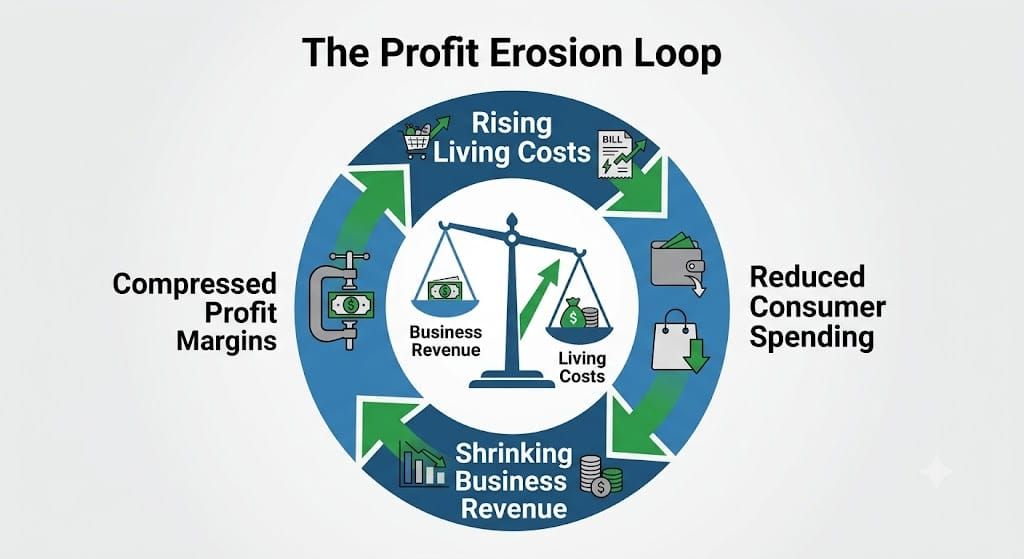
This creates a classic vicious cycle:
Rising costs → Reduced consumption → Falling revenue → Compressed profits.
This is not about not working hard enough. It’s the entire environment pushing the pressure downward onto you.
IV. Common Wrong Responses
- Thinking “I just need to tough it out for now” without adjusting your cost structure.
- Continuing to draw money from the business to maintain your current lifestyle.
- Ignoring the connection between living costs and business costs.
V. Reality Check Tool Application
Examine your situation through three levels:
- Logic Level: Has your living cost started to erode your profit margin?
- Application Level: Can you adjust your cost structure without compromising service quality?
- Endgame Level: Do you have enough buffer to handle continuously rising living costs?
When living costs begin to eat into your business profits, you need to reassess your pricing and cost structure to ensure your income can support both your personal life and the continued operation of your business.
Case 45 | 澳洲生存經濟學 |生活成本 —— 當日常開支變成生存壓力
一句話總結:
你的收入沒有減少,但你的錢正在被隱形地侵蝕。
一、表面現象:帳單來了,錢沒了
超市一週的帳單從 $200 漲到 $250,一年下來就是 $2,600 的額外支出。這不是「物價波動」,這是結構性的生活成本上升。
對於一個家庭來說,這可能只是「少買幾次外食」的問題。但對一個小生意人來說,這意味著他必須從自己的收入中擠出更多錢來支付生活開支,而這些錢本來可能用來維持生意的營運。
二、第一層原因:生活成本的結構性上漲
2026 年,澳洲的官方通膨率維持在 4.6%,但日常消費品的價格漲幅更高:
· 食品價格年增幅 5.8%
· 能源價格年增幅 8.4%
· 租金年增幅 6.5%
這些數字不是「市場波動」,而是生活成本的結構性上升。對於依賴固定收入或利潤率偏低的小生意人來說,這些上升的成本無法轉嫁,只能自行吸收。
三、第二層蝴蝶效應:生活成本如何擠壓小生意生存空間
當生活成本上升時:
· 消費者的荷包變薄,買花、吃飯、搬家這些非必要開支會優先被砍掉。
· 小生意人的收入來源開始萎縮。
· 為了維持生存,他們開始削減自己的利潤空間。
這是一個典型的惡性循環:成本上升 → 消費減少 → 收入下降 → 利潤壓縮。這不是你不夠努力,而是整個環境在把壓力往下傳。
四、常見錯誤應對
· 認為「只要撐過去就好」,卻沒有調整成本結構。
· 為了維持現有生活水準,持續從生意中提取資金。
· 忽略生活成本與生意成本之間的關聯性。
五、Reality Check 工具應用
從三個層級檢視你的處境:
- 邏輯層:你的生活成本是否已經開始侵蝕你的利潤邊界?
- 應用層:你是否有能力在不降低服務品質的情況下調整成本結構?
- 終局層:你是否有足夠的緩衝來應對持續上升的生活成本?
當生活成本開始侵蝕生意的利潤時,你需要重新評估你的定價和成本結構,確保你的收入能同時支撐個人與業務的持續運作。