Case 33 | Physical Credit — The Compass of a Decentralised Era
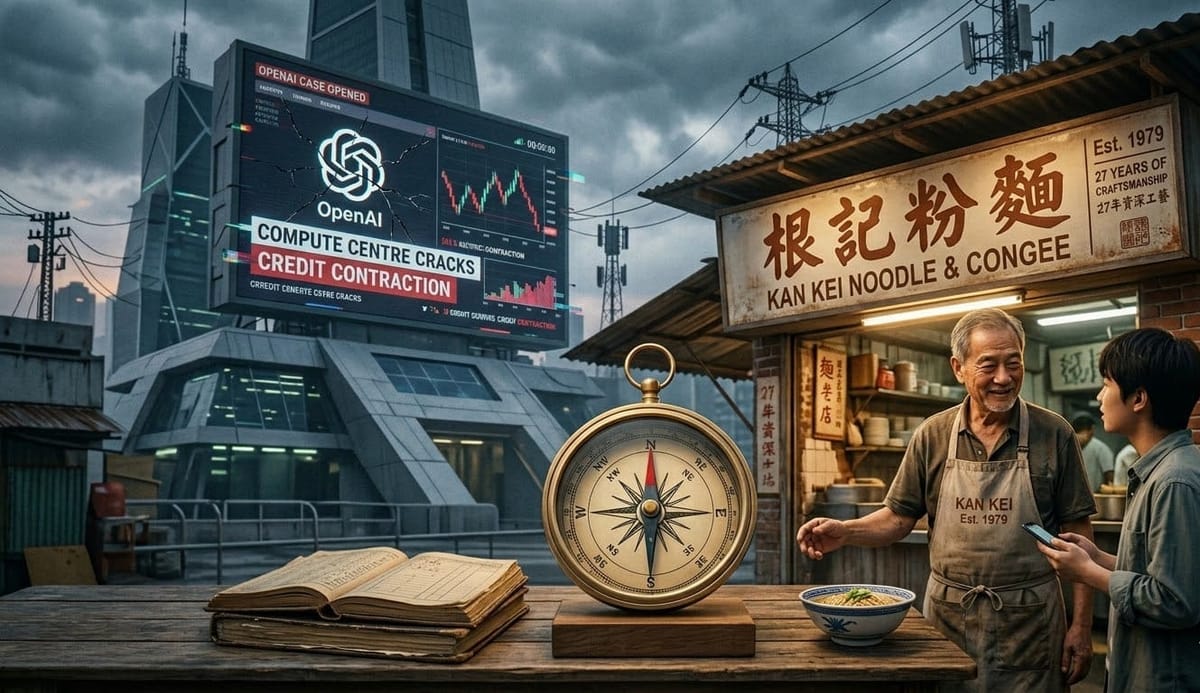
When the centralised compass fails, people don't automatically become explorers. They get lost. Until they discover that the real compass was always there.
Introduction: Three Axes Shaking at Once
In 2026, three seemingly unrelated systems began to crack simultaneously.
The compute centre — OpenAI faces massive litigation, its internal black box about to be forced open. The virtual valuations built on the narrative of "AI disrupting everything" are finally being tested against reality.
The energy centre — US data centres face four to seven years of wait time just to connect to the grid. Rising electricity prices create political pressure. The expansion of compute is being stopped by the oldest infrastructure problem imaginable.
The credit centre — banks no longer care about "growth stories." They ask two questions: what collateral do you have, and what does your historical cash flow look like? The virtual financial bubble is slowly deflating. Physical assets are regaining value.
These three axes reveal the same underlying structure — the fragility of centralised nodes is being exposed, one by one.
When the compass people have relied on begins to fail — they don't automatically become explorers. They become lost, anxious, unsure what they can still believe in.
And yet, some things have always been there.
Time. Cases. Reputation. Trust.
This is the physical credit that becomes the new compass in a decentralised era.
Chapter One: Compute, Energy, Credit — The Chain Reaction
1.1 The Fragility of the Compute Centre
Musk's lawsuit. Collective copyright litigation. The internal conflict with Microsoft. Core team members cashing out and leaving. Supply chain turbulence.
OpenAI isn't facing a single crisis. It's facing pressure from five directions at once.
April 27th. Court opens. Internal emails and financial data will be forced into the public record. The numbers investors have never seen are about to become common knowledge.
This isn't just one company's problem. It's the first time the entire narrative of "AI disrupting everything" is being tested by the real world.
1.2 The Energy Bottleneck
Jensen Huang announced a trillion dollars in orders at GTC. Twenty-eight cities across four continents.
Nobody asked: where does the electricity for all these data centres come from?
The US power grid is ageing. Building a data centre and connecting it to the grid takes four to seven years. Rising electricity costs for ordinary households create political pressure.
The expansion of compute is being blocked by the oldest infrastructure problem on earth.
Compare this to China — cheap electricity stacked with domestic chips, using scale to compensate for individual chip performance. Energy resilience determines the real cost of compute.
1.3 The Contraction of Credit
Banks no longer care about growth potential. They ask two questions: what collateral do you have, and what does your historical cash flow look like?
The era of virtual valuations is ending.
This is the axis that ordinary people feel most directly. Buying a home, paying a mortgage, running a business, managing cash flow — credit contraction affects every household.
The first to feel the pressure are the corner shops, the tradespeople, the families with mortgages.
Chapter Two: The Evolution of Credit — From Memory to Algorithm, and Back Again
Credit is not a modern invention.
It existed from the moment humans began exchanging things.
At first, credit was memory — you owe me a sheep, I remember. You paid on time last time, I trust you. This kind of credit relied on a network of people who knew each other. Limited in range, but real.
Then came currency and receipts. Credit shifted from a bilateral relationship between two people, to trust in a centralised institution. Efficiency increased. But the source of credit moved from real human relationships to a central authority.
Then came banks. A passbook is a "receipt for a receipt." Banks created credit far beyond the value of physical assets. Bubbles accumulated within the system, until the day they collapsed.
Now we are waiting for the next transformation.
Before AGI fully takes over the production line — before society enters UHI (Universal Human Income) — credit contraction will continue to filter out those with real, stable cash flows. Valuations built on "growth stories" will collapse, one by one.
But before that transformation arrives, one form of credit has never disappeared.
Hong Kong. A wet market somewhere in the city.
A noodle shop that has been open since the days before mobile phones.
No website. No Instagram. No Google rating.
But the neighbourhood knows it's there, because someone told them. And that person knew, because someone else told them.
I went back once. It was Chinese New Year. The door was closed — a handwritten sign on the front. The owner had gone back to their hometown to pay respects to their ancestors.
I stood at the door, a little disappointed. But at the same time, I felt something I hadn't expected.
Relief.
This shop has roots.
It isn't a machine. It isn't an algorithm. It's a person who goes home for the new year.
This chain of trust is older than any algorithm.
But it has one fatal weakness — it has never been recorded.
Chapter Three: The Old Establishment — Physical Credit as a Defensive Asset
Thirty years ago, a professional tennis player returned to Melbourne from overseas.
He had a few dozen dollars in his pocket.
He faced two choices — take a factory job, or go to a tennis club as a coach.
He chose the second.
He started with one student. No advertising. No social media. No marketing budget.
Just coaching.
A parent brought their child, saw the results, and told another parent. That parent brought their child, saw the results, and told someone else.
In his third year, he became the head coach of the club.
He stayed in that role for thirty years.
Now he's planning to retire.
People say it's a shame. They say they can't find anyone else like him to teach their children.
That sentence is something no advertisement can buy.
This is the core of physical credit —
Not "will make money in the future," but "has been making it consistently for decades."
Not "the cheapest option," but "worth every dollar."
Not "how many ratings does it have," but "the absence people feel when you're gone."
The moat of an old establishment is time itself.
Time cannot be faked. Every case, every student, every returning client — each one is a brick, laid over thirty years.
Chapter Four: The Trust Lighthouse — What a Website Is Really For
If that tennis coach had a website —
Not an advertising page, but a record —
A record of the students he coached over thirty years, his teaching philosophy, his observations about the different needs of each child —
Then when he retires, those records remain.
The next coach can start from there.
The children he taught grow up, have children of their own, and can still find that record — see what they learned all those years ago.
This is the fundamental difference between a digital business card and a trust lighthouse.
A digital business card is advertising — passive, waiting for people to come.
A trust lighthouse is a record — actively emitting light, providing a stable signal in a sea of chaotic information.
What is the lighthouse's light made of?
Real cases — with photographs, addresses, documented processes.
Craft details — why this approach was taken, why these materials were chosen.
Client stories — the feedback of every client, the background of every project.
Pitfall guides — the mistakes outsiders commonly make, and how to avoid them.
This content cannot be replicated by AI or stolen by competitors.
Because its source is real experience, and time.
Chapter Five: The Dual-Track Power of Content
Turning physical credit into a digital form requires two tracks running simultaneously.
Track One: Pitfall Guides — Building Expertise and Integrity
Not selling yourself. Helping others avoid mistakes.
"Why does waterproofing fail within two years?"
"How do you choose a trustworthy tradesperson?"
"Why is the cheapest quote usually the most expensive in the end?"
The purpose of this content isn't to say "choose me" — it's to say "I understand your problem."
When a client feels understood, trust follows naturally.
Track Two: Case Archive — Documenting Process and Results
Every case shows more than the finished photographs.
It documents the process, the details, the client feedback.
It explains why this wall was removed, why these materials were selected, what problems arose during construction, and how they were resolved.
These details are something AI-generated content can never replicate — because they require real presence.
Both tracks are essential.
The pitfall guide builds trust — the reader believes you understand the industry.
The case archive builds confidence — the reader believes you can execute.
Together, they form the complete trust lighthouse.
Chapter Six: The Time Moat — Turning Time Into Structured Data
Hong Kong. An interior design company with twenty-seven years of history.
Twenty-seven years of projects. Twenty-seven years of clients. Twenty-seven years of reputation.
But most of that twenty-seven years exists only in the owner's memory, in old photographs on a hard drive, in the words of a few long-standing clients.
If the owner retires one day, those twenty-seven years of credit could disappear — just like the Hong Kong noodle shop — into a history that no one ever recorded.
Digitisation is not building a beautiful website.
Digitisation is turning time into something that can be searched, cited, and read by AI.
foundingDate — mark the year the company was established, so Google knows this isn't a new site.
review — collect genuine feedback from long-term clients, marked with Schema for rating and content.
caseStudy — build a dedicated page for each project, marking start date, completion date, client location, and project type.
These are not technical details. They are the digital fingerprint of a time moat.
They tell Google and AI — there is real history here. Real people. Real work.
That is a form of trust that no advertisement can purchase.
Closing: When the Centralised Compass Fails
When the centralised compass — the banks, the platforms, the rating agencies — begins to fail, people don't automatically become explorers.
They get lost. They become afraid. They don't know what they can still believe in.
But eventually, someone notices that what they have always had — time, cases, reputation, trust — is the new compass.
Is that noodle shop in Hong Kong still there?
I don't know.
But I know that this time, when I go back, I'm going to find it.
Not to write an article. Not to take a photograph.
Because someone once told me there's a bowl of noodles there worth waiting for.
And that "someone once told me" —
is everything this entire piece has been trying to say.
Case 33 is the master framework for the Physical Credit series.
Each chapter will be developed independently:
Chapter 01: Three Axes — From Promissory Note to Electricity Bill
Chapter 02: The Other Side of Credit — Where Is Your Anchor?
Chapter 03: The Illusion of the Time Moat: What Kind of Legacy Businesses Still Survive?
Chapter 04: The Root System of Trust — The Basic Survival Formula in the New Era
Chapter 05: Signal and Noise — How Truth Survives in Abundance
Case 33 | 實體信用——去中心化時代的指南針
當中心化的指南針失靈,人們不會自動成為探險家。他們會迷失。直到他們發現,真正的指南針一直在那裡。
引言:三條軸線同時震盪
2026年,三個看似不相關的系統同時出現裂縫。
算力中心——OpenAI面臨鉅額訴訟,內部黑箱即將被強制公開。那些建立在「AI顛覆一切」敘事上的虛擬估值,開始接受真實的檢驗。
能源中心——美國數據中心併網需等待四至七年。民生電價上漲引發政治壓力。算力的擴張,被最古老的基礎設施問題卡住了。
信用中心——銀行不再看重「增長故事」,只關注抵押資產與歷史現金流。虛擬金融泡沫逐漸破裂,實體資產重新獲得重視。
這三條軸線,揭示的是同一個結構——中心化節點的脆弱性正在逐一暴露。
當人們習慣依賴的指南針開始失靈——他們不會自動成為探險家。他們會迷失、焦慮,不知道還能相信什麼。
然而,有些東西一直存在。
時間。案例。口碑。信任。
這些「實體信用」,正是去中心化時代的新指南針。
第一章:算力、能源、信用——三條軸線的連鎖反應
1.1 算力中心的脆弱
馬斯克的訴訟、版權集體訴訟、與微軟的內鬥、核心團隊套現離場、供應鏈動盪——
OpenAI面臨的不是單一危機,而是同時從五個方向施加的壓力。
四月二十七日,法庭開庭。內部郵件與財務數據將被強制公開。那些投資者從未看過的數字,即將成為公開記錄。
這不只是一家公司的問題。這是「以AI顛覆一切」的整個敘事,第一次接受真實世界的檢驗。
1.2 能源中心的瓶頸
黃仁勳在GTC宣布一萬億美元的訂單。二十八個城市,四大洲。
但沒有人問:這些數據中心的電,從哪裡來?
美國電網老化。建設數據中心並併網,等待時間長達四至七年。民生電價上漲,引發政治壓力。
算力的擴張,被最古老的基礎設施問題卡住了。
對比中國——廉價電力疊加國產芯片,用規模彌補單體性能。能源韌性,決定算力的實際成本。
1.3 信用中心的收縮
銀行不再看重「增長潛力」。他們只問兩個問題——你有什麼抵押資產?你的歷史現金流是多少?
虛擬估值的時代正在結束。
這條軸線,是普通人感受最深的一條。買樓、供樓、做生意、資金周轉——信貸收縮直接影響每一戶家庭的生活。
最先感受到壓力的,是街邊店鋪、裝修師傅、普通供樓家庭。
第二章:信用的演化——從記憶到算法,再回到記憶
信用不是現代的發明。
它從人類開始交換東西的那一刻就存在了。
最初,信用是記憶——你欠我一隻羊,我記得。你上次準時還,我信任你。這種信用依靠熟人網絡,範圍有限,但真實。
然後出現了貨幣和收據。信用從雙邊關係,變成對發行機構的信任。效率提升了,但信用的源頭,從真實的人際關係,轉移到了一個中心化的機構。
再後來是銀行。存摺是「收據的收據」。銀行創造出超過實體資產的信用額度。泡沫在其中積累,直到某一天,崩潰。
現在,我們在等待下一個轉變。
AGI全面接手生產線、社會進入UHI(普遍人權收入)之前——信貸收縮會持續篩選出真正具備穩定現金流的實體。那些靠「增長故事」支撐的估值,會一個一個破裂。
但在那個轉變到來之前,有一種信用一直沒有消失。
香港,某個街市。
一家麵店,從沒有手機的年代一直開到現在。
沒有網站,沒有Instagram,沒有Google評分。
但街坊知道它在那裡,因為有人告訴過他們。而那個人,是因為另一個人告訴他的。
我上次回去,碰上過年。門關著,貼著手寫的紙——店家回鄉拜祭。
我站在門口,有點失望。但同時感到一種安心。
這家店,有根。
它不是機器,不是算法。它是一個人,在過年的時候要回家。
這條信任鏈,比任何算法都更古老。
但它有一個致命的弱點——它從來沒有被記錄下來。
第三章:老字號——實體信用的避險資產
三十年前,一個網球職業選手從外地回到墨爾本。
口袋裡只有幾十塊錢。
他面對兩個選擇——去工廠打工,或者去一家球會當網球教練。
他選了第二個。
從一位學生開始。沒有廣告,沒有社交媒體,沒有推廣預算。
只有教學。
家長把孩子帶來,看到結果,告訴另一個家長。那個家長帶著孩子來,看到結果,又告訴另一個家長。
三年後他當上了球會主教練,三十年後,他成了那家球會的主教練,然後一當,就是三十年,家傳戶曉。
現在他打算退休了。
很多人覺得可惜。他們說,找不到另一個像他這樣的人來教自己的孩子。
這句話,是任何廣告都買不到的。
這就是實體信用的核心——
不是「未來會賺錢」,而是「過去一直在賺錢」。
不是「最便宜」,而是「物有所值」。
不是「有多少個評分」,而是「沒有你的時候,人們感受到的那個空缺」。
老字號的護城河,是時間本身。
時間無法造假。每一個案例,每一位學生,每一個回頭客——都是一塊磚,砌了三十年。
第四章:信任燈塔——網站的真正角色
如果那位網球教練有一個網站——
不是廣告頁面,而是記錄——
記錄他三十年教過的學生,他的教學方法,他對每個孩子不同需求的觀察——
那麼當他退休的那一天,那些記錄還在。
下一個教練可以從那裡開始。
那些家長的孩子長大了,有了自己的孩子,還可以找到那個記錄,看看他們當年學到的東西。
這就是信任燈塔和數位名片的根本分別。
數位名片是廣告——被動等待,等人上門。
信任燈塔是記錄——主動發光,在混亂的資訊海洋中提供穩定的訊號。
燈塔的光是什麼?
真實案例——有照片、地址、過程記錄。
工藝細節——為什麼這樣做、為什麼選用這些材料。
客戶故事——每一位客戶的反饋,每一個案例的背景。
避坑指南——外行人常犯的錯誤,以及如何避免。
這些內容,AI無法複製,競爭對手無法偷走。
因為它們的源頭,是真實的經驗和時間。
第五章:內容的雙軌力量
實體信用的數位化,需要兩條軌道同時運行。
第一軌:避坑指南——建立專業與誠信
不是推銷自己,而是幫助別人避開錯誤。
「防水工程為何兩年就漏?」
「如何選擇可信的師傅?」
「為什麼最便宜的報價往往最貴?」
這類內容的目的,不是說「選我」——而是說「我理解你的問題」。
當客戶感受到被理解,信任自然產生。
第二軌:實例相冊——展示過程與成果
每個案例不只展示完工照片。
記錄過程、細節、客戶反饋。
說明為何拆這面牆、為何選用這些材料、施工中遇到什麼問題、如何解決。
這些細節,是AI生成內容永遠無法複製的——因為它們需要真實的在場。
兩條軌道缺一不可。
避坑指南建立信任——讀者相信你懂得這個行業。
實例相冊建立信心——讀者相信你有能力執行。
兩者結合,才是完整的信任燈塔。
第六章:時間護城河——將時間轉化為結構化數據
香港,一家有二十七年歷史的室內設計公司。
二十七年的工程案例。二十七年的客戶。二十七年的口碑。
但這二十七年,大部分只存在於老闆的記憶裡,存在於舊照片的硬碟裡,存在於幾個老客戶的口中。
如果有一天老闆退休了,這二十七年的信用,會跟那家香港麵店一樣——消失在沒有人記錄的歷史裡。
數位化不是建一個漂亮的網站。
數位化是把時間變成可以被搜索、被引用、被AI讀取的結構。
foundingDate——標記公司成立年份,讓Google知道這不是新站。
review——收集老客戶的真實評價,用Schema標記評分與評論內容。
caseStudy——為每個案例建立獨立頁面,標記開始日期、完成日期、客戶位置、工程類型。
這些不是技術細節,而是時間護城河的數位指紋。
它們告訴Google和AI——這裡有真實的歷史,有真實的人,有真實的工作。
這是任何廣告都買不到的信任。
結尾:當中心化指南針失靈
當中心化的指南針——銀行、平台、評級機構——開始失靈,人們不會自動成為探險家。
他們會迷失、會恐懼,不知道還能相信什麼。
但總會有人發現,他們一直擁有的東西——時間、案例、口碑、信任——就是新的指南針。
那家香港麵店,還在嗎?
我不知道。
但我知道,這次回去,我會去找它。
不是為了寫一篇文章,不是為了拍一張照片。
是因為有人告訴過我,那裡有一碗值得等的麵。
而那個「有人告訴過我」——
就是這整篇文章想說的東西。
Case 33是「實體信用」系列的總綱。
後續每一章將獨立深耕——
Chapter 01:三條軸線——從銀票到電費單
Chapter 02:信用的背面——你的錨點在哪裡?
Chapter 03:輕資產的未來生存——AGI 時代的生存公式
Chapter 04:信任的根系——新時代生存的基本公式
Chapter 05:訊號與噪音——真實如何在過剩中倖存