Case 33 | Chapter 02 | The Other Side of Credit — Where Is Your Anchor?

I. When Trust Becomes a Bet
When the economy is good, people have surplus to spend, brands have steady patronage, and credit is trust — you trust the restaurant serves good food, so you go; you trust the florist has fresh flowers, so you buy; you trust the bank is sound, so you deposit.
But when a country tilts its resources toward one or two industries, development becomes unbalanced. In the boom years, the nation’s wealth flowed into property, leaving other sectors drained. Today, those with capital are pouring everything into AI, betting on returns that have not yet arrived.
Credit shifts from I trust you to I bet on you.
First bet: individuals bet on assets.
You borrow to buy a home. The moment you sign, your palms sweat. The paper has your name on it, but you are not sure what you just bought.
You are not buying a house. You are buying a string of data inside the bank’s system. That data means the bank trusts you will pay back over the next thirty years. It does not look at the value of your home. It looks at your job stability, your payment history, whether you are a trustworthy person.
But what the bank lends you is also data. The money in its account is not actually someone else’s savings — it is created from your credit. What it lends you is promise; what you pay back is real.
Every month, you repay not the house, but the interest on that string of data. Thirty years later, you will have paid enough to buy two houses. What you own is the right to use a string of data.
That moment when you sign — are you happy, or are you under pressure?
In the boom years, signing felt like becoming a landowner, an investor, a winner of the era. You knew prices would rise, you knew whatever term you signed would pay off. You were not buying a place to live — you were buying a chance to make money.
In the bust, signing feels like becoming a debtor, a wage slave, someone bound to the system. You do not know what prices will do. You know your time is no longer yours. You know your life is defined by a string of data.
But whether happy or anxious, it is the same paper. What you own is never fully yours. What you gain is the surplus the system extracts from your time.
The other side of credit is not risk. It is you — your joy, your anxiety, your time, your life.
Second bet: capital bets on the future.
You buy AI stocks, listen to the CEO talk about “disrupting the world,” and feel you are part of something momentous. You do not understand the technology they talk about, but you believe. You believe in him, you believe in the system, you believe in that future.
But what he sells is not technology — it is a story. The valuation is not based on what has been done, but on what you believe will be done. What you put in does not buy you dividends — it buys a number that might go up.
The other side of this bet is a bubble. When you win, you think it was your insight. When you lose, you ask: who told me it was worth this?
Third bet: businesses bet on cash flow.
You supply goods to a customer, betting they will pay. They cannot pay because their own customers cannot pay. Delays become routine — not because they do not want to pay, but because they cannot.
You look at the ledger, count how long each one has been overdue. You turn off the light, wondering how to talk to them tomorrow. You know your cash flow depends on the payment capacity of customers further down the chain. You are just one link.
Fourth bet: nations bet on a single industry.
When a nation puts all its chips on property, the property market cracks, the banks crack; the banks crack, businesses cannot collect payments; businesses cannot collect, small firms close; small firms close, consumption contracts; consumption contracts, no one buys AI stocks.
You watch the television as experts talk about “structural adjustment.” You turn it off, because you know the cost of adjustment is tomorrow’s electricity bill.
II. Who Guarantees You?
When you win, you think it was your judgment. When you lose, you ask: who guarantees you?
For individuals — when property prices rise, it was your foresight; when they fall, it was the bank’s failure to warn you.
For capital — when AI valuations climb, it is the founder’s genius; when they fall, it is market conditions, government regulation.
For businesses — when you cannot collect, it is your customer delaying payment; when your supplier demands payment, it is your poor management.
For education — when a student falls behind, the complaint is that the teacher did not provide enough resources. The teacher is brought into a review system, examined point by point: did you provide remote materials? Did you offer catch-up sessions? Did you give extra support? She caught the student, but who catches her?
Shifting responsibility has become the standard answer of this era. Your success is your achievement; your failure is the system failing to catch you.
III. When the System Itself Becomes Unreliable
Banks — credit contracts, rates rise, small businesses fold. You see a restaurant owner washing dishes, waiting tables, working the register. You see them smile at the regulars, then turn to the electricity bill and frown.
Education — teachers buckle under the system and leave. Adam’s wife was a high school math teacher. In the end, she left the stable, well-paid traditional school system to become a private tutor — because the weight of the system was too heavy to carry.
AI — models hallucinate, make up cases, get sanctioned by courts. A lawyer submits briefs generated by AI with citations that do not exist. The judge asks: why did you not check? The lawyer says: I trusted it.
The guarantees the system promised are failing. What you believed in cannot even guarantee itself.
IV. Finding Your Own Anchor
When the banking system’s credit becomes a bet, when AI narratives become bubbles, when education’s promises become burdens, when national development becomes unbalanced — when the upper level of the system begins to crack, what can people at the bottom do?
You cannot change interest rates. You cannot stop AI bubbles. You cannot repair the cracks in education. You cannot reverse national imbalances. But you can do one thing: build your own anchor.
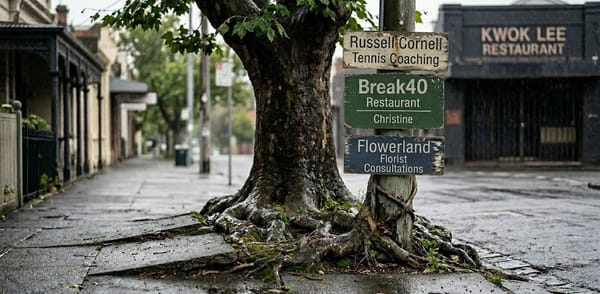
Russell Cornell is one such window.
For thirty years, he has coached tennis at Bulleen Tennis Club in Melbourne’s east. Over those decades, he has watched children learn to hold a racket, then play for their school; seen timid ones who feared the ball grow to love the game; watched withdrawn kids slowly stand straight on the court.
He never thought about how to build trust. He simply showed up every day, remembered each student’s name, their habits, their progress. His trust was not designed — it was lived.
His anchors are thirty years of time, every student’s case, the word-of-mouth among parents, the moment he looks a student in the eye and says you can do it.
He does not need Google ratings — his students speak for him. He does not need social media — parents recommend him. He does not need AI recommendations — his existence itself is the recommendation.
His information does not come from algorithms, but from conversations with neighbours. On the courtside, he talks with parents — learns who just found a job, whose shop needs renovation, whose elder is in hospital. This is his signal library. These conversations are his physical noise.
He is not ignoring the system — he is transcending it. In thirty years, he has proven one thing: once you build your own anchor, you no longer need the system’s algorithms. Your information comes from your neighbours; your trust network is your community.
And Russell is not alone.
In 2026, Generation Z around the world began moving offline.
In the United States, sales of flip phones jumped 340 percent. They are not buying them because they cannot afford an iPhone. They are buying them because they want something that cannot track them. They join digital detox retreats, staying at network‑free lodges that cost five hundred dollars a night — and they are fully booked.
In Europe, they started “digital strikes,” turning off all screens every Sunday. They exchange services through “time banks,” grow vegetables on community farms. They are not farmers. They are people trying to reclaim sovereignty over their lives.
In Asia, they write “Instagram deactivated” in their dating profiles. They collect vinyl records, film cameras, second‑hand books. They go to Wi‑Fi‑free cafés, where the seats are filled with others their age.
They are not going offline because they do not know how to use technology. They are going offline because they want to find their own anchor. They grew up in a world fed by algorithms. They know that their “choices” are really being chosen; their “preferences” are being fed; their “social life” is being watched.
They use flip phones to resist being tracked. They use community farms to resist being harvested. They use face‑to‑face meetings to resist being defined by algorithms.
They are not retro. They are moving beyond. They are not anti‑technology. They are anti‑dependency.
When the upper level of the system begins to crack, people at the bottom can build their own anchors. Russell Cornell did it in thirty years. Generation Z is doing it by going offline. It is the same thing: using time, using cases, using word‑of‑mouth, using trust — using every step to solve each small problem, using conversations with neighbours to gather real information.
Your restaurant, your flower shop, your tennis court, your classroom — every person who sweats in the real world is an anchor. They are small, but they are solid. They are slow, but they are real.
This is the survival strategy for those at the bottom. Russell Cornell is one window. Generation Z going offline is another.
Case 33 | Chapter 2 | 信用的背面——你的錨點在哪裡?
第一節:當信任變成賭注
經濟好的時候,人們有餘糧消費,品牌有持續供養,信用是「信任」——你相信餐廳好吃,所以去;你相信花店新鮮,所以買;你相信銀行穩健,所以存。
但當一個國家將所有資源傾斜在某一兩個產業,發展就會失衡。早年紅利帶動全民財富傾向房地產,其他領域被掏空;現在,全民有資金的都全投在 AI 產業,賭那未來的回報。
信用,由「我信你」變成「我賭你」。
第一層賭注:個人賭資產
你借錢買樓,簽名那一刻,手心出汗。那張紙上有你的名字,但你不知道自己在買什麼。
你買的,不是那間房子。你買的,是銀行系統裡的一串數據。這串數據,代表它相信你未來三十年會還得起。它不看你的房子值多少,它看你的工作穩不穩定,看你過去有沒有遲交款,看你是否一個「可信」的人。
但它借給你的,也是數據。它的帳戶裡那筆錢,不是真的有人存了那麼多,而是它用你的「信用」創造出來的。它借給你的,是「信用」;你還給它的,是「真實」。
你每個月供樓,供的不是那間房子,而是它借給你的那串數據的利息。三十年後,你還的錢,夠買兩間房子。而你,只得到一串數據的使用權。
簽名那一刻,你是快樂,還是壓力?
紅利期,你簽名那一刻,覺得自己是「地主」,是「投資者」,是「時代的贏家」。你知道房價會升,你知道簽多少年都抵得回來,你知道你不是買一個歸宿,而是買一個「賺錢的機會」。
崩潰期,你簽名那一刻,覺得自己是「奴隸」,是「負債者」,是「被系統綁住的人」。你不知道房價會怎樣,你知道你的時間已經不是你的,你知道你的生活,是由一串數據定義的。
但無論你快樂還是壓力,你簽的都是同一張紙。你擁有的,都是「不完全屬於你的歸宿」。你賺的,都是「系統用你的時間換出來的紅利」。
信用的背面,不是風險,而是「你」——你的快樂、你的壓力、你的時間、你的生活。
第二層賭注:資本賭未來
你買 AI 概念股,聽著 CEO 講「顛覆世界」,覺得自己是時代的一部分。你連他講的技術都不懂,但你相信。因為你相信他,你相信這個系統,你相信那個未來。
但他賣給你的,不是技術,而是「敘事」。他的估值,不是建立在「他做到了什麼」,而是建立在「你相信他會做到什麼」。你的錢,換來的不是分紅,而是一個「可能會升值」的數字。
賭注的背面,是「泡沫」。賺的時候,你覺得自己眼光獨到;賠的時候,你問:誰告訴我它值這個價?
第三層賭注:生意賭現金流
你送貨給人,是賭他會付錢。他付不出來,是因為他的下游付不出來。拖欠成為常態,不是「不想付」,而是「付不出」。
你對著那本帳簿,數著誰拖了多久。你關了燈,想著明天怎麼跟客戶說。你知道,你的現金流,是建立在最下游的還款能力上。而你,只是這條鏈的其中一環。
第四層賭注:國家賭單一產業
當一個國家將所有資源押在房地產,樓市崩,銀行崩;銀行崩,B2B 收不到錢;B2B 收不到錢,中小企業倒閉;中小企業倒閉,消費萎縮;消費萎縮,連 AI 股都沒人買。
你看著電視,專家講「結構性調整」。你關了機,因為你知道,調整的代價,是你明天的電費單。
第二節:誰在替你擔保?
賺的時候,你覺得自己眼光獨到;賠的時候,你問:誰在替我擔保?
個人層面:你買樓賺了,是你眼光好;虧了,是銀行沒提醒風險。
資本層面:AI 公司賺了,是創辦人英明;虧了,是市場環境差、政府監管不力。
生意層面:你送貨收不到錢,是下游拖欠;你被上游追款,是你管理不善。
教育層面:學生跟不上,投訴老師沒提供足夠資源。老師被帶入檢討系統,逐項審視:有沒有提供遠端資源?有沒有補課機制?有沒有額外的學習支持?她接住了學生,但誰接住了她?
責任外推,是這個時代的「標準答案」。你的成功,是你厲害;你的失敗,是系統沒有接住你。
第三節:當系統不再可信
銀行:信貸中斷,加息壓力,中小企業倒閉潮。你看見一間餐廳,老闆自己洗碗、自己樓面、自己收銀。你看見他對著熟客笑,但轉頭看著那張電費單,皺眉。
教育:老師被制度壓垮,離開學校。亞當的妻子是中學數學老師,正因為這樣的制度壓力與責任,最後離開了高薪穩定的傳統學校體系,轉職成全職家教。
AI:模型亂講,幻覺頻生,被法院制裁。律師用 AI 提交假案例,法官質問:你為什麼不檢查?律師說:我信它。
系統承諾的擔保,開始失效。你相信的東西,自己都自身難保。
第四節:找回自己的錨點
當銀行的信用變成賭注,當 AI 的敘事變成泡沫,當教育的承諾變成負擔,當國家的發展變成失衡——上層的系統開始裂開,下層的人,怎麼辦?
你無法改變銀行的利率,無法阻止 AI 的泡沫,無法修補教育的裂縫,無法扭轉國家的失衡。但你可以做一件事:建立自己的「錨點」。
而 Russell Cornell,就是一個「窗口」。
他在 Melbourne 東區的 Bulleen Tennis Club,教了三十年球。三十年,他見過無數個學生——有些由不懂握拍,到代表學校比賽;有些由害怕球,到喜歡這項運動;有些由蜷縮一團,到站直身體。
他沒有想過「怎樣建立信任」。他只是每天準時到球場,記住每個學生的名字,記住他們的習慣,記住他們的進步。他的信任,不是「設計」出來的,而是「走」出來的。
他的「錨點」,是三十年的時間、是每一個學生的案例、是家長之間的口碑、是他對著學生說「你可以的」那一刻的真實。
他不需要 Google 評分,因為他的學生會幫他傳。他不需要社交媒體,因為他的家長會幫他講。他不需要 AI 推薦,因為他的存在本身就是推薦。
他的資訊來源,不是演算法,而是 「街坊鄰里的接觸對話」。他在球場邊與家長聊天,知道誰最近找到工作、誰的店鋪要裝修、誰的長輩進了醫院。這些資訊,是他的「真實訊號庫」;這些對話,是他的「物理噪聲」。
他不是「無視」系統,而是 「超越」 系統。他用三十年,證明了一件事:當你建立自己的「錨點」,你就不需要再依賴系統的演算法,也可以無視系統的依賴。你的資訊來源,就是你的街坊;你的信任網絡,就是你的社區。
而 Russell,不是唯一的例子。
2026 年,全球 Z 世代開始集體 offline。
在美國,翻蓋手機的銷量增長了百分之三百四十。他們不是買不起 iPhone,而是想買一個「不會被追蹤」的自由。他們參加數位排毒營,入住沒有網絡的度假村,每晚收費五百美元,依然一位難求。
在歐洲,他們發起「數位罷工」,每週日關閉所有電子設備。他們用「時間銀行」交換服務,用社區農場種植自己的食物。他們不是農夫,而是想找回生活主權的人。
在亞洲,他們在交友應用程式上標註「IG 已停用」。他們收集黑膠唱片、底片相機、二手書。他們去沒有 Wi-Fi 的咖啡館,裡面坐滿的,都是 Z 世代。
他們 offline,不是因為不懂科技,而是因為想找回自己的「錨點」。他們從小活在演算法餵養的世界裡,他們知道,自己的「選擇」其實是「被選擇」;自己的「喜歡」其實是「被餵養」;自己的「社交」其實是「被監控」。
他們用翻蓋手機對抗被追蹤,用社區農場對抗被收割,用面對面見面對抗被演算法定義。
他們不是「復古」,而是「超越」。他們不是「反科技」,而是「反依賴」。
當上層的系統開始裂開,下層的人,可以自己建立「錨點」。Russell 用了三十年,Z 世代用 offline——本質都是同一件事:用時間、用案例、用口碑、用信任,用每一步去尋找每個小問題的解法,用街坊對話去收集真實的資訊。
你的餐廳,你的花店,你的球場,你的教室——每一個真實流汗的人,都是一個「錨點」。他們微小,但他們實在。他們緩慢,但他們真實。
這就是下位者的生存方案。Russell Cornell 是一個窗口,Z 世代的 offline 熱潮,是另一個窗口。