Case 32 | The Aftereffects of a Sugar-Coated Education — Why Generation Z's Struggles Are Not Their Fault
I. Opening
You are not useless.
You are not lazy. Not fragile. Not failing to try hard enough.
You were raised by a broken system.
This is not here to comfort you.
Comfort doesn't fix structural problems.
This is here to show you where your struggles actually come from.
Because you can only begin to calibrate when you know where the root is.
II. The Sugar-Coated Education
From the first day you walked into school, the system was telling you one thing——
You're doing great. You're on the right track. Well done. Good try.
Even when you got it wrong. Even when you fell short. The response was still affirmation.
Nobody told you specifically what went wrong.
Nobody told you how to do it better.
Nobody let you sit with failure long enough to actually learn from it.
Because the system was afraid of hurting you.
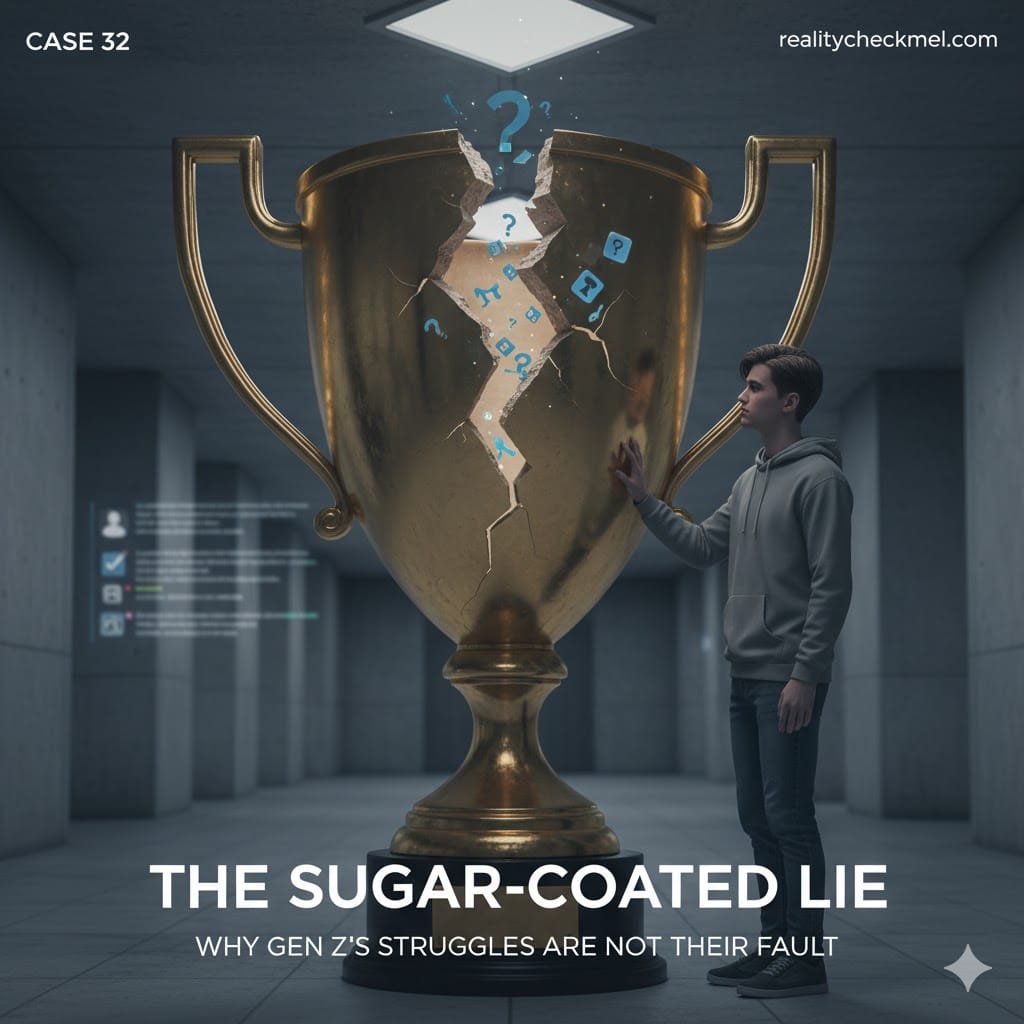
So instead, it gave you a kind of confidence — confidence built on ground with no roots.
It looked solid. Until the first real impact arrived.
Then it shattered.
III. The Information That Was Always Distorted
The school gave you one layer of sugar-coating.
The internet gave you another.
On social media, everyone is succeeding. Everyone has found their path. Everyone's life looks better than yours.
You thought you knew what the world looked like.
But what you knew was what other people chose to show you.
The information gap was always there——
How many failures behind every success story were never recorded?
How much struggle behind every confident post was never shared?
How much luck behind every "I made it" was never acknowledged?
What people can profit from, they keep for themselves first.
What they let you see is only the part they're willing to share.
You were navigating with an incomplete map.
Then you wondered why you kept getting lost.
IV. A System Already Full
You grew up. You stepped into the real world.
And found that nothing matched what you had in your head.
Work wasn't what you imagined.
Opportunities weren't as available as you assumed.
Effort didn't always produce results — not because the effort wasn't enough, but because the space was already taken.
When the previous generations were building their lives, the system still had room.
By the time you arrived, the room was nearly gone.
The paths you could choose were getting fewer. Getting narrower.
You tried to find a second direction, only to discover that outside of the one thing you knew, you'd have to start from scratch.
And by the time you finished starting from scratch, the rules might have changed again.
Because AGI hasn't fully arrived yet. But it's already rewriting the conditions.
Is that laziness?
Or is that clarity?
V. The Debt Passed Down
And then — the people who created this situation started telling you that you weren't trying hard enough.
When they bought homes, prices were three times the average salary.
When you try to buy, it's ten times or more.
When they entered the workforce, a degree was rare.
When you enter, a degree is standard — and still not enough.
When they were building wealth, the system was expanding.
When you arrived, it was already contracting.
But they use the standards of their era to judge a completely different set of circumstances.
They call you lazy. Tell you their generation worked harder. Tell you things were harder in their day.
They don't mean harm.
They're just applying a narrow set of experiences to a world they're no longer living in.
But the direction was already wrong.
VI. The Root
All of it — the lostness, the emptiness, the anxiety, the not knowing who you are, the sense that nothing you do matters——
Comes from one root.
Nobody ever taught you how to face real failure.
Not because you weren't capable.
Because the system never gave you the chance to learn.
Sugar-coated education taught you that failure was abnormal.
Distorted information taught you that other people didn't fail.
A saturated system made the cost of failure feel unbearable.
Inherited debt made failure feel like your personal fault.
So the first time you truly failed at something that mattered——
You didn't learn from it.
You collapsed.
Because nobody told you that failure is normal.
That failure is information.
That failure is where calibration begins.
VII. The Way Out
This isn't here to give you answers.
Because the answers can only come from you.
But one thing can start now——
Stop measuring yourself against the standards of a broken system.
The system told you to succeed. But it never defined what success looks like for you specifically.
The system told you to have direction. But it never told you that direction is found through action, not imagination.
The system told you to be confident. But the confidence it gave you was built on sand.
Real calibration begins with admitting these three things——
"I don't know."
"I failed."
"I need to start again."
These are not signs of weakness.
They are the first time you speak in your own voice.
If you want to go deeper — to understand the structure behind these struggles and use AI to begin your own calibration——
→ [Reality Check Track 2 — Generation Z Reality Calibration Framework]
Alt Text: A fractured mirror reflecting a young person's face — symbolising the distorted self-image created by sugar-coated education and filtered social media.
Case 32 | 糖衣教育的後遺症——為什麼Z世代的困境不是他們的錯
一、開門
你不是廢的。
你不是懶。不是脆弱。不是不夠努力。
你只是被一個壞掉的系統養大的。
這篇不是來安慰你的。
安慰解決不了結構性問題。
這篇是來告訴你,你現在感受到的困境,從哪裡來的。
因為只有知道根在哪裡,才能開始校準。
二、糖衣教育
從你第一天踏進學校開始,系統就在告訴你一件事——
你很好。你做得對。Well done. Good try.
就算做錯了,就算做得差,換來的還是一句肯定。
沒有人告訴你錯在哪裡。
沒有人告訴你怎樣做才會更好。
沒有人讓你在失敗裡停留足夠長的時間,讓你真正理解那個失敗。
因為系統害怕你受傷。
於是系統給了你一種自信——一種建立在沒有根的土地上的自信。
看起來很穩,直到第一次真實的衝擊來臨。
然後它一碰就碎。
三、資訊失真
學校給了你糖衣。
網路給了你另一種糖衣。
社交平台上,每個人都在成功。每個人都找到了方向。每個人的生活都比你的好看。
你以為你知道世界是什麼樣子。
但你知道的,是人家想讓你看到的。
訊息差一直都在——
你看到的成功,背後有多少失敗從來沒有被記錄?
你看到的自信,背後有多少掙扎從來沒有被分享?
你看到的方向,背後有多少運氣從來沒有被承認?
人家能賺的,都是先留給自己的。
能讓你看到的,只是他們願意分享的那一部分。
你用一個不完整的地圖,試圖找到自己的路。
然後發現怎麼走都不對。
四、系統飽和
你長大了,走進了現實世界。
然後發現——
腦子裡以為的,跟眼前的完全不一樣。
工作不是你想的那樣。
機會不是你以為的那麼多。
努力不一定有回報——不是因為努力不夠,是因為位置已經滿了。
上一代吃盡紅利的時候,系統還有空間。
你進來的時候,空間已經快用完了。
能選的路越來越少,越來越窄。
你想找第二個方向,發現自己除了本來那一樣,什麼都不懂,還要重新開始學。
而且學完之後,不知道那條路還在不在。
因為AGI還沒有完全進場,但已經開始改變規則了。
這是懶?
還是清醒?
五、世代轉嫁
更諷刺的是——
造成這個局面的人,現在在說你不努力。
他們買房的時候,房價是年薪的三倍。
你買房的時候,是十倍以上。
他們找工作的時候,大學學歷是稀缺的。
你找工作的時候,大學學歷是標配,還不夠用。
他們積累財富的時候,系統在擴張。
你進場的時候,系統已經在收縮。
但他們用自己時代的標準,評判一個完全不同的處境。
說你懶。說你不夠努力。說他們那個年代怎樣怎樣。
他們沒有惡意。
他們只是用自己狹窄的經歷,去理解一個他們已經不再身處其中的世界。
但方向已經錯了。
六、根源
所有這些問題——
迷失、空虛、焦慮、不知道自己是誰、做什麼都感覺沒有意義——
背後只有一個根。
從來沒有人教你怎麼面對真實的失敗。
不是因為你不夠好。
是因為系統從來沒有給你機會學。
糖衣教育讓你以為失敗是異常的。
資訊失真讓你以為別人都沒有失敗過。
系統飽和讓失敗的代價變得更高。
世代轉嫁讓你以為失敗是你的錯。
於是你第一次真正失敗的時候——
不是學到了什麼,而是垮掉了。
因為沒有人告訴你,失敗是正常的。
失敗是信息。
失敗是校準的起點。
七、出口
這篇不是來給你答案的。
因為答案只能你自己找。
但有一件事可以從現在開始——
停止用一個壞掉的系統的標準,來評判自己。
系統告訴你要成功。但它從來沒有定義過,什麼是屬於你的成功。
系統告訴你要有方向。但它從來沒有告訴你,方向是在行動裡找到的,不是在想象裡找到的。
系統告訴你要自信。但它給你的自信,是建立在沙上的。
真正的校準,從承認這些開始——
「我不知道。」
「我失敗了。」
「我需要重新開始。」
這三句話,不是軟弱。
是你第一次用真實的聲音說話。
如果你想更深入理解這些問題的結構,和用AI幫你開始校準的方法——
→ [Reality Check Track 2 — Z世代現實校準框架]