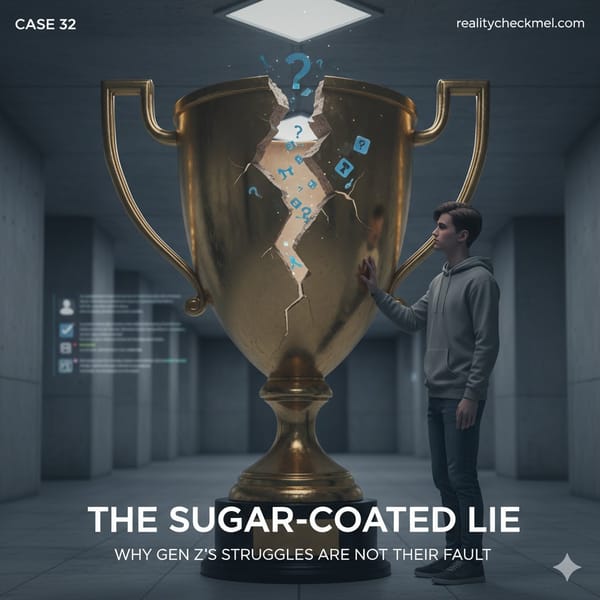
Case 31 | The Edited Generation: Generation Z and the Structural Trap
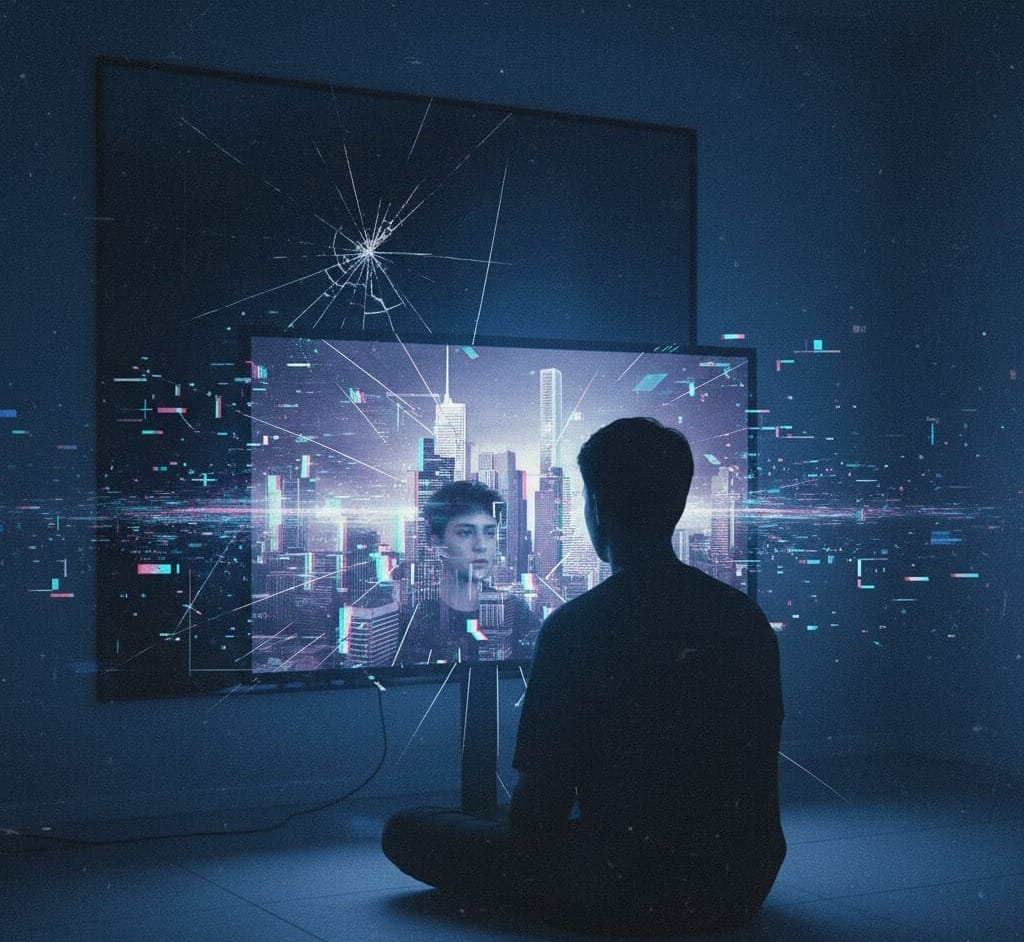
I. Who Raised Them
We talk about Generation Z often — saying they're addicted to their phones, socially withdrawn, living in virtual worlds.
But rarely does anyone ask: who was there when they were growing up?
Generation X and Y were squeezed dry by society. Work, mortgages, the pressure of keeping life together — every last bit of energy accounted for. Time with their children was quietly reduced, compressed, sacrificed.
So something else filled that space.
Electronic devices.
Some said it was fine — a learning tool, a way to build knowledge. Some said early exposure to technology was an advantage in the world to come. Both things are true.
But there was one thing no one said:
When a child grows up with a screen as their primary companion, what does their understanding of "real" become?
II. The Fed Generation
Generation Z are the first true digital natives.
Not because they chose this world — but because this was simply the world they were born into. The internet existed for as long as they can remember. Social media is not a new thing. It is just daily life.
They never experienced the era when information asymmetry was an advantage.
They only know information overload.
Their way of understanding the world was fed to them.
Open TikTok — a knowledge point every fifteen seconds. Open Instagram — one reel after another. It feels productive. But ask what they remember an hour later, and the answer is often: not much.
They chase answers and outcomes, and often skip over reasons and process.
Have you noticed — always wanting to arrive without the journey? Wanting results before understanding the foundation. Wanting answers before understanding the question.
Like building a structure without laying the base. Of course it doesn't hold.
III. The World They See Has Been Edited
On social media, everyone is succeeding.
Influencers with millions of followers. Authors with novels turned into films. Experts on the news every week. Motivational stories telling you: with enough effort, anyone can make it.
They believed it. Because from the beginning, that's what the feed said.
But the feed never showed the other side.
During World War II, analysts studied the aircraft returning from combat missions. The wings and fuselage were riddled with bullet holes. The prevailing view was that these areas were most vulnerable and should be reinforced.
But one analyst saw it differently.
You are only looking at the planes that made it back. The truly fatal damage is in the areas with no bullet holes — because the planes that were hit there never returned.
Social media is those returning aircraft.
You see the influencer who succeeded. You don't see the ninety percent who tried and disappeared. You see the author who became famous. You don't see the equally talented writers no one ever heard of. You see the world's top analysts. You don't see the ones who worked just as hard and ranked nowhere.
Two people. Same effort. Completely different outcomes.
Like a lottery — you see the winner. You never see the millions who didn't win.
Ever wonder why?
It's not that success doesn't exist. It's that behind every success are things you cannot see: foundations built over years, timing, circumstance, and often, plain luck.
The feed doesn't show you any of that. The feed only shows you the result.
IV. Knowing Too Much, Doing Too Little
Information overload doesn't produce stronger judgment. It produces more hesitation.
Because they can't tell what's real, they're afraid to choose. Because they're afraid to choose wrong, they overthink. And the more they think, the less they move.
But real growth has never come from thinking. It comes from trying.
Trial and error is the only path to learning. But because they're afraid of being wrong — afraid that one mistake means falling permanently behind — they don't try. Without trying, there's no feedback. Without feedback, there's no way to calibrate.
The result: the more they think, the less they do.
And the cost of not moving is always greater than the cost of getting it wrong.
V. The Difference Between Z and Y
Generation Y were the trial-and-error generation.
Less information — so they had to find things themselves. Unclear paths — so they had to try. Wrong turns corrected over time, slowly finding what worked.
Generation Z are the fed-and-calibrated generation.
More information than they can process — but no framework to filter it. More directions than they can count — but no compass to choose. Seen everything — but afraid to act.
Generation Y's trap: no time to learn.
Generation Z's trap: no sense of direction.
VI. What They Actually Need
Not another success formula from the feed.
Not more information, faster methods, or better tools.
Because they already have too much of all of that.
So much that they don't know where to start. So much that finishing a video leaves them more lost than before. So much that sometimes closing the phone feels like the first real breath of the day.
If you've felt that — that moment of relief when the screen goes dark —
That's not a problem with you. That's a signal.
Your system is telling you: I need something real.
What does something real look like?
Not perfect. Not edited. Not filtered.
A meal you don't photograph.
A conversation you don't turn into a caption.
A failure you don't reframe as a "growth moment."
A person, in front of you, not performing.
The feed cannot give you any of this.
But you already know what it feels like — because every time you've had even a few minutes of it, you remember.
That feeling is called: real.
You don't need to leave this world.
You don't need to throw away your phone and move to the mountains.
You just need an anchor —
One thing, one person, one place, that reminds you what real feels like.
With an anchor, you can measure everything else against it.
With an anchor, you can decide what to believe when the algorithm pushes something your way.
With an anchor, you stop drifting — and start knowing where you are.
No one can give you this anchor.
But someone can help you find it.
Not by giving you the answer. By helping you ask the question you've never asked yourself:
"In everything I've been shown — what do I actually believe?"
VII. Closing
Every era. Every generation. Their own way of growing, their own rhythm of living.
No one can give you the answer.
What you need is to find it yourself — a path that fits your shape, an anchor you can trust.
What Reality Check can offer is a framework.
The road, you still have to walk yourself.
Case 31 | 被剪輯過的一代:Z世代的結構性困境
一、誰在陪他們長大
我們常常討論Z世代——說他們沉迷手機、不善交際、活在虛擬世界。
但很少人問:陪他們長大的,是誰?
X世代和Y世代,被社會擠壓得沒有時間。工作、供樓、生活壓力,已經用盡每一分精力。陪伴孩子的時間,不知不覺被削減、被壓縮、被犧牲。
於是填補那個空位的,成了電子產品。
有人說,這是學習工具,可以增長知識。有人說,未來世界離不開科技,早點接觸是好事。這些話都對。但有一件事,沒有人說:
當一個孩子從小便與屏幕為伴,他對「真實」的認知,會變成什麼樣子?
二、被餵食的一代
Z世代是第一批「數字原生」的人。
不是他們選擇了這個世界,而是這個世界本來就是這樣。互聯網從他們有記憶起就在那裡,社交媒體是日常,不是新事物。他們沒有經歷過「訊息差即優勢」的時代,只有「資訊過載」的日常。
他們的認知模式,是被餵食出來的。
打開TikTok,15秒一個知識點。打開IG,reels一個接一個。看完好像很充實,但問記住了什麼?說不出。
他們追求答案和結果,卻常常忽略原因和過程。
有沒有發現,自己總想一步到位?未了解基礎,就想生成結果。未搞清原因,就想拿到答案。就像蓋樓沒打地基,直接想砌上蓋——當然不穩。
三、他們看到的,是被剪輯過的世界
社交媒體上,每個人都在成功。
網紅幾百萬粉絲,作家小說改編電影,專家天天上新聞,勵志故事告訴你:只要努力,誰都可以。
他們相信。因為從小到大,feed就是這樣說的。
但feed不會告訴你另一面。
二戰時期,有學者研究返航的戰機。機翼和機身佈滿彈孔,主流意見認為這些部位最脆弱,應該加固。
但一位分析員提出相反的觀點:
你看到的,是能夠回來的飛機。真正致命的地方,是那些沒有彈孔的部位——因為被打中的,已經回不來了。
今天的社交媒體,就是那些「返航的戰機」。
你看到成功的網紅,看不到那90%失敗的人。你看到成名的作家,看不到水平相近卻默默無聞的人。你看到世界第一的分析,看不到排名靠後但同樣付出的人。
兩個人做同一件事,可能出現完全不同的結果。就像買彩票——你看到有人中獎,卻看不到背後那幾百萬個沒中的人。
有想過為什麼嗎?
不是沒有成功案例,而是成功背後有太多看不見的東西:基礎、過程、時機、際遇、甚至純粹的運氣。
但feed不會告訴你這些。feed只展示結果。
四、知道太多,反而不敢動
資訊過載帶來的,不是更強的判断力,而是更多的遲疑。
因為分不清真假,所以不敢選擇。因為怕選錯,所以想得太多。想得太多,就沒有時間去做。
而真正讓人成長的,從來都不是「想」,而是「試」。
試錯,是學習的唯一路徑。但因為害怕犯錯,因為怕輸了就追不回來,所以不敢試。不試,就沒有反饋。沒有反饋,就永遠無法校准自己。
結果是:想得愈多,動得愈少。
而不敢動的代價,其實比做錯更大。
五、他們和Y世代的分別
Y世代是「試錯校準」的一代。
資訊少,要自己找;路不明,要自己試;錯了再調,慢慢摸索出適合自己的方向。
Z世代是「被餵食校準」的一代。
資訊多,卻不知如何過濾;方向多,卻不知如何選擇;看了很多,卻不敢行動。
Y世代的困境是:沒有時間學。
Z世代的困境是:沒有方向感。
六、他們真正需要的
不是feed裡面的「成功公式」。
不是更多資訊、更快的方法、更神的工具。
因為這些東西,他們已經有太多了。
多到不知道從哪裡開始。多到看完之後更迷茫。多到有時候關掉手機,反而感覺輕鬆一點。
如果你有過這種感覺——關掉手機之後突然呼吸順了——
那不是你的問題。那是訊號。
你的系統在告訴你:我需要一些真實的東西。
真實的東西長什麼樣子?
不是完美的。不是被剪輯過的。不是帶著濾鏡的。
是一頓飯,不需要拍照。
是一段對話,不需要總結成金句。
是一次失敗,不需要包裝成「成長經歷」。
是一個人,在你面前,不表演。
這些東西,feed給不了。
但你其實已經知道它們的存在——
因為每次你真正經歷過一次,哪怕只是短短幾分鐘,你都記得那個感覺。
那個感覺叫做:真實。
你不需要離開這個世界。
你不需要扔掉手機,搬去山裡住。
你只需要一個錨點——
一件事、一個人、一個地方,讓你知道什麼是真實的。
有了錨點,你才能判斷其他東西是不是真的。
有了錨點,演算法推給你什麼,你才能選擇相信還是不相信。
有了錨點,你才不會在資訊的海裡漂流,不知道自己在哪裡。
這個錨點,沒有人能給你。
但有人可以幫你找到它。
不是告訴你答案,而是幫你問出那個你一直沒有問過自己的問題——
「在所有被剪輯過的東西裡,什麼是我真正相信的?」
七、結尾
每個時代、每個世代,都有屬於自己的成長方式和生命節奏。
沒有人能給你答案。
你需要的,是自己去尋找——找一條適合自己的路,找一個可以相信的錨點。
Reality Check能給你的,只是一個框架。
路,始終要你自己走。