Case 26 | Structural Arbitrage in Foundational Technologies
(Entry-Level)
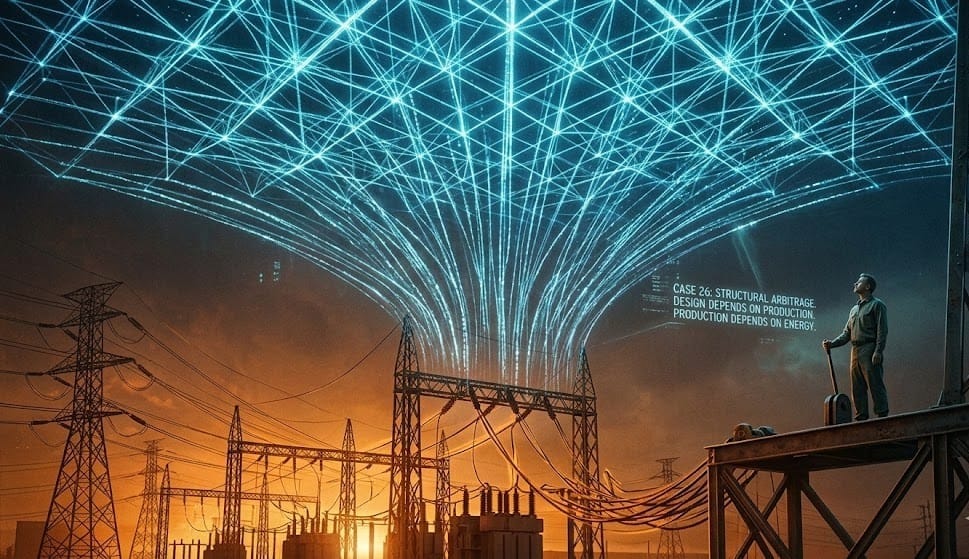
When design depends on production, and production depends on energy, who truly holds the reins?
Two Parallel Realities
In early 2026, two different trajectories were rising simultaneously.
One came from global strategic research, which divided technologies into four categories:
Stacked: semiconductor design, large AI models
Precision: high-end manufacturing equipment
Production: rare earth processing, steel
Foundational: energy, minerals, logistics infrastructure
The report noted that the U.S. held advantages in design and manufacturing, but production and foundational technologies were highly dependent on China.
The other came from internal AI industry data: token consumption for large models surged, yet energy usage rose accordingly. Physical constraints mean that no matter how much computing power is added, bottlenecks remain.
The issue is not who is stronger—it is about dependency chains: design relies on production, and production relies on energy. Which nodes are truly irreplaceable?
Technology as Dependency, Not Competition
Technologies can be seen as two paths:
- Gravity-type capital: design and precision manufacturing. Locked in by patents, scale, and ecosystems. Excellent at expansion but dependent downstream.
- Node/system-type capital: production and energy. Dependent on geography, energy costs, and policy. Hard to replicate, forming the stable foundation of the system.
While attention focuses on breakthroughs in design, energy and logistics quietly set the ceiling.
Compute Can Grow Exponentially, Energy Cannot
Large models can expand geometrically, but energy supply is finite. Any surge in compute demand is constrained by energy costs.
This is what is called “energy entropy”—the more complex a system, the more energy it consumes just to maintain itself, compressing the remaining capacity.
The question isn’t whether AI progresses—it’s:
who can bear the energy pressure, and who gains the next round of pricing power?
The True Arbitrage Window Lies at the Base
Most focus on design, chips, and model performance, but structural bottlenecks appear in energy, minerals, transport, and policy constraints.
When foundational technologies become the bottleneck, power and pricing reorder themselves. This is not a crisis—it is a structural arbitrage opportunity: by positioning yourself at the base, you retain decision-making power rather than being pushed around.
From Geopolitics to Personal Capital Architecture
Structural arbitrage is not only a national-level concern—it is personal. You can choose:
- The gravity path: rapid expansion and high consumption
- The node path: control dependencies and maintain stability
- Or be the parasitic type, taxed by the system
As the global tech ecosystem tilts toward foundational technologies, the defensive value of node-type strategies rises. This is not retreat—it is retaining the right to act.
Stability Is Not the End, But Flexibility
Many equate seeking stability with conservatism, but stability is a choice option.
Apple rarely exhausts resources to be first. It usually waits for technology to mature, supply chains to stabilize, and costs to be under control before taking decisive action.
This is not slowness—it is delayed gravity release.
Running a restaurant is similar: when rent, supply, and energy costs are manageable, you have the capacity to act strategically when the market misaligns.
Stability is not defense—it is delayed offense.
Why Choose Energy Instinctively
Choosing energy over models is not about chasing windfall profits—it is about sustainable structures:
- Stable supply
- Controllable costs
- Manageable dependency chains
- Predictable cash flow
When the world obsesses over compute, energy represents constraints. Those who master constraints maintain initiative in a highly volatile world.
Conclusion
When everyone focuses on design breakthroughs, real stability comes from the bottom of the dependency chain.
Design depends on production. Production depends on energy. Energy depends on geography and policy.
The core of Case 26 is not investment advice. It is a reminder: under a gravity-type narrative, foundational nodes are quietly rising in value. True structural arbitrage means standing on top of constraints, rather than being pushed around by them.
case 26 :基礎型技術的結構性套利 (入門版)
當設計依賴生產,生產依賴能源,誰才真正掌握主導權?
2026 年初,兩條不同的現實曲線同時上升。
一邊來自全球戰略研究,將技術拆分為四類:
- 堆疊型:半導體設計、大模型
- 精密型:高端製造設備
- 生產型:稀土加工、鋼鐵
- 基礎型:能源、礦產、物流基礎設施
報告指出,美國在設計和製造層面佔優,但生產與基礎技術高度依賴中國。
另一邊來自 AI 行業內部數據:大模型的 Token 消耗量暴增,但能源消耗也隨之飆升,物理限制讓算力再怎麼提升,也會遇到瓶頸。
這不是誰更強的問題,而是依賴鏈的問題:設計依賴生產,生產依賴能源。真正不可替代的節點在哪?
技術不是競爭,而是依賴鏈
可以把技術分為兩類路線:
- 重力型資本:設計、精密製造。靠專利、規模和生態鎖定市場。擅長膨脹,但依賴下游。
- 節點型 / 系統型:生產、能源。靠地理位置、能源成本和政策支持。難以複製,是系統底層的穩定力量。
當大家都盯著設計突破時,能源和物流悄悄決定天花板。
算力可以指數增長,能源不能
大模型可以指數級成長,但能源供應有限,任何算力需求暴增都會被能源成本壓制。
這就是所謂的「能源熵」——系統越複雜,維持自身運作需要消耗越多能量,剩餘空間被壓縮。
問題不在於 AI 是否進步,而在於:誰能承受能源壓力,誰就掌握下一輪定價權。
真正的套利窗口在底層
大多數人關注的是設計、晶片和模型性能,但結構性短板往往出現在能源、礦產、運輸和政策約束。
當基礎型技術成為瓶頸,價格和權力會重新排序。
這不是危機,而是 結構性套利的機會:選擇站在底層,就能保留決策權,而不是被推著走。
從地緣政治到個人選擇
結構性套利不只是國家層面的事,也是個人的事。
你可以選擇:
- 高速擴張、高消耗的重力型路線
- 控制依賴、維持穩定的節點型路線
- 或成為被系統抽稅的寄生型
當全球技術生態向基礎型傾斜,節點型策略的防禦價值會上升。這不是退縮,而是 保留出手權。
穩定不是終點,而是彈性
很多人將求穩理解為保守,但穩定其實是一種選擇權。
就像 Apple 不會第一時間耗盡資源去爭先,它通常等技術成熟、供應鏈穩定、成本可控,然後才重手入場。
這不是慢,而是延遲釋放重力。
經營餐廳也是如此:當租金、供應和能源成本都在可控範圍,你才有餘力在市場錯位時出手。
穩定不是防守,而是延遲進攻。
為什麼本能地選擇能源
選擇能源而非模型,不是追求暴利,而是追求可持續的結構。
- 供應穩定
- 成本可控
- 依賴鏈可管理
- 現金流可預測
當世界迷戀算力,能源代表約束。掌握約束的人,才能在高波動世界中保留主動權。
結論
當所有人盯著設計突破,真正穩定的權力來自依賴鏈底部。
設計依賴生產,生產依賴能源,能源依賴地理與政策。
Case 26 的核心,不是投資建議,而是提醒你:
在重力型敘事之下,基礎型節點正在悄悄提高價值。真正的結構性套利,是站在約束之上,而不是被約束推著走。