Case 23 | Energy Entropy and the Architect’s Counter-Cycle —From Australia’s Old Grid to Next-Generation Structural Choices
1.Phenomenon Layer: Structural Costs of Energy
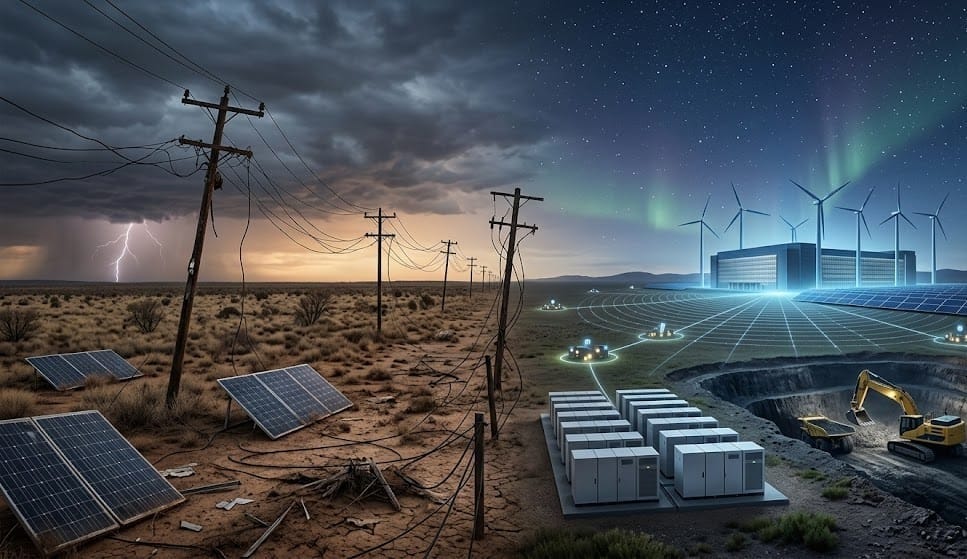
Australia has the world’s highest per capita solar capacity, yet grid stability has not improved. The issue is not a lack of electricity, but aging infrastructure. According to EA Technology (January 2026), about 73% of Australia’s low-voltage overhead cables are exposed to extreme weather threats—wildfires, storms, and floods annually cut power to hundreds of thousands of households. February 2026 floods disrupted 1,035 km of roads, isolating remote communities for weeks, with power restoration entirely dependent on on-site repairs. AEMO notes that extreme weather exposes “edge blind spots” in the grid, forcing operators to cut power reactively.
Each repair and outage represents a “system tax”—energy spent maintaining old systems rather than creating new value.
2.Conflict Layer: Energy Demands of a New Era
Australia faces two major structural pressures. First, the rapid growth of AI computing power drives local startup Firmus to deploy over 1.6GW of green AI infrastructure in Melbourne and Tasmania. Second, heavy industry is undergoing electrification, with Fortescue investing approximately AUD 1B annually to replace diesel at its mines. These examples show that the key question is not whether electricity is used, but whether new systems replicate old “gravity models” and whether they are truly designed for low-entropy, high-efficiency operation.
3.Structural Layer: Four Competing Energy Philosophies
Fortescue’s electrification demonstrates that replacing diesel with solar, wind, and batteries saves AUD 2-4 per ton of iron ore in structural costs, which do not create real value but merely maintain old systems. Firmus’ green AI data centers embed energy efficiency into the system from day one. Community batteries and giant data centers present a contrast: community batteries keep energy within the community, decentralizing profit and control; giant data centers create an energy black hole, sucking energy into the system and reselling it to users. Hazelwood’s coal plant redevelopment warns that new systems can merely be a re-skinned version of the old, perpetuating systemic parasitism.
4.Architect Roles: Designing Low-Entropy Energy Systems
Architects’ value emerges in four layers. As noise reducers, they identify and cut structural costs that do not create value, exemplified by Fortescue’s electrification. As structural designers, they embed efficiency from the ground up, ensuring low-entropy operation, as Firmus’ green AI data centers demonstrate. As distribution judges, architects ensure energy flows to real value, not system complexity, evident in the contrast between community batteries and giant data centers. Finally, as transformation architects, they prevent new systems from repeating the structural mistakes of the old, as seen in Hazelwood’s redevelopment. Architects are not just inventing technologies—they redesign the core logic to ensure each unit of energy produces real value rather than feeding system complexity.
5.Conclusion: Energy Issues Are Structural Issues
While most focus on producing more electricity, architects focus on ensuring each unit generates more real value. Australia’s old grids, new data centers, community batteries, and industrial transitions—all represent structural choices: choose a “gravity” or “node” model, high or low entropy, energy flowing to systemic parasitism or genuine welfare. This is not an environmental slogan; it is a matter of survival efficiency.
Case 23:能源的熵與架構師的逆週期
——從澳洲舊電網到新時代的結構選擇
一、現象層:能源的「結構性成本」
澳洲擁有全球最高的人均太陽能裝機量,但電網穩定性卻未見提升。問題不在於「不夠電」,而在於「結構老化」。根據 EA Technology 2026 年 1 月的報告,澳洲低壓電網中約 73% 的架空電纜暴露於極端天氣威脅——山火、風暴、洪水每年導致數十萬戶斷電。2026 年 2 月的洪水更造成 1,035 公里道路中斷,偏遠社區被隔離數週,電力恢復完全依賴現場搶修。AEMO(澳洲能源市場營運機構)指出,極端天氣令電網的「邊緣盲區」暴露,營運商往往只能被動切斷電源。
每一次搶修、每一次被動斷電,都是一次「系統稅」——能源被用於維持舊系統運轉,而非創造新價值。
二、衝突層:新時代的能源需求
澳洲當前面臨兩大結構性壓力。首先,AI 算力的快速增長促使初創公司 Firmus 在墨爾本及塔斯馬尼亞部署超過 1.6GW 的綠色 AI 運算設施。其次,重工業正在進行電氣化轉型,例如 Fortescue 每年投入約 10 億澳元推動礦場替代柴油的電氣化。這些案例顯示,問題不在於是否使用電力,而在於新系統是否會重複舊系統的「重力模型」,以及能否設計成真正低熵、高效率的系統。
三、結構層:四種能源哲學的對決
Fortescue 的電氣化實驗表明,使用太陽能、風電、電池取代柴油,每噸鐵礦節省 2-4 美元的結構性成本。這些成本本質上只是為維持舊系統運轉,而不創造實際價值。Firmus 的綠色 AI 數據中心則將能源效率寫入系統底層,確保從一開始就低熵運作。社區電池與巨型數據中心形成對比:社區電池將能源留在社區,利潤與控制權分散;巨型數據中心則形成能源黑洞,把能源吸入系統再賣回給用戶。Hazelwood 煤電廠遺址的改造提醒我們,新系統若僅是舊系統的換殼,可能重蹈覆轍,形成「系統性寄生」。
四、架構師的角色:設計低熵能源系統
架構師的價值主要體現在四個層面。首先,作為減噪者,他們識別並削減那些不創造價值、僅維持舊系統運轉的結構性成本,例如 Fortescue 的電氣化案例。其次,作為結構設計師,他們將效率寫入系統底層,保證新系統從設計之初就能低熵運作,如 Firmus 的綠色 AI 數據中心。第三,作為分配判斷者,架構師確保能源流向真實價值,而非僅維持系統複雜性,這在社區電池與巨型數據中心的案例中尤其明顯。最後,作為轉型架構師,他們需要避免新系統重複舊系統的結構性錯誤,例如 Hazelwood 遺址轉型中的潛在風險。整體而言,架構師不僅是技術創新者,更是從底層重新設計系統邏輯,確保每一度電都能創造真實價值,而不是餵養系統複雜性。
五、結語:能源問題,歸根結底是結構問題
當大多數人關注「如何生產更多電力」時,架構師關注的是「如何讓每一度電創造更多價值」。澳洲的舊電網、新數據中心、社區電池、工業轉型——每一個選擇都是結構性選擇:選擇「重力模型」還是「節點模型」?選擇「高熵」還是「低熵」?能源流向「系統寄生」,還是流向「真實福祉」?這不是環保口號,而是生存效率的選擇。