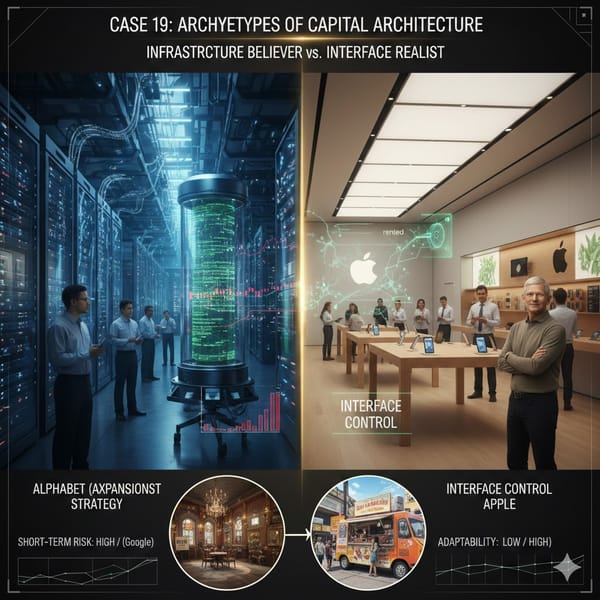
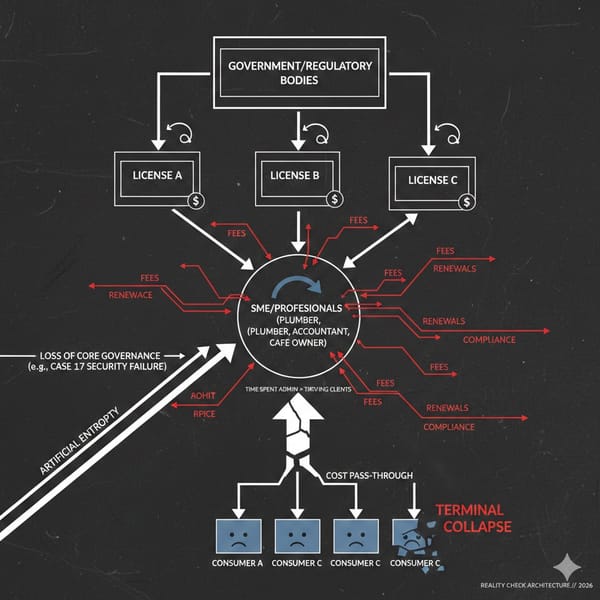
Case 21: The Fragility of “Heavy” - Why Small Businesses Can't Afford to Think Like Giants

Reality Check Melbourne – Economic Observation Series
- The Misreading of First Principles
When people reference Elon Musk and “first principles thinking,” they often focus on disruption and expansion. What is frequently ignored is the underlying condition that makes such thinking viable: error tolerance.
Large corporations operate with capital buffers, diversified revenue streams, and structural resilience. For them, failure is not necessarily catastrophic — it is data. Scale absorbs mistakes.
But for a small business owner operating in Ringwood or Glen Waverley, cash flow is survival. A single major miscalculation may not be a lesson — it may be closure.
For small enterprises, first principles thinking is not about “how to grow big.” It is about:
How to remain alive and flexible in a low-tolerance environment.
This is not conservatism.
It is risk hierarchy.
This is not emotional.
It is structural. - The Amplification Effect of Heavy Assets
Consider a hypothetical retail store in Ringwood paying $8,000 per month in rent. Add wages, utilities, and inventory — fixed monthly costs reach approximately $20,000.
In a high-interest, high-cost environment, heavy asset models face amplified exposure:
Long-term lease commitments
Rising labour and energy expenses
Inventory risk and perishability
Increased borrowing costs
Heavy assets are not inherently flawed. Many successful enterprises operate this way.
However, when high leverage combines with high fixed costs, volatility becomes magnified.
The question during interest rate increases is not:
“Are we profitable?”
It is:
Can our cash flow withstand fluctuations?
That is a structural constraint — not a psychological one. - Financial Models vs Operational Reality
Financial theory often recommends long-term holding or strategic leverage. In stable macro environments, such approaches are rational.
But small businesses operate in immediate timeframes:
Cash flow is immediate.
Costs are immediate.
Risk is immediate.
Equity on paper does not equal liquidity.
When capital becomes expensive, liquidity matters more than valuation.
A company valued at five million dollars with only fifty thousand in accessible cash may collapse under short-term stress. Meanwhile, a smaller, asset-light business with steady cash flow may survive indefinitely.
Survival is not determined by size.
It is determined by flexibility. - Why Asset-Light Structures Improve Survival Probability
The advantage of asset-light models lies not in scale, but in adaptability:
Lower fixed commitments
Faster structural adjustment
Greater mobility
Reduced dependence on physical locations
This is not an argument against physical businesses.
It is a reminder that during periods of elevated cost and uncertainty, reducing irreversible commitments increases survival probability.
Digital assets compound over time. Physical leases do not.
One accumulates signal and trust.
The other accumulates obligation. - Survival Strategy in a High-Cost Era
In a high-cost economic cycle, the core question for small businesses shifts from expansion to resilience:
Cash flow security
Cost flexibility
Exit optionality
Digital transition capacity
Heavy assets are not relics of the past.
But under volatility, highly leveraged heavy structures magnify risk.
Becoming lighter is not retreat.
It is optimization.
In an era of declining error tolerance:
Survival precedes expansion.
Flexibility precedes scale.
Lighter.
Faster.
Longer-lived.
In Case 20, The Vanishing Century, we examined the erosion of long-term institutional guarantees.
Case 21 extends that observation.
When systemic commitments become less reliable, irreversible private commitments grow more expensive.
If Case 20 addressed institutional fragility,
Case 21 addresses individual adaptation.
《案例 21:重資產的脆性——當第一性原理在高成本時代轉向「彈性」》
- 被誤讀的第一性原理
當人們談論 Elon Musk 與「第一性原理」時,往往只看見顛覆與擴張,卻忽略了一個關鍵條件:容錯率。
對大型企業而言,失敗是成本,也是數據。規模與資本緩衝使它們可以承受試錯,甚至將試錯轉化為競爭優勢。
但對於在 Ringwood 或 Glen Waverley 經營的小企業主而言,現金流就是生存線。一次重大判斷失誤,可能不是調整,而是結束。
因此,對中小企業來說,第一性原理不是「如何做大」,而是:
在低容錯環境下,如何保持存活與彈性。
這不是保守,而是風險排序。
這不是情緒問題,而是物理問題。 - 重資產的放大效應
以一個假設案例為例:一間位於 Ringwood 的高租金實體零售店,月租 $8,000,加上人工、水電、庫存,每月固定支出約 $20,000。
在高利率與成本上升環境下,重資產模型面臨幾個放大風險:
· 固定租金成本(租約不可隨時退場)
· 人工與能源支出上升
· 庫存壓力與損耗
· 借貸成本增加
重資產並非錯誤。不少成功企業都行重資產模式。
但當高槓桿與高固定成本疊加時,波動會被放大。
當利率上升時,問題不在於「是否盈利」,而在於:
現金流能否承受波動。
這是物理問題,不是情緒問題。 - 數據模型與現場現實
許多金融分析建議「長期持有」或「利用槓桿」,這在穩定環境中合理。
但小企業的世界不同:
· 現金流即時
· 成本即時
· 風險即時
紙面資產淨值(Equity)不等於流動性。
當資金成本上升時,流動性比資產規模更重要。
一間市值 500 萬的公司,如果流動資金得 5 萬,短期波動就足以造成結構性壓力。反之,一間輕資產公司,即使規模較小,只要現金流穩定,就可以持續生存。 - 為何「輕量化」提高生存機率
輕資產模型的優勢不在於規模,而在於彈性:
· 較低固定成本
· 更快調整能力
· 更高可轉移性
· 對實體空間依賴較低
這並不是否定實體經營。
而是提醒:在高成本、高波動時期,降低不可逆承諾,會提高生存概率。
數位資產具有時間複利效應,而實體租約沒有。
前者可以在時間中累積信號與信任;後者則隨時間產生成本。 - 2026 的生存策略
當經濟進入高成本階段,小企業的核心問題不再是擴張,而是:
· 現金流安全
· 成本彈性
· 離場能力
· 數位轉型能力
重資產不是舊時代的錯誤。
但在波動期,高槓桿重資產更容易放大風險。
輕量化,不是逃避,而是優化。
在容錯率下降的年代:
· 生存優先於擴張
· 彈性優先於規模
輕一點。
快一點。
活久一點。
在 Case 20《The Vanishing Century》中,我們討論了「承諾的消失」——制度、契約與長期保證正在變得更不穩定。
Case 21 是那個觀察的延伸。
當承諾的穩定性下降時,重資產的不可逆承諾會變得更昂貴。
而輕量化,則成為一種對抗不確定性的結構回應。
如果 Case 20 談的是制度層面的變化,
Case 21 談的是個體層面的適應。