Case 09 | The Cognitive Ladder (Part 3) — Lost in Imitation, Awakened in Tradition

Prologue: The Afterglow of the Australian Open
The Melbourne summer is fading, and with the conclusion of the Australian Open, the air still carries the echoes of cheers from the stands and the palpable tension of sweat hitting the sun-drenched asphalt.
Over the past few days, a deep conversation at a bar with a friend—an aspiring pro-player—unexpectedly completed this final dialectic on "Architecture vs. Instinct." This is not just a story about tennis; it is a mirror reflecting every "Executor" from Part 1 trapped in diligent linear labor, and every "Crossover" from Part 2 struggling to climb the ladder without the right foundation.
He practices eight hours a day, obsessing over every data point of "Modern Tennis" and meticulously mimicking the swings of icons. Yet, he admitted despondently: "The more I learn, the more my game falls apart."
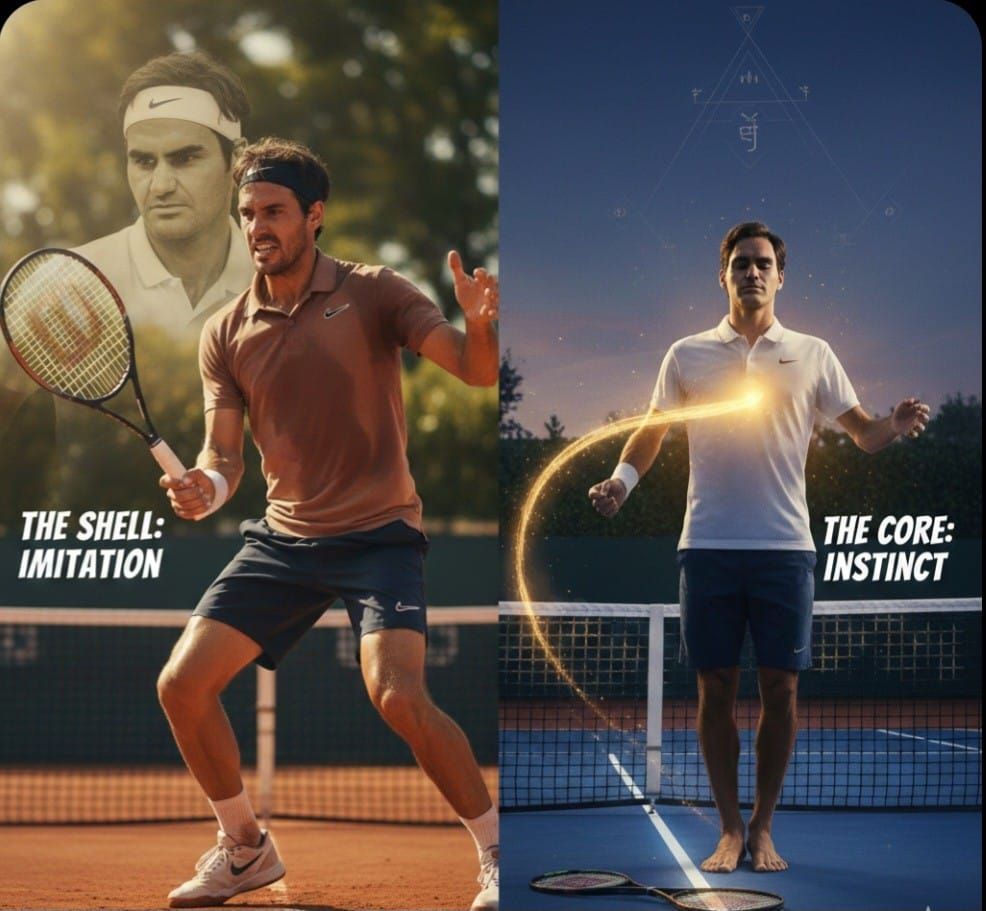
1. The Shell Trait: The Imitation Trap
His effort was, in reality, a constant injection of "The Shell" into his own system. He was copying Federer’s fluidity and Nadal’s RPM, but he was duplicating the "Result," not the "Architecture."
This is a sophisticated error: mistaking the system's "Output Variables" for the system's "Core." The more forceful the imitation, the more noise accumulates within the system, eventually leading to a total collapse of operational logic.
2. Tradition (Old School): The Forgotten Source Code
It is a common misconception that so-called "Modern Tennis" is a brand-new invention. In truth, the unique styles of all elite players are deeply rooted in the most monotonous, unified Tradition (Old School)—the underlying system architecture of the sport: kinetic chains, gravity utilization, and rhythm.
The Core is the common denominator; the expression is the variable.
Skipping the foundation to imitate "Variables" is simply piling noise onto your own system. It is akin to a company copying a successful competitor’s product design while ignoring the supply chain, talent density, and cash-flow architecture that makes it possible.
3. Lost Instinct and Environmental Alignment
I told him that the moment you become hyper-focused on calculating swing angles and aligning yourself with online tutorials, you are effectively shutting down your Instinct (Intuition).
This instinct is not mysticism; it is the "Self-Optimization" that occurs when your unique physical attributes merge with a stable underlying architecture. Everyone’s bone proportions, upbringing, and spatial intuition are different. The best choice is never to become a replica of someone else, but to use your own conditions to align with the demands of the environment.
Blind imitation is an act of "formatting" oneself. You are no longer "playing the game"; you are "performing an act." Once pressure arrives, this transplanted system—one that does not belong to you—will be the first to shatter.
Epilogue: Listen to the Sound of Your Own System
I said to my friend: "Perhaps we have all misunderstood the nature of competition. When you stop trying to be Federer, have you ever actually heard the sound of your own swing?"
That sound is the honest dialogue between your unique skeletal structure, muscles, and nerves, interacting with the ball, the wind, the ground, and the present moment. It is not perfect, but it is real.
- In Business, that sound is the authentic feedback of the market, not imagined data.
- In Creation, that sound is the honest urge to express, not the algorithm of traffic.
- In Career, that sound is the resonance between your talent and passion, not the template of societal expectation.
The Melbourne wind was cool that night. Those who know, know.