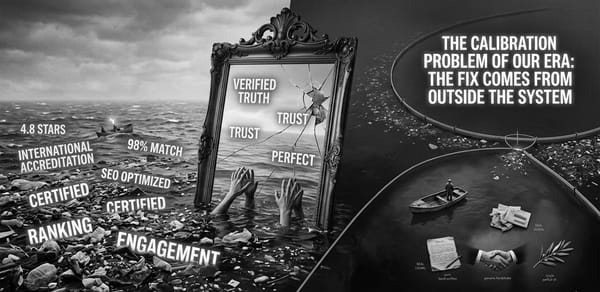
Case 09 (Part 1): The Cognitive Divide
Why "Linear Diligence" Leads to Structural Decay
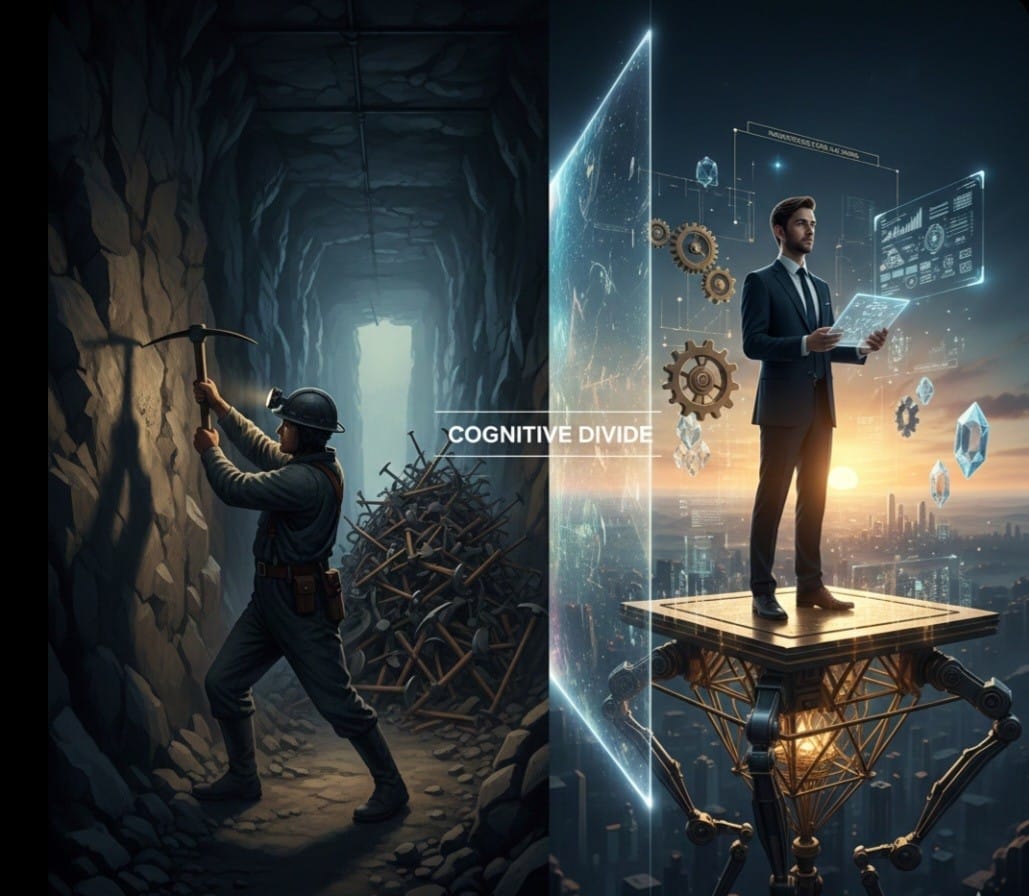
1. The Fault Line: Two Realities, One System
In most organisations, a persistent divide shapes outcomes:
- One group expends immense effort at the Execution Layer—the point of visible action.
- Another operates at the Architectural Layer—designing rules, allocating resources, and calibrating systems.
This is not a division of diligence, but a fundamental misalignment in cognitive models. One sees tasks; the other sees the logic that tasks exist within.
2. The Linear Trap: When Effort Replaces Strategy
Many are confined by a point-to-point logic:
- Belief: “Perfect execution equals value.”
- Assumption: “A good product automatically finds a market.”
- Reflex: When results falter, add more—more hours, people, labour.
This works in stable, high-growth environments. Its fatal blind spot? Markets are not linear. Personal effort does not guarantee market return. When decisions rely on “I think this is good,” business shifts from value exchange to subjective projection.
3. The Architectural Mind: Building Systems, Not Just Outputs
High-order cognition operates differently. It focuses not on the single action, but on the system that governs all actions:
- The product is merely one variable in a complex equation.
- Decisions weigh probability, cost structure, risk distribution, and sustainability concurrently.
- The core question is not “Can we do it?” but “Can it be replicated, scaled, or systematized?”
Here, effort is not the currency. The real value is the ability to transform effort into repeatable, structural capital.
4. The Great Revealer: Non-Linear Environments
In growth periods, linear diligence can mask structural flaws. Hard work alone appears sufficient.
The true test arrives with the non-linear shift: volatile demand, rising costs, and collective caution. Suddenly, ignored structural flaws become critical. Systems lacking architectural resilience see their adaptive capacity collapse.
This is the tipping point: when the environment stops rewarding mere effort, and starts demanding systemic intelligence.
5. The Neutral Verdict: It’s Not Morality, It’s Physics
Business decline is rarely about a “bad product.” It is often the failure to upgrade decision-making logic as the environment changes.
This cognitive divide is not a judgement of character. It is a structural reality—a boundary defined by one’s ability to perceive and interact with systems.
In a non-linear era, diligence does not buy security. Understanding systems is the new survival literacy.