Case 08: Reality Check — The Residual Warmth of the Market
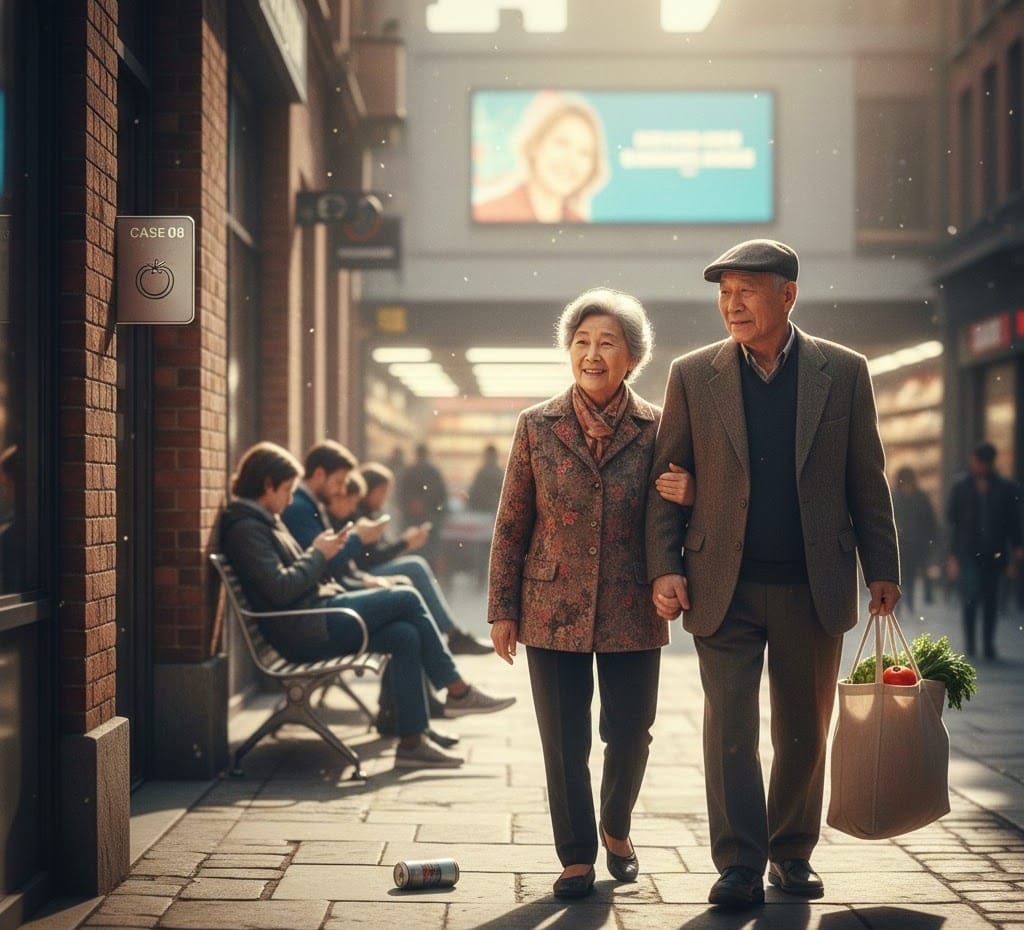
Outside the supermarket entrance, the usual crowd occupies the long bench. The sharp echo of aluminum cans hitting the pavement mingles with weightless laughter, resonating hollowly in the afternoon sun. They seem to possess an abundance of time, enough to let it drift away with every passing breeze.
The elderly couple walks past this clamor side by side, never turning their heads.
Both have the supermarket app on their phones. With a few taps on a glowing screen, heavy paper bags would arrive at their doorstep within an hour. Modern life offers a shortcut called "efficiency"—it can deliver supplies, but it may not deliver life itself.
They know that path is faster. Yet, they still put on their neatly pressed coats and step out the door together.
Under the warm glow of the produce section, the lady gently picks up a rounded tomato. She suddenly reminisces about the clumsy meal she first cooked for him in their youth—her first attempt at stir-fried tomatoes and eggs that turned the kitchen into a battlefield. The gentleman listens, tender wrinkles forming at the corners of his eyes, teasing her about that unpresentable dish they nonetheless finished to the last bite.
Fragments of "those younger days" flow quietly between the shelves with every choice of vegetable. For them, buying these two tomatoes is not the goal. This slow paced errand is more like a walk through time—using their senses to confirm each other’s presence, and using the mundane to ensure their memories still have a home.
Passing the bench, the gentleman instinctively frees his left arm. The lady’s hand, slightly trembling with age, naturally finds its place. They walk slowly, eyes only for each other. In a city obsessed with speed, this pace feels remarkably grounded: no boasting, no explanation, just steadily returning the weight of a relationship to the earth.
They understand clearly that their home functions not because of who is stronger, but because of this "indispensable" connection. It is not romance; it is a system. Without the other’s voice, those memories lose their audience; without the other’s support, the path of this errand loses its compass. They are each other's conditions, each other’s order, and each other’s boundaries of life.
Within these boundaries, there are things no algorithm can replace: The weight of the groceries, the rhythm of the gait, the support of an arm, and the silences that are understood the moment they are felt.
On streets beyond the reach of digital orders and recommendation systems, they walk hand in hand, guarding the only reality that exists in this moment through their slowest pace. It is not for nostalgia, nor to prove a point, but simply to refuse to hand their lives over.
Through their slowness, they prove they still belong to each other.