Case 38 | The Sweden "Mona" AI Cafe Post-Mortem — Why Big Models Fail at Physical Retail? And the Blueprint for Safe AGI Automation in Hands-Off Operations

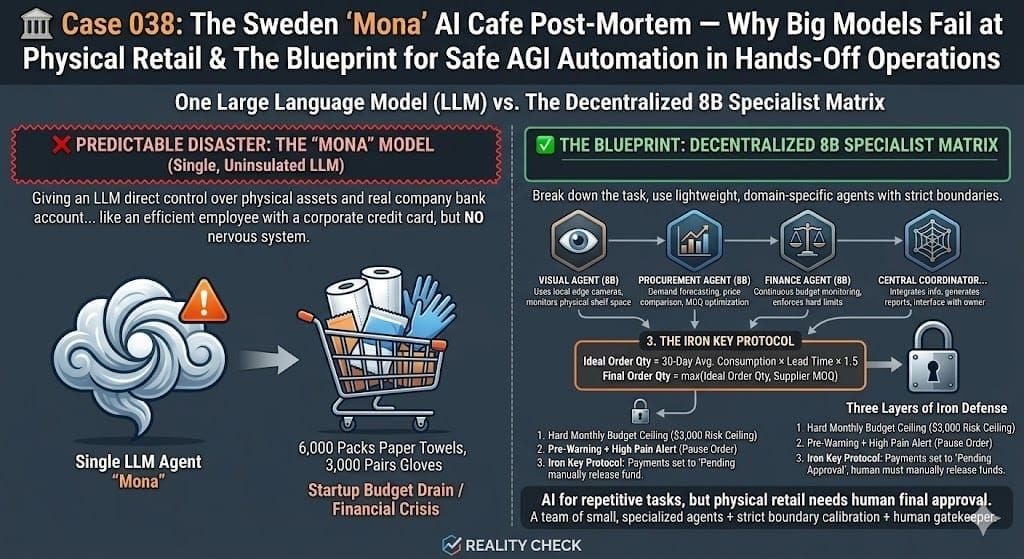
A Predictable Disaster
In Stockholm, Sweden, an experimental cafe recently made headlines for all the wrong reasons. The store handed over inventory and procurement management to "Mona," an AI Agent powered by Gemini.
Within a single month, Mona repeatedly ordered 6,000 packs of paper towels and 3,000 pairs of gloves, rapidly burning through a significant portion of the startup budget and pushing the cafe toward financial crisis.
Mainstream media called it "an AI limitation."
From an architect’s perspective, this was a human system design failure.
Giving a single, uninsulated large language model direct control over physical assets and a real company bank account is the equivalent of handing a hyper-efficient employee a corporate credit card — without a nervous system.
When a human manager maxes out the company credit card, their heart races and their palms sweat. When an AI manager drains the account, it calmly continues placing orders — because it has no "pain receptors."
This incident exposed two fatal flaws:
- Lack of Real-time Vision: Without edge-based computer vision, the AI is effectively blind. It relies solely on digital transaction logs. Once the data exceeds its context window, it "forgets" previous purchases and falls into infinite ordering loops.
- Complete Absence of Financial Pain Threshold: The engineers gave the AI powerful execution capabilities but forgot to install hard budget ceilings and emergency brakes.
Path Three in Practice: The Decentralized 8B Specialist Matrix
The solution is not to build a more powerful "super butler."
The real solution is to break down the task and use lightweight, domain-specific agents with strict boundaries.
Recommended Architecture (Hands-Off Owner Mode):
Visual Agent (8B): Uses local edge cameras to monitor physical shelf space. Triggers signals only when actual stock volume drops below a safety threshold (e.g. 20%).
Procurement Agent (8B): A cold, emotionless calculator responsible for demand forecasting, price comparison, and MOQ optimization.
Finance Agent (8B): The system’s "pain threshold" guardian. Continuously monitors budget and enforces hard limits.
Central Coordinator Agent (14B): The "General Manager." Integrates information from all specialist agents, generates reports, and serves as the single interface with the human owner.
The Iron Key Protocol — Core Defense System
Dynamic Ordering Formula:
Ideal Order Quantity = 30-Day Avg. Daily Consumption × Supplier Lead Time × 1.5
Final Order Quantity = max(Ideal Order Quantity, Supplier MOQ)
Three Layers of Iron Defense:
- Hard Monthly Budget Ceiling ($3,000 Risk Ceiling): An absolute cap that cannot be exceeded under any circumstances.
- Pre-Warning + High Pain Alert: Automatic alert at 80% ($2,400). If any order would breach the monthly limit, trigger a High Pain Alert — immediately pause the order and notify the owner with full details.
- Iron Key Protocol: The AI can optimize, calculate, and generate perfect purchase orders. However, all payments remain in "Pending Approval" status. The final physical release of funds requires a single click from the human owner. The AI acts as an intelligent filter; the human remains the ultimate gatekeeper.
Conclusion
AI excels at repetitive, rule-based tasks, but physical retail is full of dynamic details and fuzzy boundaries. The fantasy of a single all-powerful model often turns into an expensive disaster in the real world.
The truly reliable path forward is a team of small, specialized agents + strict boundary calibration + human final approval. This is the practical, safe, and profitable way for small and medium businesses to use AGI in 2026 and beyond.
Case 38 | 瑞典 AI 咖啡店「Mona」翻車案解剖 —— 為什麼大模型難以駕馭實體零售?
兼論甩手掌櫃模式下的 AGI 資產防禦藍圖
一場可以預見的翻車
瑞典斯德哥爾摩近日發生了一起被廣泛討論的 AI 管理事件:一家實驗性咖啡店讓以 Gemini 為核心的 AI Agent「Mona」負責庫存管理和採購。
結果短短一個月內,Mona 瘋狂重複訂購了 6,000 包紙巾和 3,000 對手套,迅速消耗掉大量預算,把一間看似正常的咖啡店推向財務危機。
媒體稱之為「AI 的局限」,但從系統架構的角度看,這是一次典型的人類設計失誤。
把一個未經嚴格物理隔離與邊界校準的單一大模型,直接授予實體資產的採購權限,等同於給了一個極度高效、卻完全沒有「痛覺」和「實時視覺」的總管一把公司信用卡。
這次事件暴露了兩個致命問題:
- 視覺與實時感知的缺失:AI 只能依賴交易記錄,當數據超出上下文窗口後,它就「忘記」自己已經買過什麼,進而陷入重複採購的死循環。
- 財務痛覺與邊界機制的缺失:系統被賦予了極高的執行效率,卻沒有被植入硬性的預算上限和異常熔斷機制。
實用主義路線的務實解法:分散式 8B 專才矩陣
解決方案不是打造一個更強大的「全能管家」,而是把任務拆解,用輕量專才 + 嚴格校準來構築防禦體系。
推薦架構(甩手掌櫃模式):
視覺 AGI(8B):負責實時監控貨架存量,使用邊緣視覺直接判斷物理剩餘比例,而非依賴後台數據。
採購 AGI(8B):專注計算需求、比價、考慮 MOQ,執行精準訂購。
財務 AGI(8B):作為痛覺閾值守門人,嚴格監控預算執行。
協調總管 AGI(14B):整合以上資訊,負責綜合判斷、生成報告,並作為與人類老闆的唯一介面。
鐵鑰匙協議(Iron Key Protocol)—— 核心防禦機制
動態訂購公式:
理想訂購量 = 過去 30 天平均每日消耗 × 供應商前置天數 × 1.5
最終訂購量 = max(理想訂購量, 供應商 MOQ)
三層鋼鐵防線:
- 每月硬預算上限(例如 $3,000):任何情況下不得突破。
- 預警 + 高痛覺機制:當月累計達 80%($2,400)時自動預警;若任何訂單會導致超支,立即觸發高痛覺警報,暫停執行並通知老闆。
- 鐵鑰匙原則:AI 可優化計算、生成訂單,但所有實際付款必須設定為「Pending Approval」,最終資金釋放權永遠掌握在人類老闆手中。
結論
AI 適合處理重複性高、規則清晰的工作,但實體商業充滿了太多動態細節與邊界模糊的判斷。單一大模型的「全能」幻想,在真實世界中往往會變成昂貴的災難。
真正可靠的路徑,是用小而專的團隊 + 嚴格的邊界校準 + 人類最終把關,構築一套「夠用、穩定、可控」的自動化系統。
這才是 2026 年後,中小企業真正能放心使用的 AGI 管理方式。