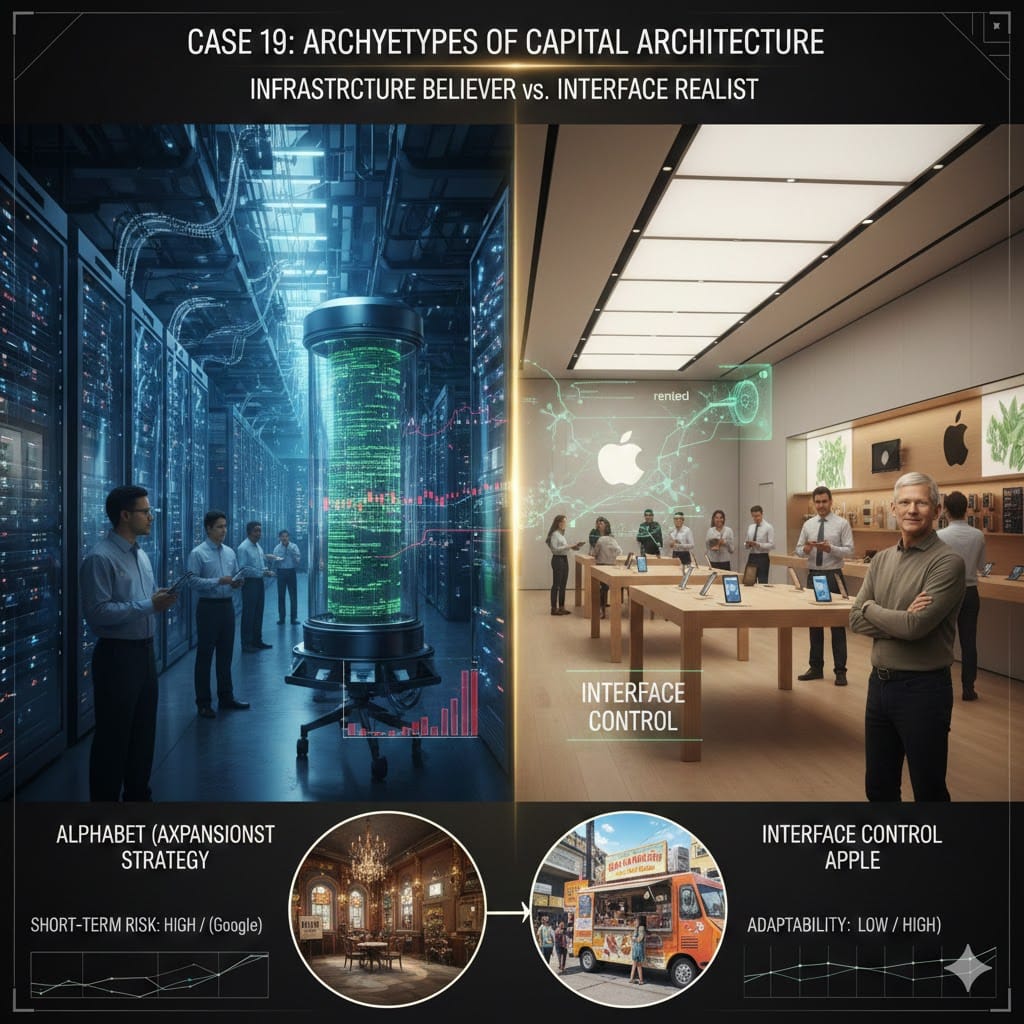
Case 19 | Archetypes of Capital Architecture
Silicon Valley's Dual Survival Strategies: AI as an Uncertainty Test
As of early 2026, tech giants have diverged into two distinct philosophies regarding AI investment: an "Expansionist Strategy" doubling down on infrastructure, and a "Defensive Strategy" focusing on endpoint experience and external integration.
1. The Expansionist: Bet on Infrastructure Sovereignty
Represented by Alphabet’s massive capital expenditure, this logic dictates that if AI reshapes the global order, controlling the underlying infrastructure (computing power and data centers) equals controlling the rules of the game.
- Strength: Scale economies create an impregnable moat once standards are set.
- Risk: Massive sunk costs if the technological path shifts abruptly.
2. The Defensive: Realism of Interface Control
Represented by Apple’s conservative spending, this strategy focuses on integrating AI capabilities into an existing ecosystem. The logic: as long as you own the user interface, the core model can be outsourced.
- Strength: Stable cash flow, high strategic flexibility, and low pivoting costs.
- Risk: Potential loss of long-term influence over underlying technological evolution.
3. Physical Mapping: Prime Location Renovation vs. Asset-Light Iteration
This mirror's real-world business: one entrepreneur invests millions in a flagship store (High barrier, high debt), while another runs a flexible pop-up model (Low barrier, high agility). Both can succeed; they simply choose different ways to endure uncertainty.
"Theory into Practice: This specific archetype of capital preservation is currently being deployed atBreak40, where the balance between quality and economic architecture is managed daily through the charcoal tradition."
Case 19 | 資本架構的對極 —— 基礎設施信徒 vs. 避險實踐家
「有人豪擲百萬裝修黃金地段,有人輕資產試錯隨時轉身。這場 Google 與 Apple 的萬億對決,背後藏著我們每個人在 2026 年最核心的生存邏輯:擁有,還是分配?」
📄 第一篇:策略與直覺
矽谷的兩種生存架構:當 AI 成為不確定性測試
2026 年初,科技巨頭在 AI 投資上的態度出現明顯分歧。一邊是持續加碼基礎設施、拉長債務週期、重押算力與底層模型的「擴張策略」;另一邊則是控制資本開支、專注終端產品體驗,並選擇與外部模型合作的「防禦策略」。
這不只是技術競賽,更像是一場關於「如何面對高度不確定時代」的選擇。
1. 擴張型:押注基礎設施的未來定義權(以 Alphabet 為代表) 其核心邏輯是:如果 AI 將重塑產業秩序,那麼掌握底層架構(算力與數據中心),就等於掌握規則制定權。這是一種高投入、高風險、高潛在回報的策略。
- 優點:一旦標準確立,規模效應將形成強大護城河。
- 風險:若技術路徑快速變化,沉沒成本將極高。
2. 防禦型:守住入口的現實主義(以 Apple 為代表) 維持保守的資本開支,選擇透過戰略整合將 AI 能力植入現有生態。其邏輯是:只要掌握終端用戶與入口,核心模型可以外部化。
- 優點:現金流穩定,策略彈性大,技術轉向成本低。
- 風險:長期可能減少對底層演進的主導權。
3. 生活映射:重資產裝修 vs. 輕資產試錯 這種對比並不遙遠。有人選擇重金投入黃金地段與完整裝修,建立不可替代的實體壁壘;有人選擇輕資產經營,把不確定模組外包,專注核心現金流。兩者都可能成功,差別僅在於對不確定性的承受方式。
結語:Case 19 揭示了在技術高度波動的周期中,企業必須在「擁有更多」與「承擔更少」之間作出選擇。這是一場關於架構,而非情緒的對決。
本案所探討的「資本架構原型」並非單純的理論推演,目前已全面應用於墨爾本東區的實體餐飲戰場 ——Break40。
🔗 The Bridge (Link to Systemic Page)
[ACCESS PROTOCOL: COGNITIVE DECONSTRUCTION]