Case 19 Decoding: A Systematic Analysis of Capital Architecture Archetypes
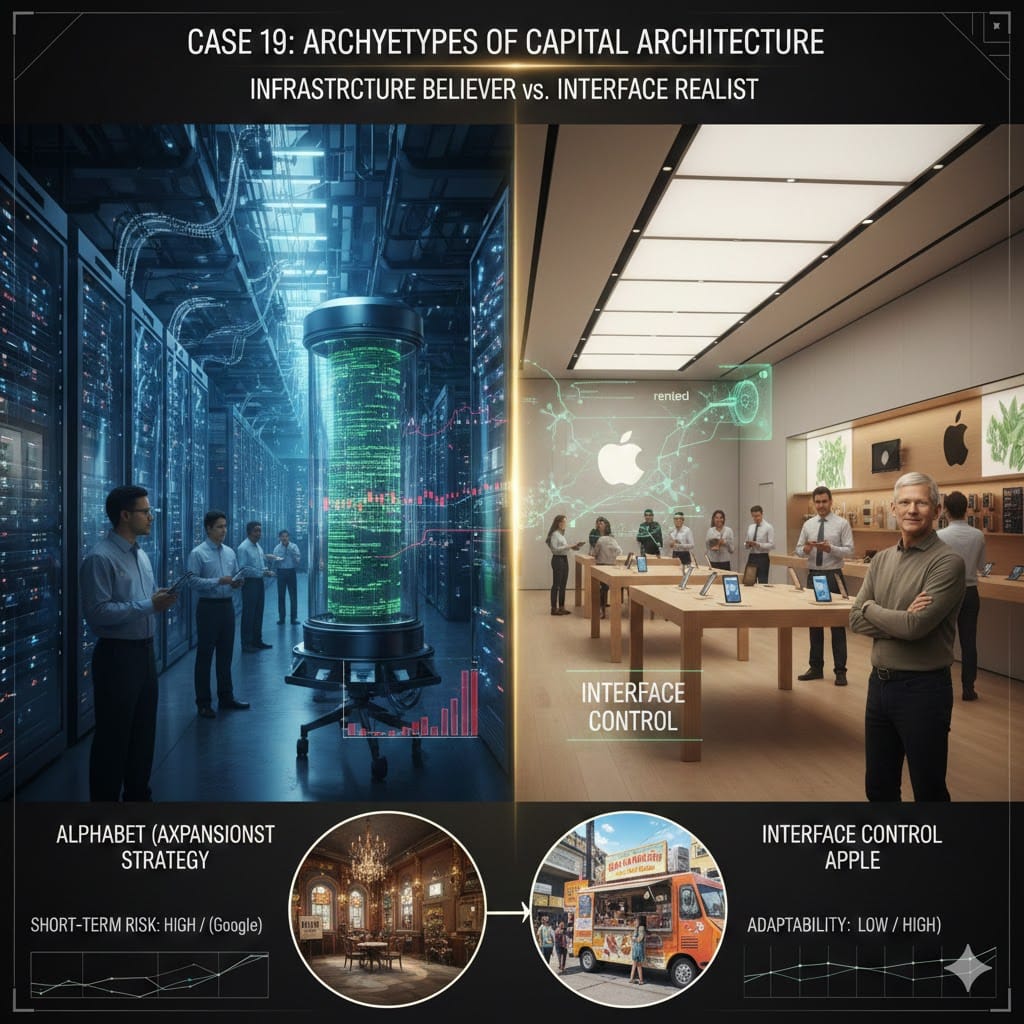
- Structural Insight: Path dependency in heavy-asset models vs. strategic elasticity in modular integration.
- Cross-Dimensional Mapping: Translating trillion-dollar CapEx into a survival model of trial-and-error costs for physical entities.
- Core Thesis: During periods of high technological volatility, interface control offers superior defensive positioning over asset ownership.
Strategic Metadata: #Case19 #CapitalArchitecture #AI2026 #SystemicResilience
[Executive Summary]
In 2026, capital allocation in AI is no longer just a financial decision — it is a survival architecture choice. This analysis compares expansion-driven infrastructure investment with defensive integration strategy, revealing two distinct models of uncertainty management in technology markets.
I. The Strategic Matrix: Expansionist vs. Defensive
| Dimension | Expansionist Strategy (Alphabet Mode) | Defensive Strategy (Apple Mode) |
| Philosophy | Be the Rule Maker | Be the Interface Gatekeeper |
| Allocation | High-intensity CapEx, Long-term Debt | Controlled Spending, Externalized Modules |
| Energy Drain | High (Heavy Asset) | Low (Asset-Light) |
| Adaptability | Low (Path Dependency) | High (Strategic Elasticity) |
| Sovereignty | Security through Ownership | Freedom through Allocation |
II. Structural Logic Breakdown
- Infrastructural Expansionist Model: This model operates on a high-pressure coupling logic. By committing massive capital to build physical barriers (Compute/Data Centers), the entity seeks to define the industry's underlying rules. This contrast reflects a broader debate in AI infrastructure strategy: whether long-term dominance requires ownership of compute, or if it creates a "sunk cost trap" during rapid technological pivots.
- Interface Integration Model (Defensive): This model prioritizes user interface control over asset ownership. By externalizing the heavy-lifting of model computation and maintaining high cash reserves, the entity retains the "right to choose" in a volatile market. It avoids path dependency, ensuring that the architecture remains agile enough to integrate the next generational shift without massive systemic friction.
III. Meta-Conclusion: The Resilience Factor
In periods of rapid innovation, capital architecture becomes a defining variable. Whether expansion-led or defense-led, strategic allocation determines not only growth potential but systemic resilience. Case 19 frames this contrast as a structural model rather than a market prediction. The ultimate question remains: Does true sovereignty come from owning the ground, or controlling the gate?
Case 19 核心解碼:資本架構的對極策略分析 本分析排除市場情緒,專注於資源配置的底層 Archetype(原型)。對比 Google 的「擴張型基礎設施策略」與 Apple 的「防禦型接口控制策略」。
- 【執行摘要】
在 2026 年,AI 領域的資本分配已不再僅僅是財務決策,而是一種「生存架構」的選擇。本分析對比了以擴張驅動的基礎設施投資與防禦型的整合策略,揭示了技術市場中兩種截然不同的不確定性管理模型。
一、 戰略矩陣:擴張型 vs. 防禦型
| 維度 (Dimension) | 擴張型策略 (Alphabet 模式) | 防禦型策略 (Apple 模式) |
| 核心哲學 | 成為規則制定者 | 成為入口守門人 |
| 資本配置 | 高強度基建投入、長期債務 | 控制支出、模組外部化 |
| 能量消耗 | 高 (重資產結構) | 低 (輕資產彈性) |
| 適應力 | 低 (路徑依賴硬化) | 高 (策略調整靈活) |
| 主權邏輯 | 透過「擁有」確保安全 | 透過「分配」獲得自由 |
二、 底層邏輯拆解
- 基礎設施擴張模型:此模型基於「高壓耦合」邏輯。透過投入巨額資本建立物理壁壘(算力中心),試圖掌握行業底層定義權。這反映了 AI 基礎設施戰略中的核心爭議:長期的統治力是否必須依賴對**「算力擁有權 (Ownership of Compute)」**的絕對控制,還是會因技術跳變而陷入沉沒成本陷阱。
- 界面入口整合模型 (防禦型):此模式優先考慮**「用戶接口控制權 (User Interface Control)」**。透過將沉重的算力負擔外部化,並保持充足的現金儲備,主體保留了在動盪市場中的「選擇權」。它避開了路徑依賴,確保架構在技術換代時能無縫切換,而不產生巨大的系統性摩擦。
三、 元認知收束:韌性因素
在快速創新的週期中,資本架構 (Capital Architecture) 成為決定勝負的關鍵變量。無論是擴張導向還是防禦導向,戰略性分配 (Strategic Allocation) 決定了增長潛力與系統韌性 (Systemic Resilience)。Case 19 將此對比視為一種結構模型,而非單純的市場預測。最終的問題是:真正的生存主權,是來自於「擁有土地」,還是「控制大門」?